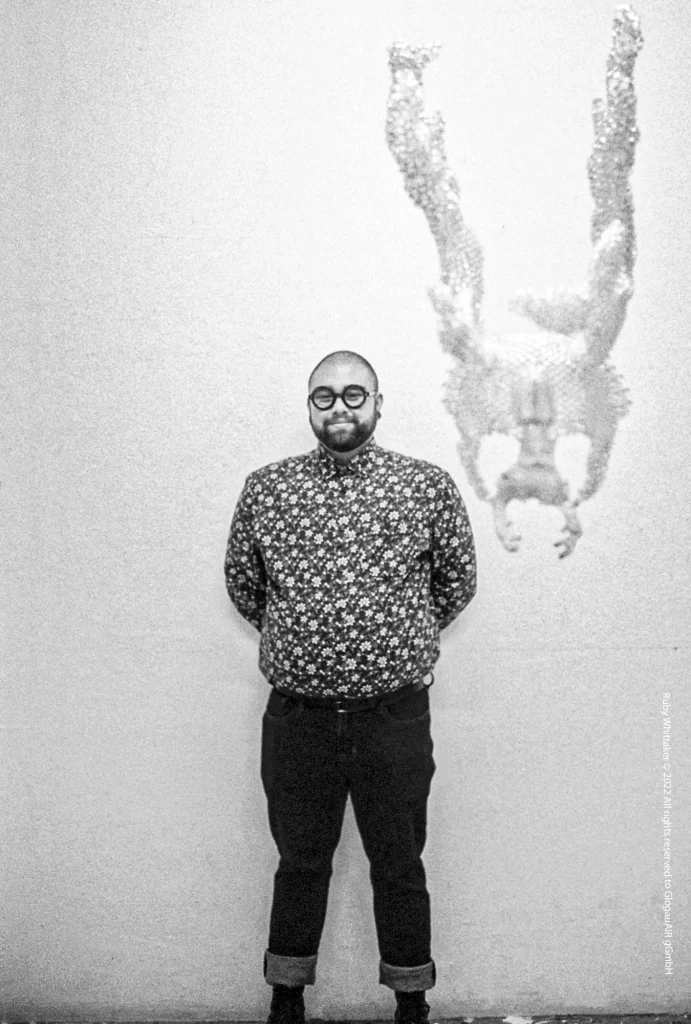
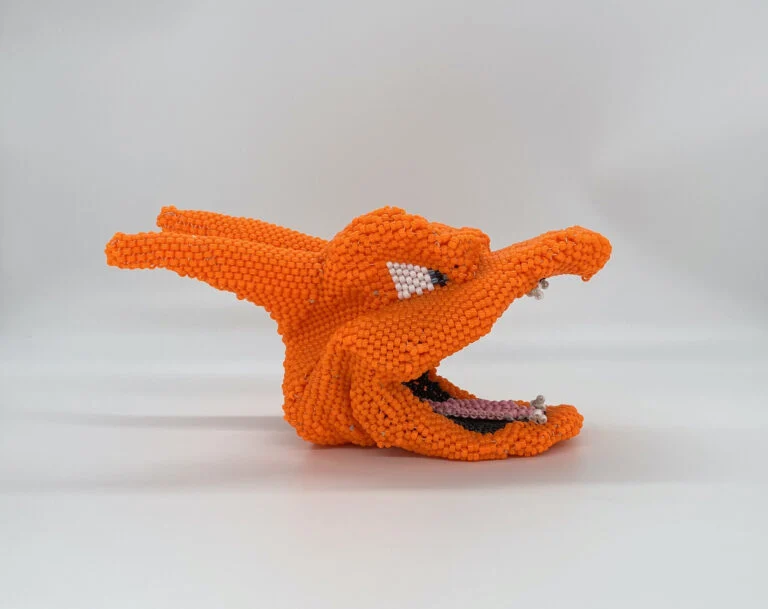
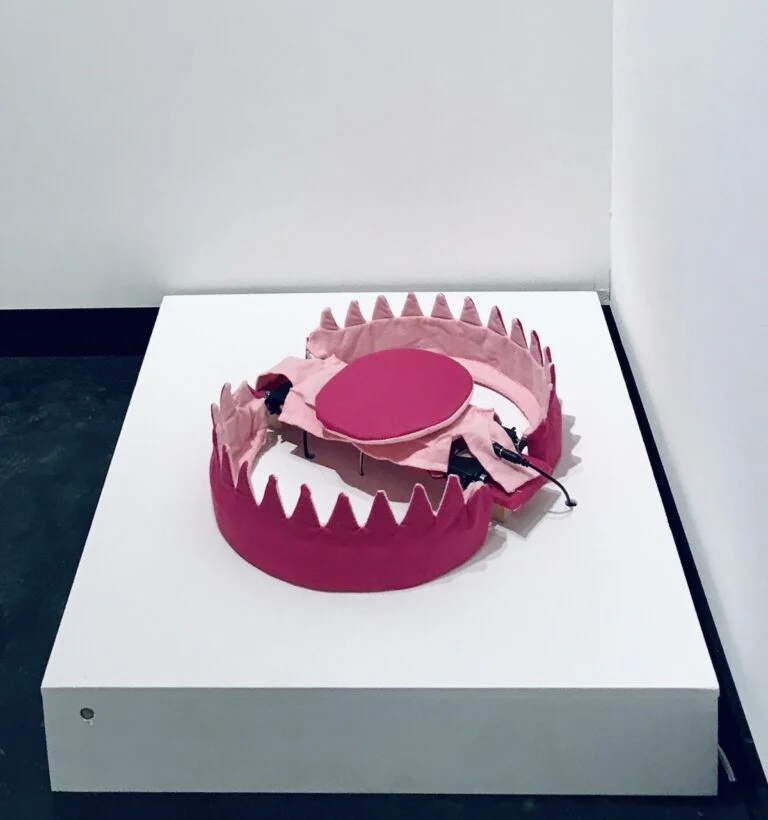
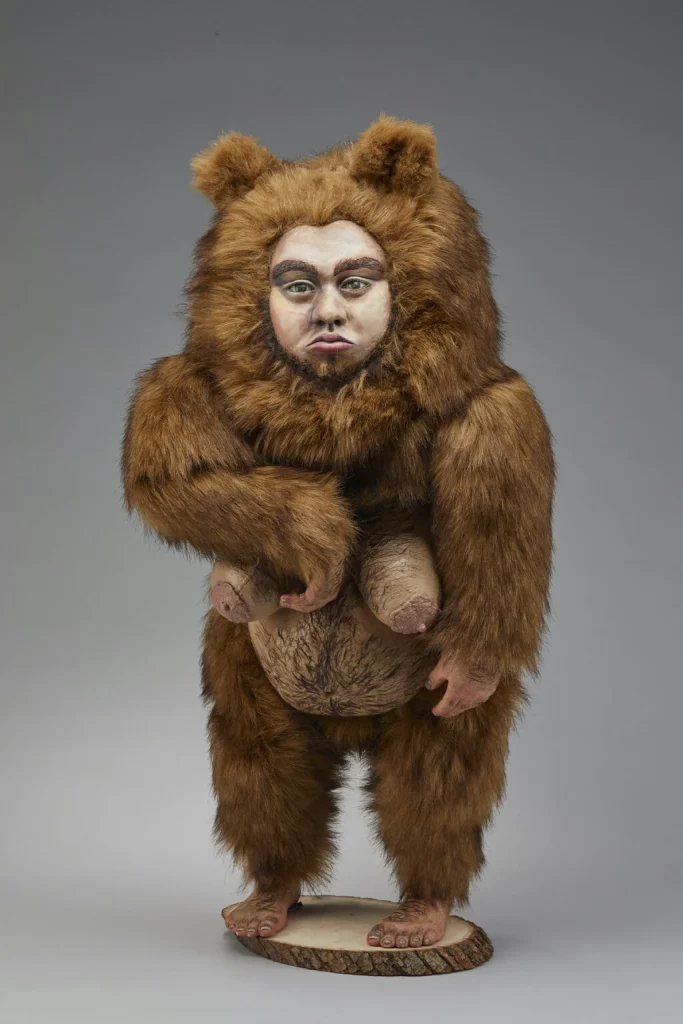
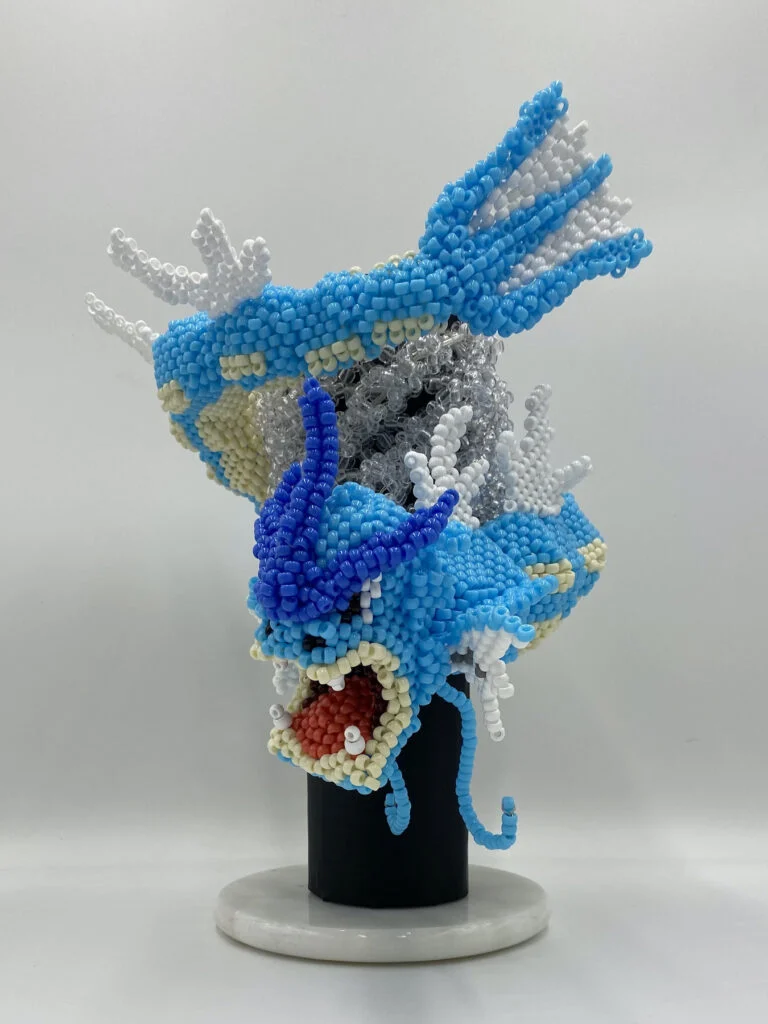
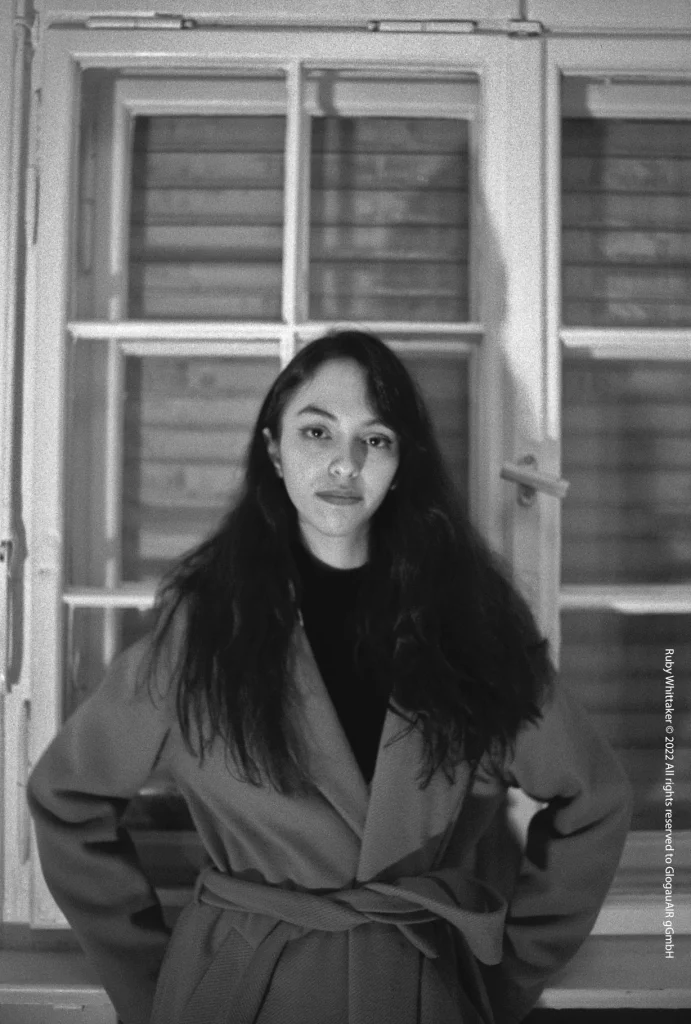
Mason Weiss is GlogauAIR resident from October, 2022 to December, 2022
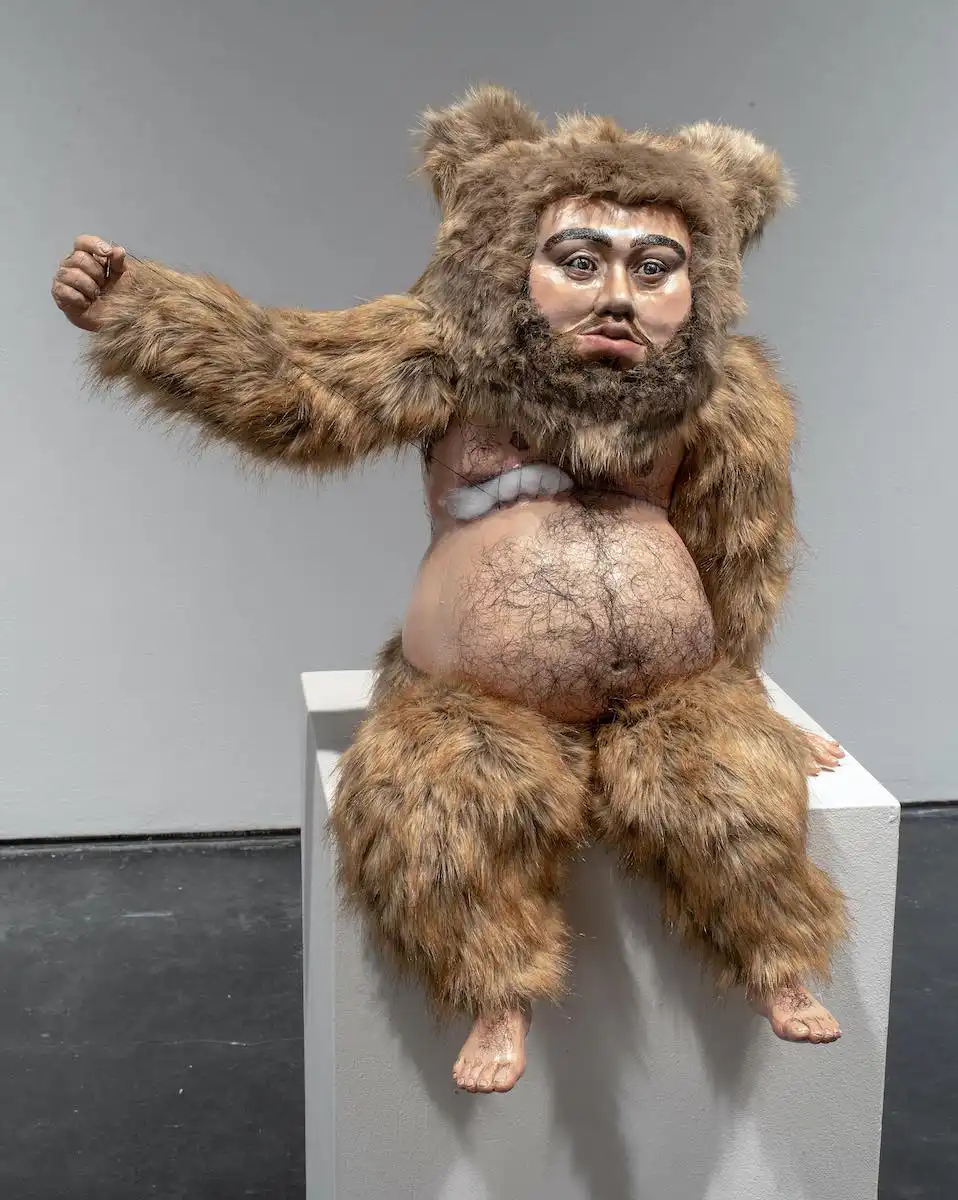
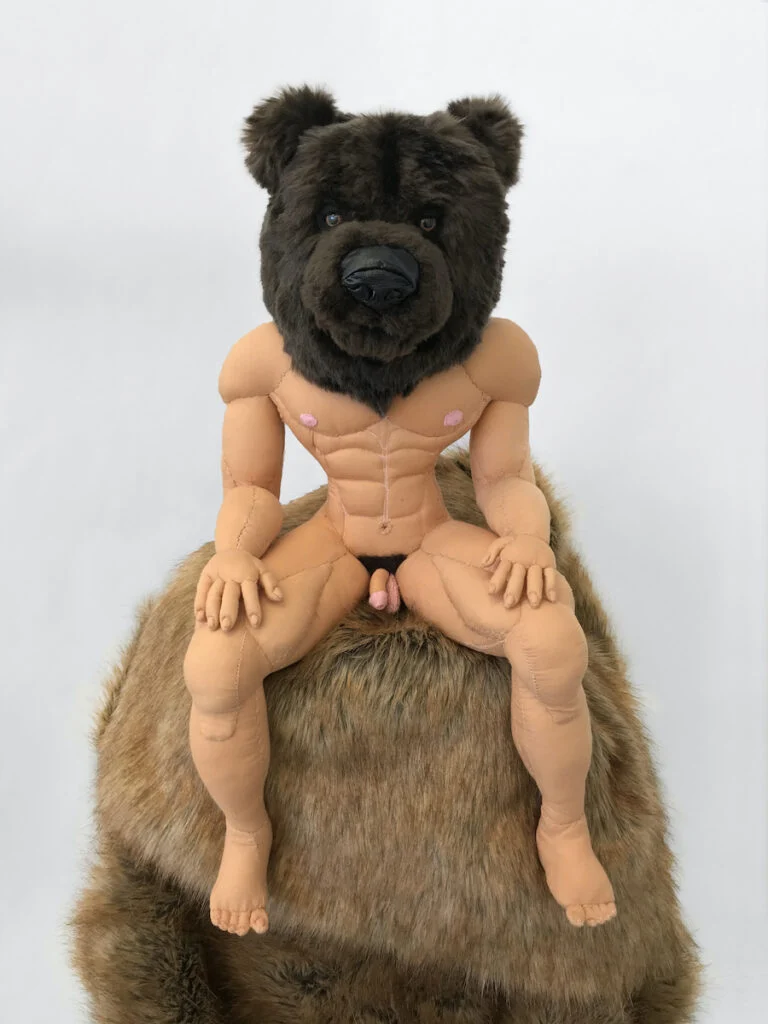
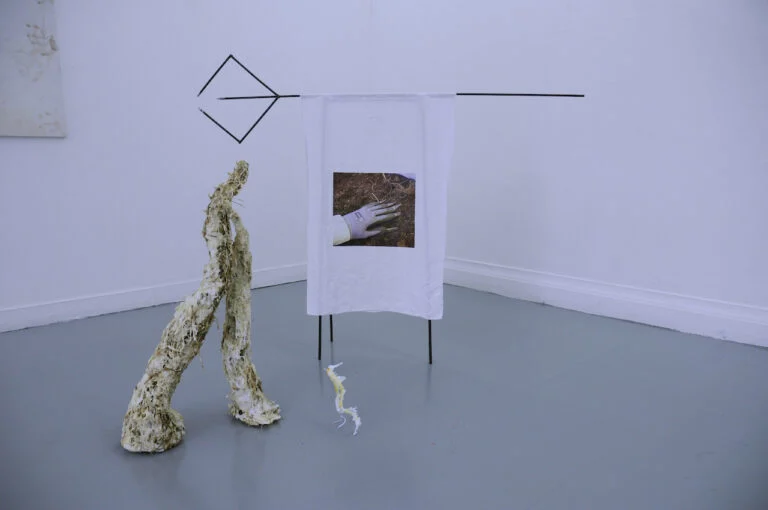
Mason Weiss creates beaded and textile sculptures to explore his relationship with being queer. His experience of metamorphosis as a transmasculine person influences his practice where he engages with topics relating to transformation.
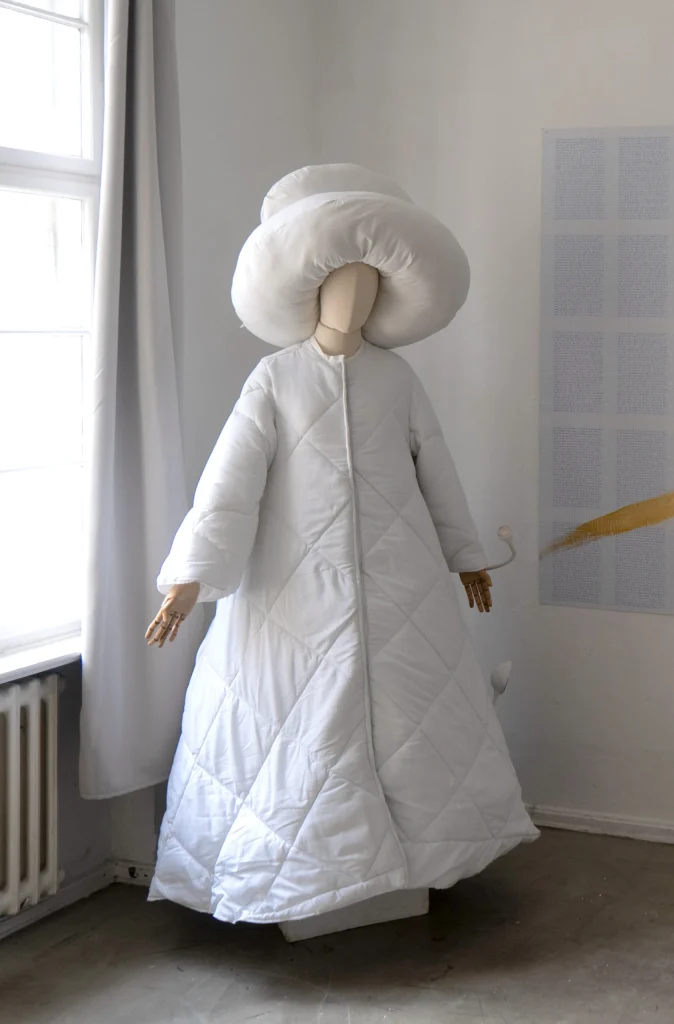
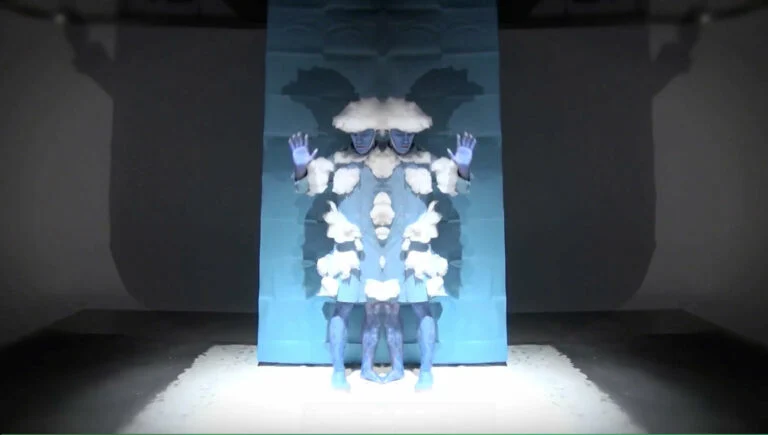
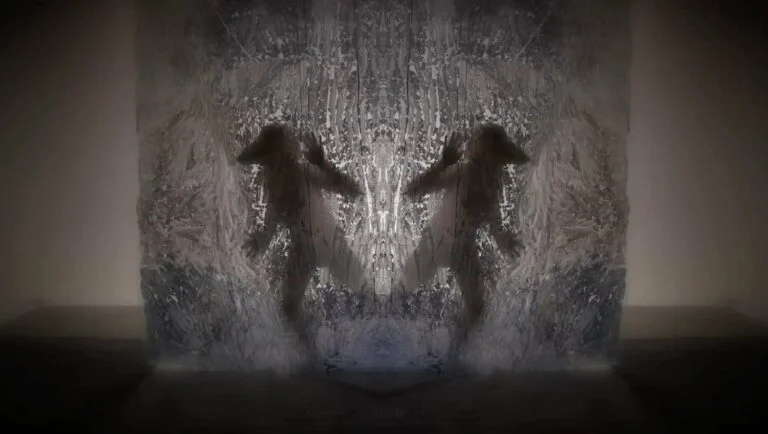
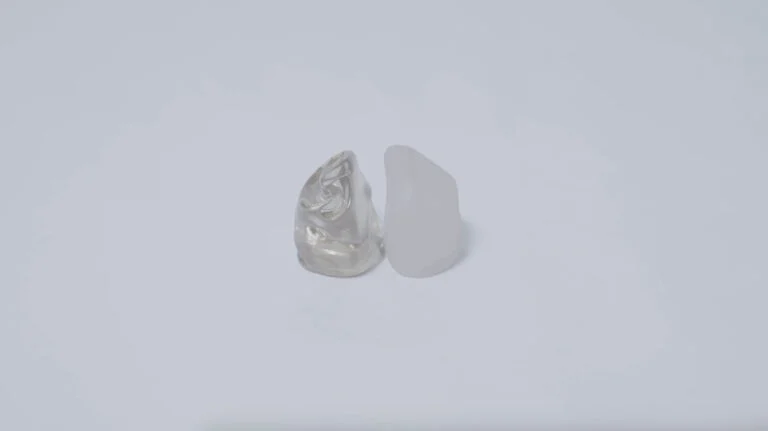
Untitled is a contemplation of coexisting feminine and masculine forces in nature. Jellyfish challenge the concept that the only two natural sexes are male and female: different species include hermaphrodites (both sexes) as well as ones that have the ability to change sex (sequential hermaphroditism).
Meet the Artist
What is your name and where are you from?
Mason Weiss, Los Angeles, California, USA
When/ how did your art practice begin …. Do you think where you’re from has affected your work?
I consider my art practice beginning in childhood. I have memories of drawing and beading (with the same kind of beads I use to this day) at my kitchen table as a young child. My parents have always supported my creativity. I think being from Los Angeles has definitely influenced my work. I have been exposed to a wide variety of art due to LA being such a central art city. There is also a large LGBTQ+ community where I am from, so feeling accepted for my gender and sexual identities as I’ve developed into who I am today has had a large influence on how I carry myself and affects my work.
How has your practice changed over time?
In many ways, yes. My practice is very much a diary for me, so as I experience more milestones as I age, my work continues to mark those moments and grow with me. Transformation is central to my practice. With that being said, my most essential ways of making have not changed all that much but have developed in complexity. Beading and sewing are my main techniques. The repetitive motions of these crafts have always brought me into a meditative state that has become a familiar and cathartic experience from the first time I began experimenting with those materials and techniques.
Do you think your art has evolved being a different environment E.g. Do you think GlogauAIR / being in Berlin has influenced your work?
Yes. Being in a new city and outside of the USA for the first time has broadened my horizons and opened up my eyes to new perspectives and experiences. Getting to be around other artists who are so passionate and dedicated to their practices has been inspiring and motivating. Also, getting to connect with the Berlin LGBTQ+ community has been entirely heart-warming and also liberating. Being here is a gift.
What are your next plans after your residency?
I will most likely go home with the intention to save up as much money as I can so I can move to Berlin within the next 2 years. I absolutely love it here and want to make this city my home. I also plan on continuing the series I have begun while here and show this new work in galleries as well as collaborate with performance artists.
My experience of metamorphosis as a transgender person permeates my practice, and so my sculptures act as a tangible story of transformation. I stitch together my queer identity with “women’s work” by combining the figure, self-portraiture, and wearables through the use of textiles and beadwork. By reimagining some of my favorite childhood characters and toys, I utilize a playful nostalgia while traversing my sexuality and gender. Treating myself as both subject and armature, I alleviate the tension between my body, psyche, and desires.
How do we harmonize the visible and repressed facets of our identities?
With a focus on gender performativity, I will investigate this question by creating masks that illustrate the coexistence of the feminine and masculine in nature. The protective facade of a mask reveals the duplicity of self-presentation; by being given an opportunity of anonymity, the wearer can be empowered to experience uninhibited self-expression.
Connecting with the Berlin LGBTQ+ community will deepen the context of my work by allowing me to explore both historical and contemporary narratives of queer people who inherently challenge gendered societal expectations. Through interviews and research, I will select animals and insects associated with gendered attributes and unify their qualities by stitching together wearable amalgamated forms.
CV Summary
Weiss has participated in several group exhibitions and had a solo exhibition, “Bare All”, at Oliver Art Center, Oakland, CA.
Weiss received his Bachelor of Fine Arts in Sculpture with high distinction from California College of the Arts in 2019.
He was a third-place recipient of the ArtistGrant.org Grant and received the Diversity Scholarship, Craft Forward Scholarship, and All College Honors.
Weiss had work in Dab Art’s juried quarterly arts publication and online exhibition, “STORIES”, which focused on the experiences of LGBTQ+ people.
Anna Dempsey selected his video performance for a group exhibition, “SHAME”, at Hera Gallery, Wakefield, RI.
Meghan Marie Malar is GlogauAIR resident from October, 2022 to December, 2022 and from January, 2023 to March, 2023
Meghan Marie Malar’s art practice is deeply informed by her sojourn in a Californian Zen monastery following her disillusionment with the machinery of Hollywood, where she trained as a filmmaker. Her artworks, bearing the mark of this influence, are sites of restraint and intense curation.
Meghan strives to condense lived experience into a simple form, guided by the thought of creating moving image pieces that feel like stones gently chiselled by water. She is particularly interested in dream-like imagery, allowing, through time for idleness and daydreaming, space for her interior life to come mysteriously to the surface.
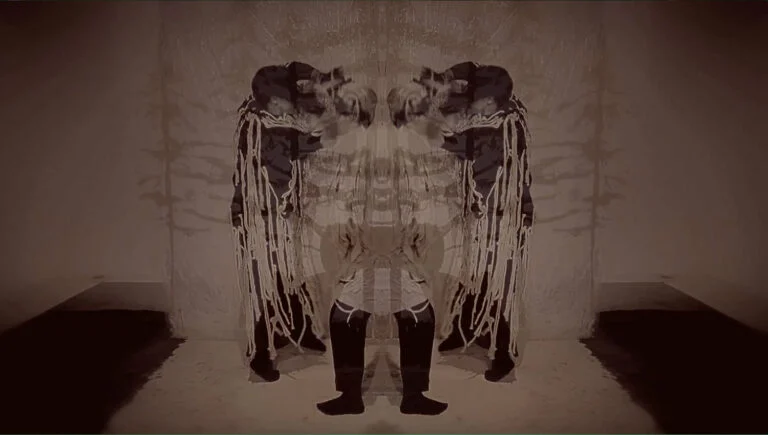
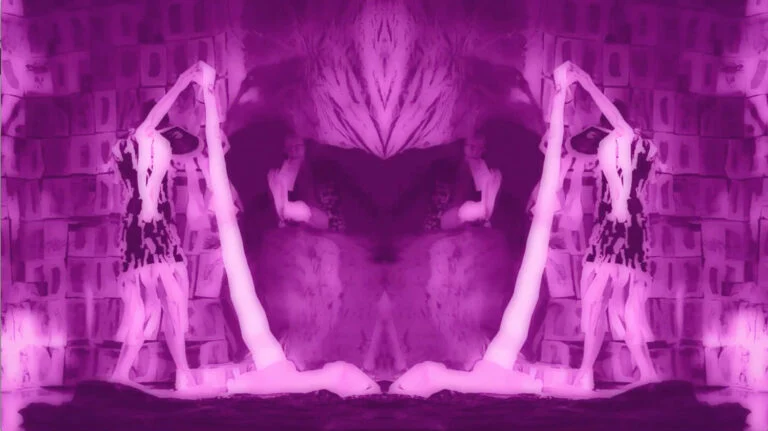
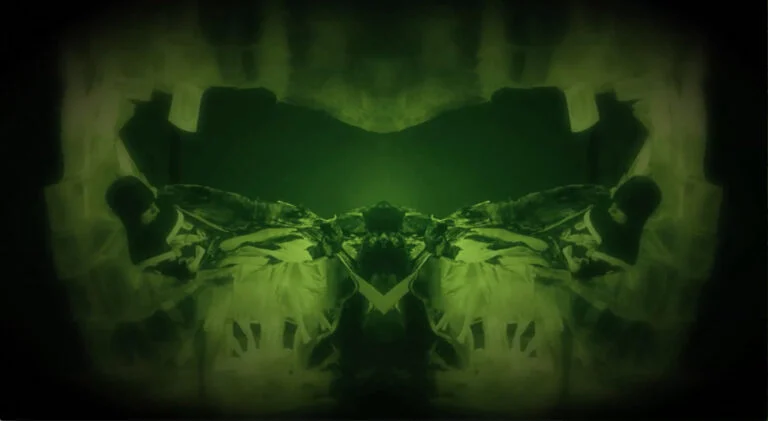
Through her six-month residency, Meghan sets in motion”Gesturals” a textual and moving-image-based exploration of gestures anchored in the sacred. She investigates the ritual practices of France and Malaysia, her homelands, to create an image repertoire reflecting her inner topography.
Meet the Artist
What is your name and where are you from?
Meghan from France.
When/ how did your art practice begin …. Do you think where you are from has affected your work?
For me, a slight removal from the world and a keenness to watch it from the periphery crystallised into an artistic gaze long before it did into an artistic practice. In some ways, I feel that my artistic practice is only beginning now. For many years, I was mostly paying attention to the world around me : writing things down, reading, dreaming. The desire to externalise images I had in my mind led me to cinema, which seemed the most immediate way to communicate my interiority. Since then, the need to translate an inner topography has taken on different forms : writing, performance, and now sculpture.
Immediately, my work was deeply informed by the French countryside in which I grew up : the wide landscapes and open skies, the reigning silence, the early, formative encounter with Catholic imagery. The denseness and humidity of Kuala Lumpur, where my mother is from and where we spent our summers, was also deeply influential; the heat of the sub-equatorial climate fostered an affinity for languor and daydreaming. Lately, I begin to explore more closely the imprints of this dual heritage, in order to eventually create an image repertoire that fuses them and is unique to me in that respect.
How has your practice changed over time?
My practice has moved across mediums, fluidly adapting it to my circumstances. I worked primarily in fiction filmmaking when the resources were there, then in writing and essayistic video when I was moving from one city to another and had become quite solitary, and currently, with more space, time and stability, I begin wanting to make material objects, that feel permanent and tangible.
The themes I’m drawn to also shift: I was deeply interested in the narrative possibilities of first-person cinema a few years ago. Now, my curiosity lays in examining my roots and their spiritual traditions to create moving images that contain something of the sacred. My time in a Zen monastery also marked a considerable turn in my practice. I began to want to do away with superfluity, and make work that feels true and exact.
Do you think your art has evolved being a different environment E.g. Do you think GlogauAIR / being in Berlin has influenced your work?
GlogauAIR altered my artistic practice in that having a studio space for the first time enabled me to begin reaching beyond video – my primary medium for the better part of ten years – to play with sculptural forms. Becoming drawn to material was the perfect antidote to the film frame, which had begun to feel claustrophobic, and is helping me grow into a more well-rounded artistic practice.
What are your next plans after your residency?
After my residency, I plan to complete work on “The Pearl and The Oyster”, a short film I shot in September. I additionally intend to organise an exhibition showcasing video, sculptural and installation work made at GlogauAIR and in the past few years.
Meghan Marie Malar’s art practice exists at the intersection of effort and non-effort, deeply informed by her sojourn in a Californian Zen monastery following her disillusionment with the machinery of Hollywood, where she trained as a filmmaker. Her artworks, bearing the mark of this influence, are sites of restraint and intense curation. Marie Malar strives to condense lived experience into simple form, guided by the thought of creating moving image pieces that feel like stones gently chiseled by water. She is particularly interested in dream-like imagery, allowing, through time for idleness and daydreaming, space for her interior life to come mysteriously to the surface.
A new development in her work is that Marie Malar finds herself countering the intangible nature of moving image with sculptural objects. To her, sculptures are often mysterious and withholding, yet substantial in a way video can never be. She seeks harmony by combining the two, ‘re-absorbing’ sculptural objects into moving images by filming them.
GlogauAIR Project
At GlogauAIR, Marie Malar investigates the ritual practices of France and Malaysia, her homelands, to create an image repertoire reflecting her inner topography.
Her exploration of French imagery, rooted in daytime and drawing on the Catholic imagination, incorporates childhood impressions of life in the French countryside to form work imparting a personal relationship with the divine. Meanwhile, night becomes the cover under which her study of Malaysian imagery takes place. It is, as Phillipe Charlier notes in Rituals, “the moment when spirits roam […] where human nature is in parentheses”. A focal point lies in the ritual of dressing, and how potent a vehicle it was for the transmission of her maternal heritage. She is further compelled by the wealth of class signifiers embedded in sartorial choices, and the impact of British colonialism on Malaysian fashion.
Through the creation of a series of trance-like moving images exploring these two sides of her heritage, she abstracts overt religious symbols and rituals in hopes of generating a cinematic language that feels spectral and sacred. She is guided by the notion of the visible revealing the invisible, and of images acting as openings or passages. She considers Paul Schrader’s essay on transcendental cinema, where he speaks of “purify[ing] the image by gradually converting it into an expressive image”. She investigates why abstracted forms seem to her more spiritually resonant than representational ones.
Her current art practice takes these theoretical concepts and confronts them with material realities: her time at GlogauAIR represents the initial stages of a search for a visual language that inches toward the sacred.
Moving image and Sculpture
CV Summary
Education
2014-2018 University of Southern California School of Cinematic Arts
2007-2014 International School of Geneva
Experience
2020 Editor at Association des Commerçants Paris-Bercy
2019 Art Intern at Budman Studios
2019 Development Intern at Marginal Mediaworks
2018 Development Intern at Highland Film Group
2017 Workshop leader and Jury President at European Student Film Festival
2017 Editor at United Nations Radio and Television Department
2015 Editor at Fondation Hardt
Group Exhibitions
2022 I, Nature in the GlogauAIR Project Space
2021 Longing/Belonging in the GlogauAIR Project Space
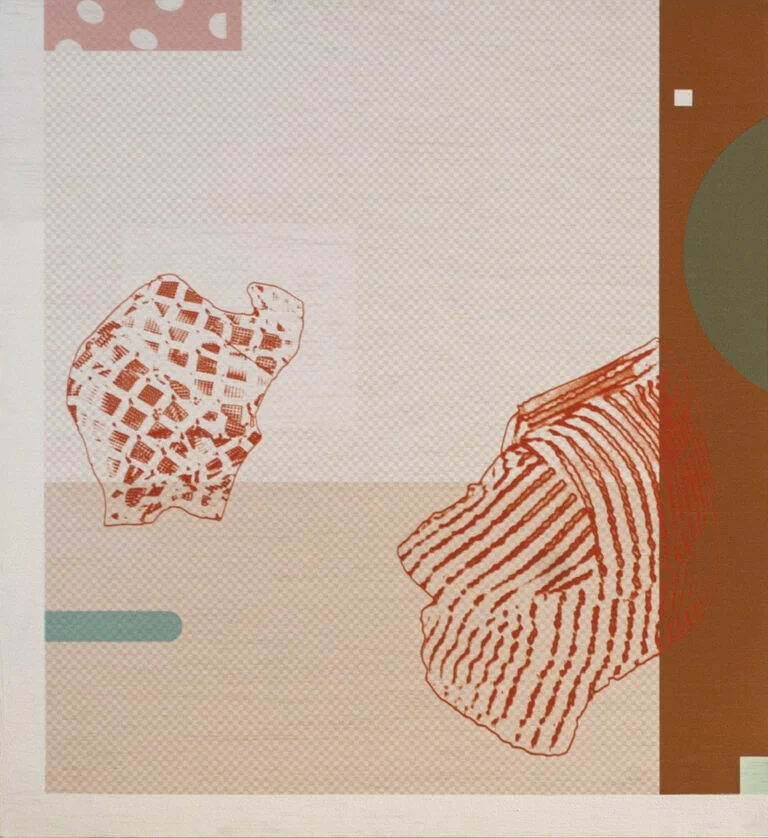
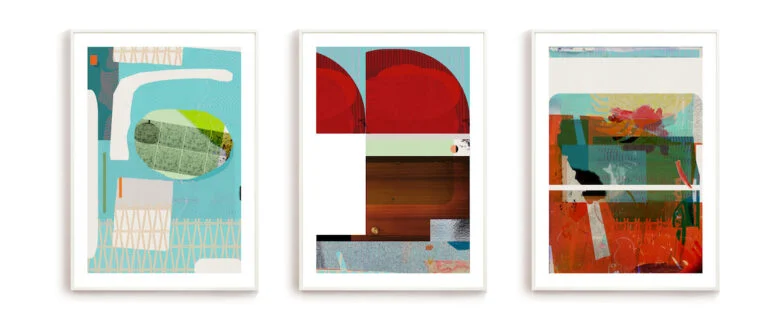
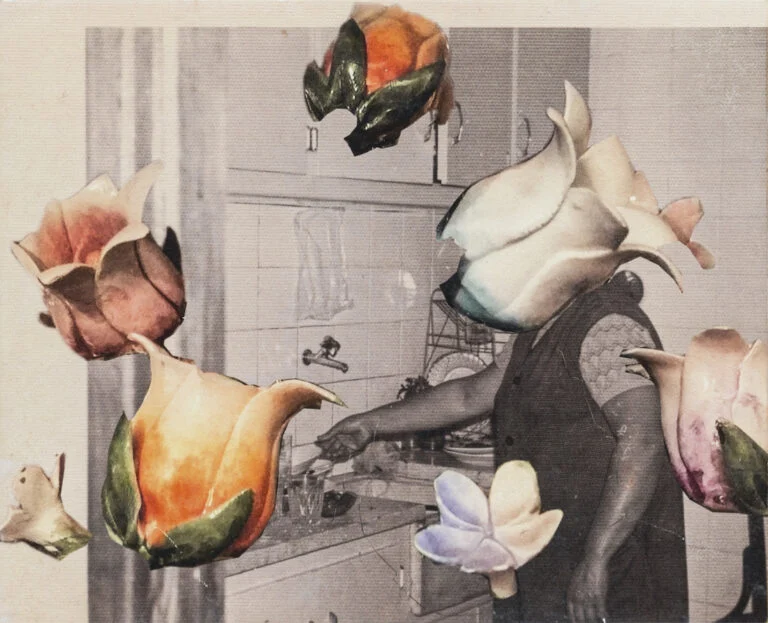
Our mind generates spaces where the dreamlike is mixed with the subjectification of reality, reproducing a new state of things. Assuming oblivion as a distorting and creative element of objectification and identification processes, I investigate the role played by digital image recording systems compare with classic analogue models.
My practice has a spiral trend where works simply represent snapshots of work processes. The materials used, collages, acrylics, drawings, and photographic or digitized images are reused at different times, transforming from the physical to digital constantly.
In 2019, Germany celebrated the centenary of the Bauhaus, with countless events and openings of spaces dedicated to this period of art. The Bauhaus understood that rationality should govern all aspects of life, from the organization of cities to the design of houses, clothing, utensils, etc. In my specific case, I am interested in investigating how the Bauhaus can be transferred to our digital age in the relationship between man and technology.
The project is structured in 2 stages, a first theoretical phase and a search for references that would serve as an image bank. I would continue in a second moment with the creation of a series of works that will build a formal investigation for the formalization of a future pictorial installation.
Collage and Painting
CV Summary
Academic Training
2020 » DEGREE IN ANTHROPOLOGY – UNED, Madrid (ES) – in progress
2018 » MASTER IN FINE ARTS – UAL, London (GB) – Distinction
2013 » FINE ARTS DEGREE – UPV, Valencia (ES) – Distinction
PROMOE – CAFA, Beijing (CN) – Distinction
1999 » DEGREE IN BUSSINESS – Universitat Jaume I, Castellón (ES)
1998 » ERASMUS – Paris XII Val de Marne, Paris (FR)
Collections
JJCC Foundation, Valencia (ES)
Raiffeisen Wels Süd, Wels (AT)
DKV collection, (ES)
Venancio Blanco, Salamanca (ES)
UPV Permanent Collection, Valencia (ES)
Premios y Colaboraciones
2022 » Finalist “Casa Velázquez” art residency award, Ayuntamiento de Valencia (ES) Selected work “Senyera” Award, Valencia (ES) Selected work “Cañada Blanch” Award, Valencia (ES) Selected work “ III Bienal M Isabel Comenge”, Las Atarazanas, Valencia (ES) Selected work “Premio Nacional de Pintuta Juan Francés Fira D’Agost”, Xàtiva (ES)
2021 » Finalist “Casa Velázquez” art residency award, Ayuntamiento de Valencia (ES) Selected work “La Rural” Award, Jaen (ES)
2020 » Selected work “Q-Art” Award, Quart de Poblet (ES) Selected work “ II Bienal M Isabel Comenge”, Las Atarazanas, Valencia (ES) Pre-selected work “Lopez-Villaseñor” Award, Ciudad Real (ES)
2015 » Nomination Best Photography Dali International Photo Festival, Dali (CN)
2014 » Chair in Art and Diseases, Fine Arts Faculty, UPV of Valencia (ES) in collaboration with CAFA Beijing, (CN)
2012 » Special Award – Club Diario Levante, Valencia (ES)
Artist & Co-net Residency Director
Residencies
2023 » ONKAF Gallery, Residencia y Exposición – Nueva Delhi (IN) (Postponed 23) GlogauAIR Art Residency, Habitat Awards, Berlin (DE) (Abril)
2021 » Art Diagonale, Wels (AT) Istambul Art Residency, Istanbul (TR)
2020 » QUARANTINE International Art Res, On-line (CN)
2018 » TIAC y ICCI Residency (Jiao Tong University), Shanghai (CN) FRESH WINDS International Art Biennale, Gardur (IS) First Floor Space Art Residency, London (GB) Art Diagonale, Wels (AT)
2017 » CWND (Canary Wharf Group), London (GB)
Art Fairs and Festivals
2022 » ESTAMPA Art Fair, with Shiras Gallery, Madrid (ES) MARTE, Art Fair sellection, Castellón (ES)
2021 » ESTAMPA Art Fair, with Shiras Gallery, Madrid (ES)
2020 » ABIERTO VALENCIA at Shiras Gallery, Valencia (ES) HEIM videoart festival & A!, Akureyri (IS) – (Postponed 23)
2019 » “5’ of Harmony” – NEW MEDIA FESTIVAL, Miami (US)
2018 » DIGITAL MAKER COLLECTIVE Tate Modern London (GB) “Beijing Walks” – IMAGINARIA PHOTO FESTIVAL, Castellón (ES)
2015 » SUMMER ART NIGHT, TopRed Gallery, 798 Art District, Beijing (CN) DALI INTERNATIONAL PHOTO FESTIVAL,”Abandon y Building the Endearment”, INPUT: 10 years of Spanish photography, Dali (CN) “Construcción del Cariño” IMAGINARIA, Museo Casa Polo, Villa-Real (ES)
2014 » SLICK ATTITUDE Paris (FR), with Jiali Gallery, Beijing, (CN)
2012 » HYBRIDA ART FESTIVAL, (art-sound concert), Las Naves, Valencia (ES) 4º SONS CREATIVOS Musica E Naturaleza (art-sound concert), Lugo (ES) INCUBARTE International Ferstival, Valencia (ES)
Main Solo Shows
2023 » “El Tiempo Suspendido”, Llamazares Gallery, Gijon (ES) – November
2022 » “El Tiempo Suspendido”, Shiras Gallery, Valencia (ES)
2020 » “La evanescencia de lo cotidiano”, Shiras Gallery, Valencia (ES)
2017 » “Beijing Walks”, Public Photo Installation, Rise Gallery, London (GB)
2016 » “Carlos Sebastiá”, Qingdao Art Museum, Qingdao (CN)
2015 » “Rostros”, Confucio Art Institut at Octubre Gallery, Valencia (ES)
2012 » “Vínculo de lo Cotidiano” Onda Townhall, Castellon (ES)
2011 » “Superaciones”, Nadir Gallery, Valencia (ES) “Presentaciones”, Nadir Gallery, Valencia (ES)
Selected Group Exhibitions
2021 » “Those remote days”, Sunning Art Museum, Shanghai (CN) “Parallel Universes”, The Artling, Shanghai (CN)
2020 » “Selección de obras de los artistas de la galería”, Galería Shiras, Valencia (ES)
2018 » “Art Diagonale”, Museum Angerlehner: Museum Wels – Thalheim (AT) “Capas”, IVAM (Valencia Institute of Modern Art), Valencia (ES) collaborative video performance with Mar Juan, Panamá Díaz and Mario Montoya “Capas”, Morgue Gallery at UAL, London (GB) collaborative video performance installation with Mar Juan and Panamá Díaz “Xhibit 2018”, Bermondsey Project Space, Londres (GB) “Collecting Time”, Shanghai Art Gallery, Shanghai (CHN)
2017 » “With Each Passing Moment”, Rise Gallery, London (GB) “One That Holds Everything”, The Crypt Gallery, London (GB) “Life In A Shoe Box”, Back Room Gallery, London (GB)
2015 » “Encounter”, CCD Show Room, Cao Chang Di Art District, Beijing (CN) “Bierlosky”, Railowsky Photo Gallery, Valencia (ES) “Building Endearment”, See+ Gallery, Beijing (CN) “Perspectives-Art, Liver Diseases And Me”, Reed Messe Congress Center, Viena (AT)
2014 » “Desmaterialización del Ser”, Instituto Cervantes, Beijing (CN) “Artworks”, Central Academy of Fine Arts, Beijing (CN)
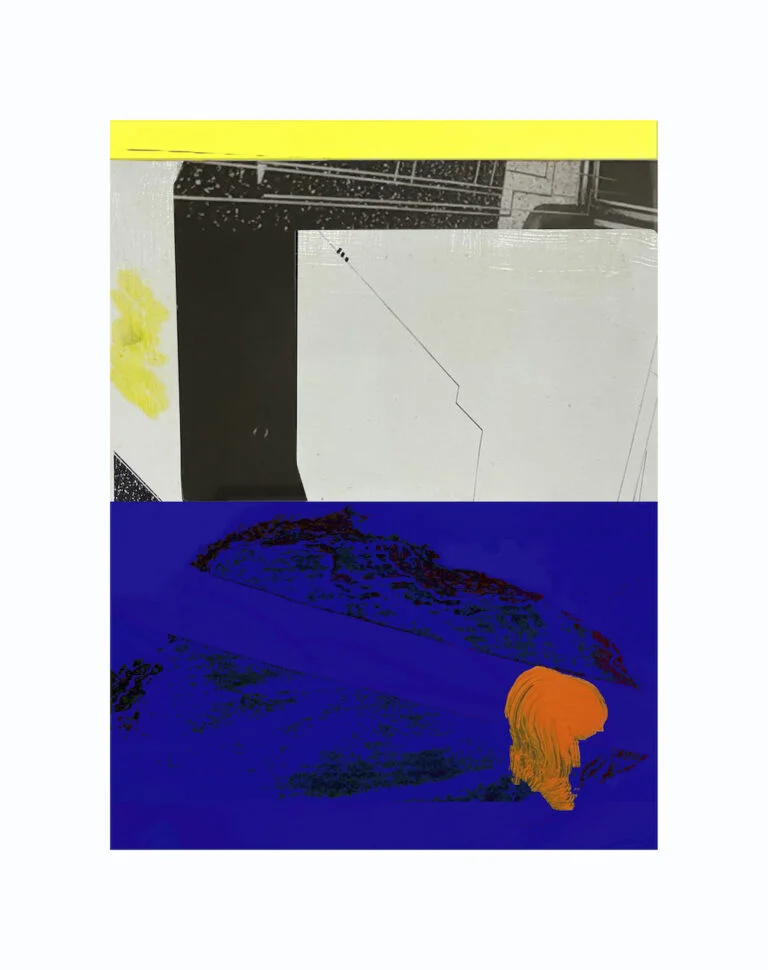
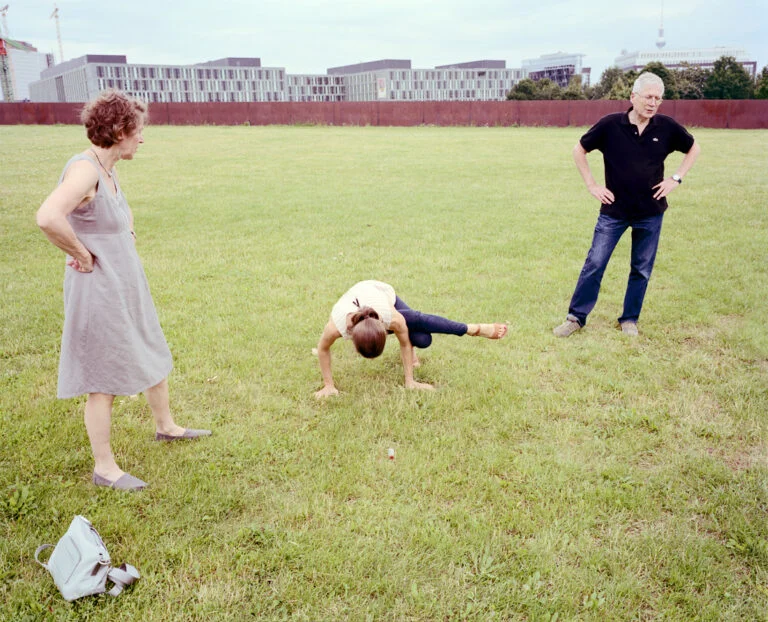
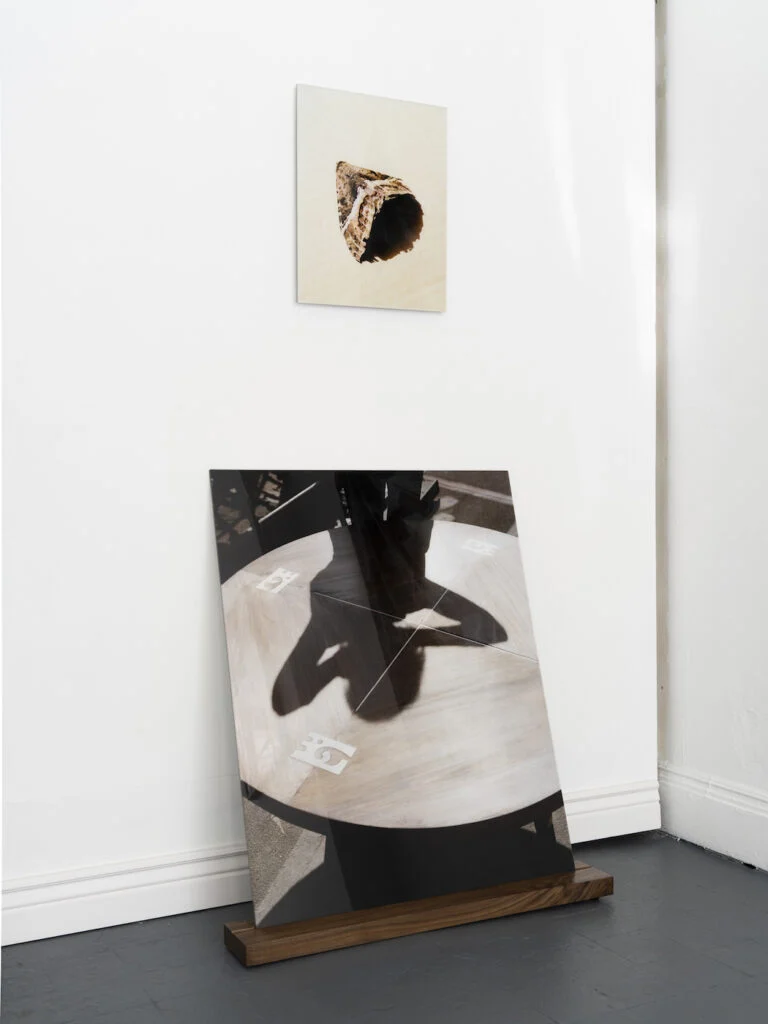
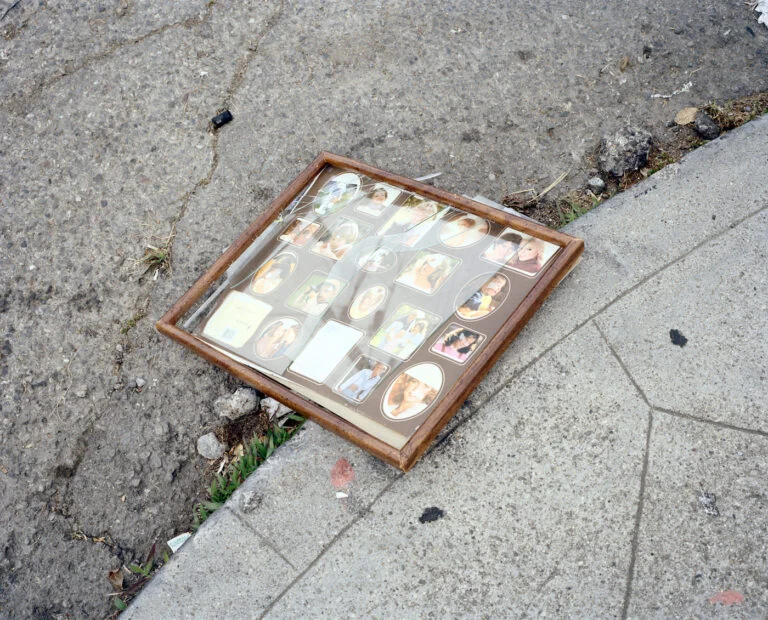
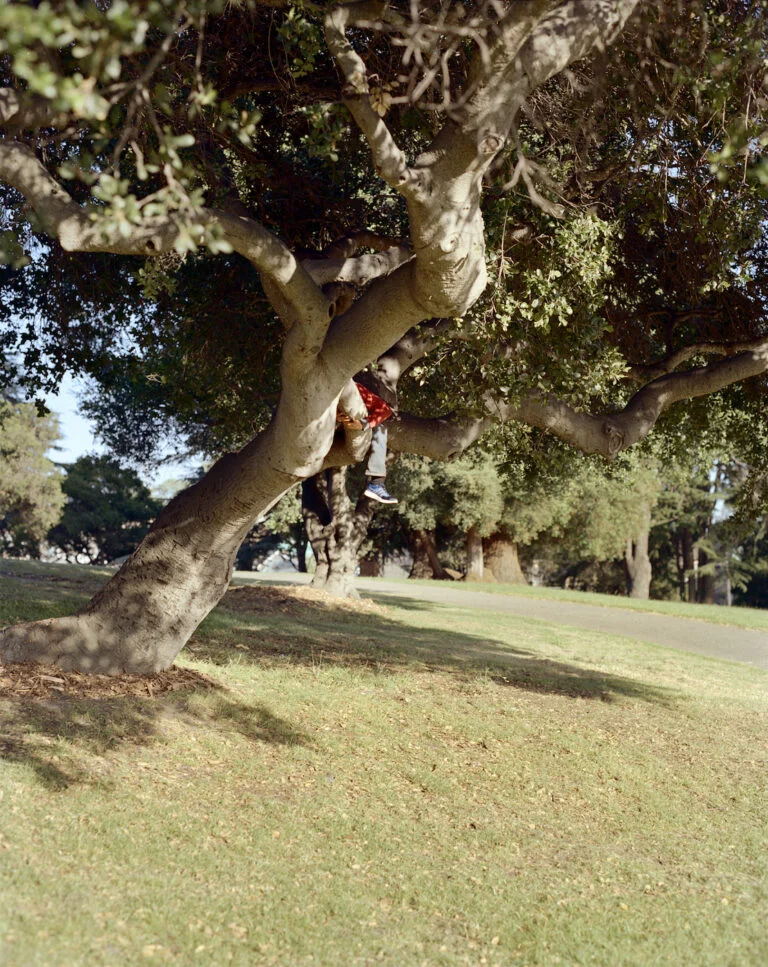
Dane Pollok works with the malleable nature of photographic meaning to explore ideas of identity, belonging, place and time. Utilizing the image’s intrinsic allegorical qualities, Pollok visualizes the emotional and psychological terrains that emerge from the experience of being in a particular environment. He sequences portraits, landscapes and found moments into open-ended narratives that invite the viewer’s own perspectives and interpretations — an image is fixed, but its message is not. What results is a conversation with the observable world and a practice of using its visual cues to spark deeper understanding and connection.
We have long distinguished between those who ‘belong’ and those who do not, yet as the city of Berlin has experienced firsthand, distilling our differences into such binary terms has tremendous repercussions. Being the international focal point that it is today, Berlin has continued to demonstrate the malleable nature of place and identity – neither are permanently fixed and definitions of who belongs are meant to be re-imagined.
During my time at GlogauAIR I would like to explore this city as a place where identity can be negotiated. Having historically grappled with the very nature of belonging, my aim is to create a series of images that speak to the ways in which Berlin continues to be shaped and claimed by those who are a part of it. Unpacking my own relationship to the city will provide the framework through which to engage and collaborate with others, whether they are from here or like myself, somewhere in between.
Installation and Photography
CV Summary
Education
2008 B.A. in Visual Culture, Pitzer College
Selected Exhibitions
2022 Six O’Clock Shadows, PALLAS, SF, CA
2022 Purview, Left Space, SF, CA
2021 {Solo Exhibition} Honeymoon, Book & Job, SF, CA
2020 Love Sick, Book & Job, SF, CA
2019 Cómplices En La Resistencia, Accion Latina, SF, CA
2016 With Our Own Eyes, Rayko, SF, CA
2016 Thank You for Coming, Group Study, Oakland, CA
2013 {Solo Exhibition} Full Space, FM, Oakland, CA
2012 Showcase, Rayko, SF, CA
2011 Encountering, 31 Rausch, SF, CA
2010 (Por)trait Revealed, Rayko, SF, CA
2010 Paint by Numbers, WE Artspace, Oakland, CA
2010 Roll Call, SF Camerawork, SF, CA
Recognition
2022 Chico Portfolio Review, Livingston, MT
2019 On Making a Photobook, workshop with Alec Soth curated by FOTOFILMIC
2017 Rayko Artist In Residence
2014 HALS Grant
2013 Honorable Mention, APA’s Easiest Season, Rayko, SF, CA
2012 3rd Place Juror’s Award, Showcase, Rayko, SF, CA
John Graham is multidisciplinary Canadian visual artist and award-winning independent filmmaker. His interests shift amongst multiple art media to explore new ideas and sensibilities. His creative processes synthesize long-standing interests in visual poetics, mythological representations, surreal aesthetics, transformational psychology, and the fantastical. John is fascinated by the montage nature of dream life and his visual artwork and short experimental films are not intended to appease the conscious mind but to challenge it.
John Graham during his residency will create a new short experimental film entitled ‘Nowness to Onwards’ which will poetically portray how being with a loved one who is dying can be sorrowful but also very beautiful. This philosophical project will be organized and shot in Berlin and collaboratively developed with creatives from the independent filmmaking and acting community.
Film Project Synopsis: A young man receives news that his favourite aunt is dying in Berlin. When he sees her in a hospital, she expresses that she does not want to die there or at home but somewhere beautiful. When he helps her fulfil her wish, he mysteriously develops Chromesthesia and the sounds of his thoughts involuntarily trigger colour changes in his sight.
Video
CV Summary
John Graham is a multidisciplinary artist based in Saskatoon, Canada.
Started his professional creative life by studying architecture and working as a young architect.
Later shifted his creative focus to develop a career as a visual artist in multiple media.
John’s ever-diversifying art practice includes printmaking, artist’s books, painting, drawing, installations, digital imaging and experimental filmmaking.
Received a Master of Fine Art from the University of Oregon in Eugene, USA and a Bachelor of Fine Art from Concordia University in Montréal, Canada.
Previously studied architecture and received a Master of Architecture and a Bachelor of Environmental Studies from the University of Manitoba in Winnipeg, Canada.
Has been the recipient of dozens of awards, grants, fellowships and prizes.
His visual art has been widely exhibited in over 175 solo, duo and group shows in North America, Europe and Asia.
As an award-winning independent filmmaker, John has created 9 short experimental films that have been screened at over 200 film festivals in over 40 countries.
Has participated in artist residencies worldwide to develop both visual art and film projects.
Has been teaching visual art in universities, college and art institutes in Canada, USA and Australia since 1999.
In 2013, joined the Department of Art & Art History of the University of Saskatchewan in Saskatoon, Canada where he is now an Associate Professor of Printmaking & Digital Media.
Continues to develop his multi-faceted art career while maintaining a busy teaching practice in studio art.
Maja Lindberg Schwaner is GlogauAIR resident from April, 2023 to June, 2023
I walk into NFTasia, the first physical object I meet – the humanesque gray sculpture precariously lying across the Majas floor, I turn. Sitting across from the computer which has become the Canvas, Maja and I settle down to discuss the world she has created, where she sees her world going and her relationship with the rising technology.
Meet the Artist
What brought you here to GlogauAIR, and the city of Berlin?
I have been here a few times, just as a visitor. It is a city which I love, and keep coming back to.
I don’t live super far, so for me it was also just a way to get a little bit out of where I am in Copenhagen. I was in Gothenburg for the last few years where I completed my masters, and I feel like sometimes in cities that are not very big you are only exposed to a certain variety of art. Often it is specific for that place, whereas here there are a lot of experimental things. It has been inspiring to have more variety.
I think with what you are doing like with your videos and stuff it’s an exciting place to be. How have you found that the city has influenced your work, if it has at all.
Maybe not in any direct way but probably in more subtle ways. Just seeing different expressions. There is just a lot of art here to soak up.
Especially in Kreuzberg Neukolln.
Yeah, there seems to be a lot of different art scenes even in one area, and a lot of room to experiment.
What is your artistic process? How do you find inspiration, and what are some of your daily activities which help you create?
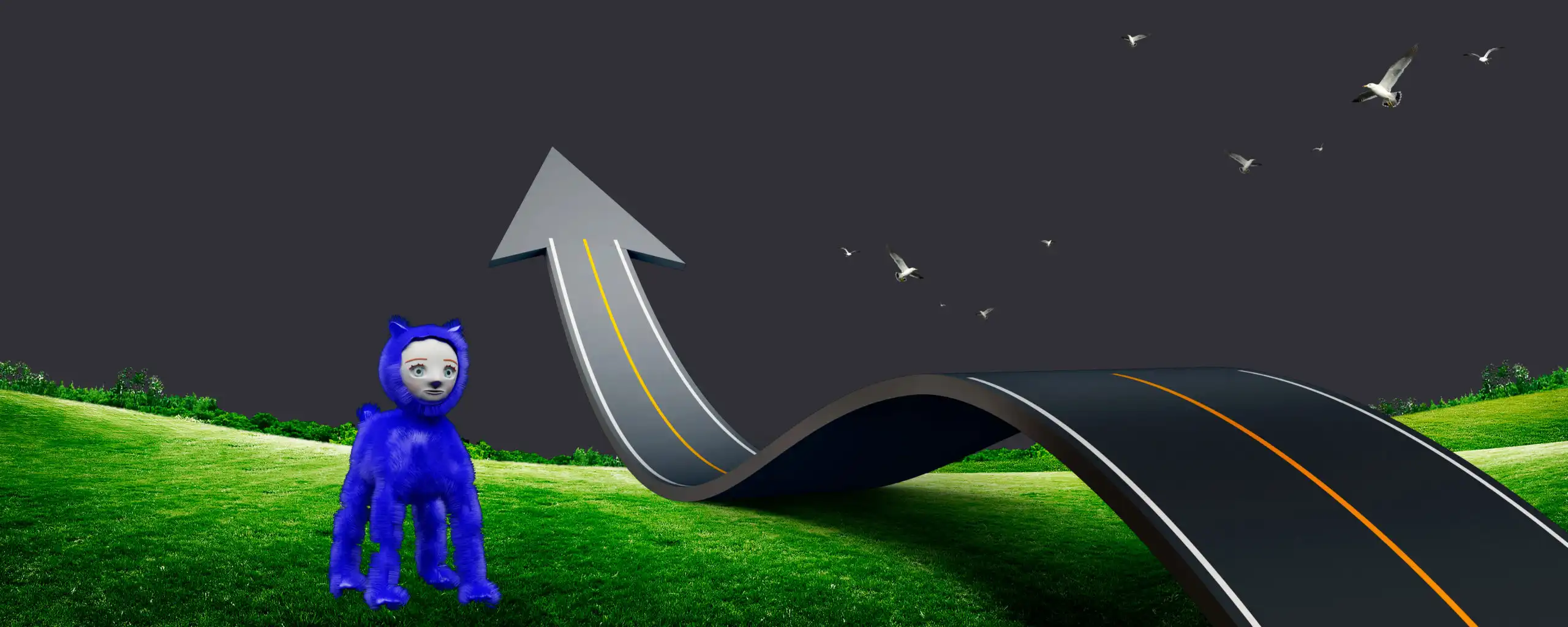
The work I’m doing here is a 3D animation project. I prepared a little bit before I got here, just modeling the characters. I am using blender for modeling and animation.
Online?
Yeah, or you download it. It’s a free program. You literally make everything out of geometrical mesh.
Even the blue character with the textural looking fur?
Yes I made these characters all using the blender. You can make different textures. It can be very complicated, but there are alot of online guides, and I like to just experiment.
In the animation part you can also use simulations. In my work I had a lot of fun with the wind simulation.
How do you formulate your characters? Where do the ideas come from?
I wrote a bit of a script. I haven’t written the whole series, so this animation is the first episode.
The dog character was inspired from thinking about the look of NFTs really, I was thinking about creating a character that is, or was, an NFT and then lost it’s value, or something like that.
Maybe it doesn’t know itself that it was an NFT. Then, later on it becomes an identity crisis. I also created this teenager who’s really into YouTube stars like Logan Paul ETC
Yes, I really picked that up from the dialogue in the animation.
Yeah maybe a bit of an isolated, geeky character and also a bit naive
So you just make them from your imagination
From my imagination, but also inspired by internet culture, and the types of things I am exposed to online.
You talk a lot about mirrors as inspiration for your work, I wondered if you could expand on this a bit?
It’s something I sort of carried with me in different versions throughout my work. Initially it came from kind of thinking about borrowing aesthetics, or elements from other places. Then I would bring them into my work, combining them in different ways. In relation to mirrors, what I’m thinking about is reflection in a distorted sense. My work doesn’t just reflect something, but it takes it in and then reproduces with a spin on it.
I think it is taking in some elements from internet culture, then kind of incorporating them into the work and then reflecting them back, but in a strange way.
I think about what happens when you go into a show, a gallery or something. You have to look with more attention than you would look at a lot of other stuff in your everyday life. I feel like that’s what I’m thinking about. It is a mirror, but one where you watch more closely. There is the possibility to single out some elements and present them in a more isolated setting.
And you’re doing that in your animation also?
I think I do it throughout my works but in different ways. In the animation, I´ve taken some elements from the crypto space and NFTs, aesthetics but also ridiculous names for currencies and problems like the fluctuation of value, and then some aesthetics from internet culture and reflected them back to the audience.
Also, I like to approach some things I don’t completely understand myself. It helps me to process some of the crazy things happening in our world at the moment.
How did you start with these animations?
Before animation I worked with sculpture for a few years, and before that with fiction writing.
I wrote a short story collection as well. In some ways it’s similar to my animation.
Kind of like the Dystopian?
A little bit. Is has some elements from sci-fi and fantasy, but it takes place in everyday spaces then it sort of flows into some other, weirder spaces
Do you think you’ll continue doing sculpture? I guess the characters you create are a sort of sculpture
It is a bit like sculpting, yes. I like to switch between different mediums. Also between different methods. Then include some elements of what I already know as a way to move forward with my work.
Have you enjoyed doing the animation
Yes I have loved it. I remember when I began with sculpture I was feeling like I wanted to work with my hands, compared to writing. Now I feel like it’s actually kind of refreshing to sit with my computer and immerse myself in a world.
Less messy as well I guess.
Not so physically challenging either! I have found the variation in work stimulating.
When did you first start using this reflective/mirror idea in your work?
I started by thinking about artworks I like that give me a certain feeling. It’s a feeling of something recognizable that’s related to other things and like spaces in your life but also has this alienating element. Maybe things that already seem weird to you but in the artwork the weirdness is stronger. I started to think about how I could incorporate this into my own works.
You get to question things more in an artwork because you can express yourself in a more unusual manner. I especially like the tone of an artwork that mimics something, but it’s not a complete parody. The tone is more ambivalent: for example it can be mimicking something and making fun of it, but at the same time appreciating it.
Sort of satirical but also hopeful
Something like that, yes.
So you sort of take elements from different artworks or different spaces you see, and then reflect them in your work
Sometimes I do reflect other artworks, but this way of thinking about them is more thinking about the way they work or the tone and attitude they have than the way they look or what they are about. I think about works that I like and then I’m like ‘okay what is it that I like in its way of working’
How can I work in a way that is a little bit similar to that particular tone, or that gives me the same feeling.
You obviously work a lot with technology. What are your views on stuff like AI and chat GTP and crypto NFTs
I feel like AI is the discussion at the moment. I didn’t really think that much about AI and now the technology is becoming more for all kinds of users, and everybody’s talking about it.
With crypto I can’t say that there isn’t potential in the technology itself, but now all the optimism around it has faded a bit. There have been scandals and scams, and it has proved pretty unstable so far.
I think with NFTs like crypto, what has actually happened hasn’t been able to match the hopes and the hype there was around them. Most artists making NFTs are still struggling economically, and then it becomes something which is only profitable for artists already famous or random internet art hyped by influencers. It is this question, what do NFTs actually change?
I think with politics in general like most people have an opinion because, it’s just a lot of people are scared to say their opinion because they aren’t clued up on it.
Yes and the same applies with cryptocurrency.
Sometimes this fear of not understanding the technology is used to keep people from having an opinion.
You don’t need to be an expert in every area to have an opinion. You can still look at a thing and have an opinion. Like the most expensive NFT art – do you like it? Why is this piece of pixel art so expensive? Even if you don’t understand all of the technology.
How do you think AI will affect the art world?
I think it will probably change something in art. Already now you can work and collaborate with some different AI technology. I actually used some AI in my project, for the music and some of the small images within the animation.
I kind of see AI as tools. You can use them or you can choose not to.
I think it’s fine as long as you are aware of what you are using. To understand it’s not a neutral tool. It still carries the same biases as humans. It learns from human made text and imagery. So it draws from human knowledge and is not a completely separate entity.
Where did you get your name NFtasia from
The place in my animation is supposed to sound like something fun, like a fantasy land or something like that. But then related to NFTs. It has these promises of fun and is talked about as an amusement park but then it’s just a really boring and empty amusement park.
Do you think you would create NFT out of your work?
I don’t think so. Right now I am a little bit too skeptical of it to want to do that.
In your work you kind of bringing the kind of NFT conversation into a playground I guess
Yeah it’s more like asking questions and processing what’s happening with crypto, NFTs and Web3, more than actually creating NFTs myself.
Have you had any key moments in your life that have influenced you?
I think it’s more like a continual development over time than any single moments. Just meeting different people and having conversations can be very impactful. Some of my friendships have been a big influence I think, looking back. But a lot of doing art is just to be able to have time. So much depends on things like opportunities and funding I feel like.
Because if you have funding you have more time
Yes, you need to buy time and materials. Doing art is expensive. My arts education was crucial because it gave me some time. I had figured out kind of late that I wanted to do art, so having this time and being able to get funding for it was important for my art to develop.
Before that I did more academic studies. I did a master’s in modern culture, then I realized I actually also wanted to do something else. I also did a writing course at Biskops Arnö and I remember we did some projects investigating our writing though experimenting with other media. I did like a mini film just for that, and some other experiments and really enjoyed it. I kind of realized that I also enjoyed working with more visual arts. There were visual elements in my writing as well.
Where do you see your work going in the future?
I think I will continue with this project for a while. Maybe work in some different mediums within this project. I would like to continue some script writing and make the next episode of ‘NFTasia’ for sure.
Would you ever like to release your episodes as a series?
I think so. I would like it if my episodes would be shown in some exhibition settings. I want to create a physical world the viewer enters into, as well as having the online world which they engage with through the animation. So you have some elements from the same universe but experienced through different mediums. I’m also considering just putting them online for people to watch.
Well, we have come to our final question, just a bit of a fun one! If you could invite one person to a dinner party, dead or alive, who would it be?
I just finished this trilogy by N.K. Jemisin, “Broken earth”. She writes these really interesting sci-fi/fantasy novels, so just because you ask me right now, I would invite her.
I work from an idea of art as a mirror that briefly fixates parts of contemporary society and reflect them back to it – parts which contain tensions and contradictions, unfulfilled longings.
The heightened attention which is a part of looking at and being with art, makes that possible – to look at these elements separately from the contexts in which they usually appear. Unusual compositions of elements create new connections. It is an uneven mirror, in which there is a selection of elements, a selection which at the same time belongs to a certain place and time but is also personal and woven together with the particular experiences of being a body in this world. Something more happens to the mirrored elements as well. A transformation rather than representation.
At GlogauAIR I plan to work on a 3D animated mini-series. It’s called ”NFTasia” and it’s about two friends – a YouTube-obsessed teenager and his dog, a former NFT – who goes to an immaterial amusement-park. The point of entry for the project has been a speculative and critical approach to the promises of cryptocurrency and NFT’s. The park, a promised land of fun and wealth, may turn out to be less sparkly than the characters first anticipate. The project is in its early stages, and so the first thing I will do at the residency is some 3D modeling. If there’s time, I would also like to do some experiments with sculptural components in the physical space.
Writing, Installation, New media, and Sculpture
CV Summary
Education
HDK-Valand Academy of Art and Design, University of Gothenburg
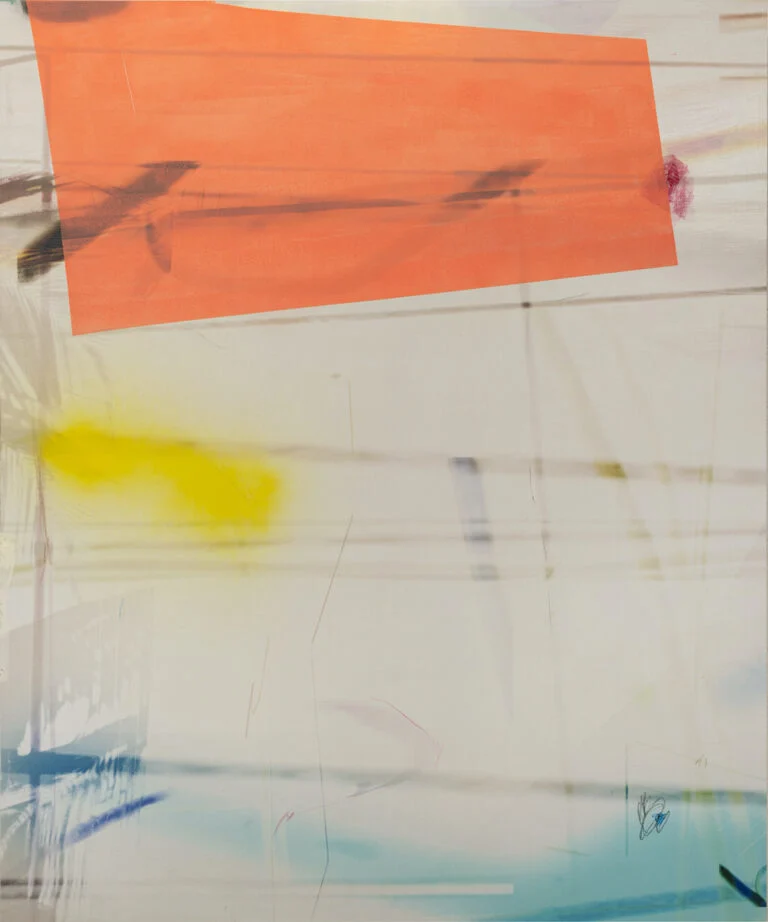
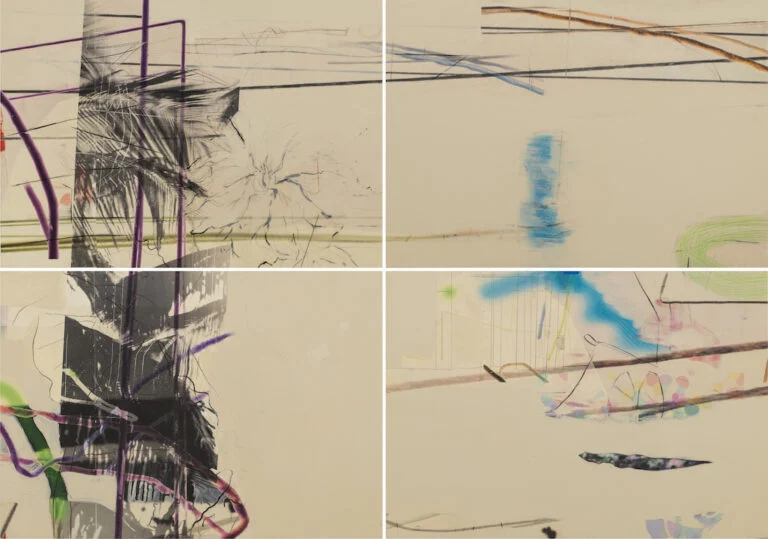
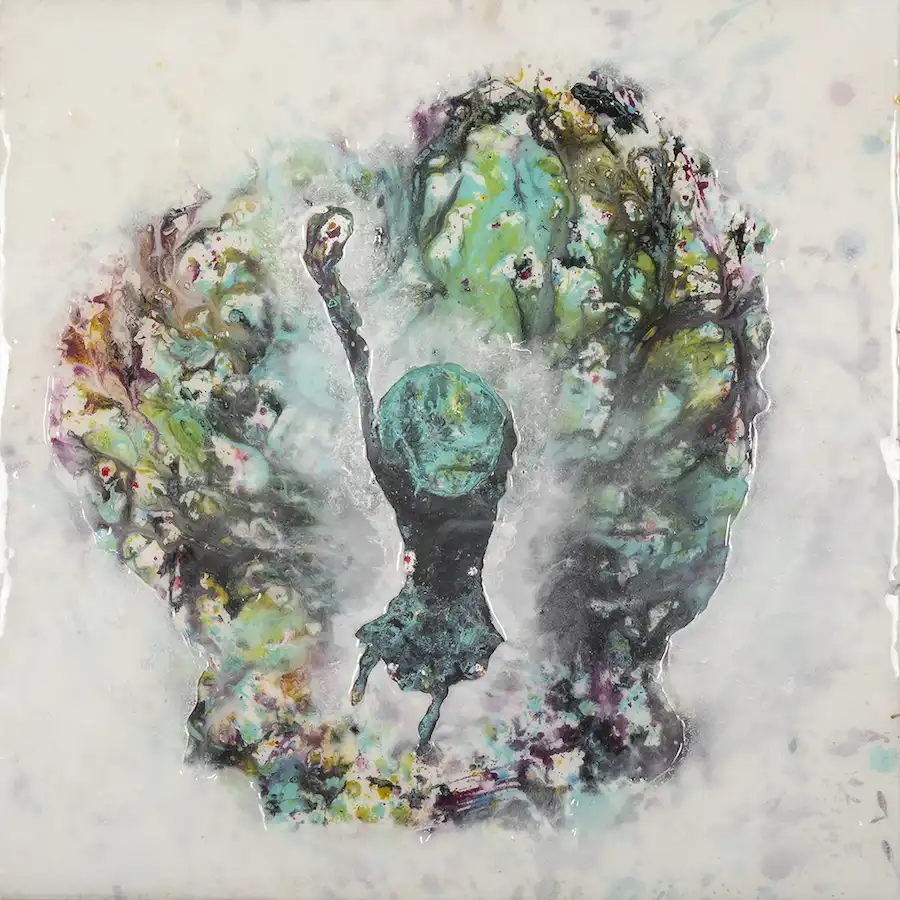
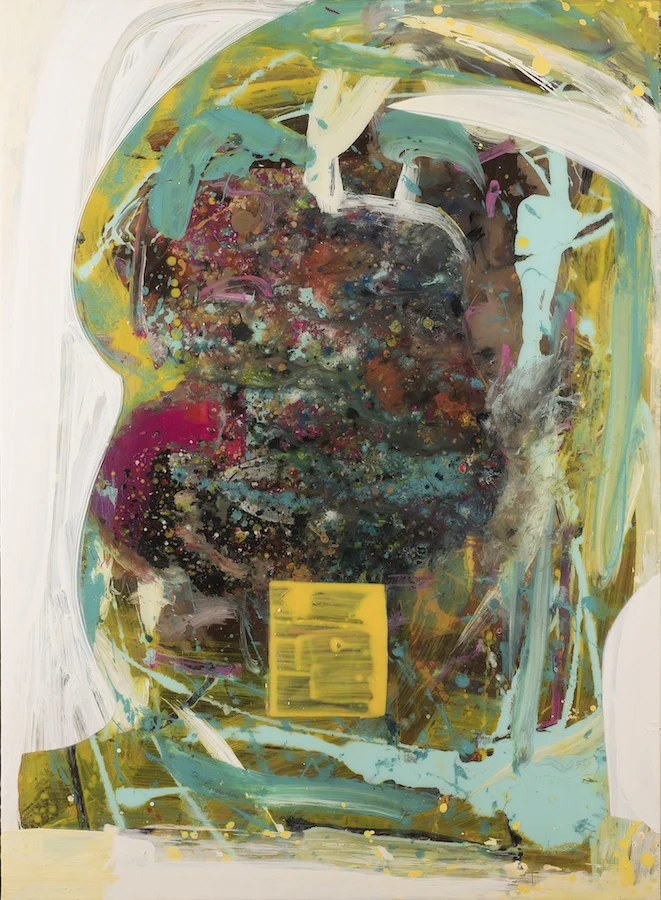
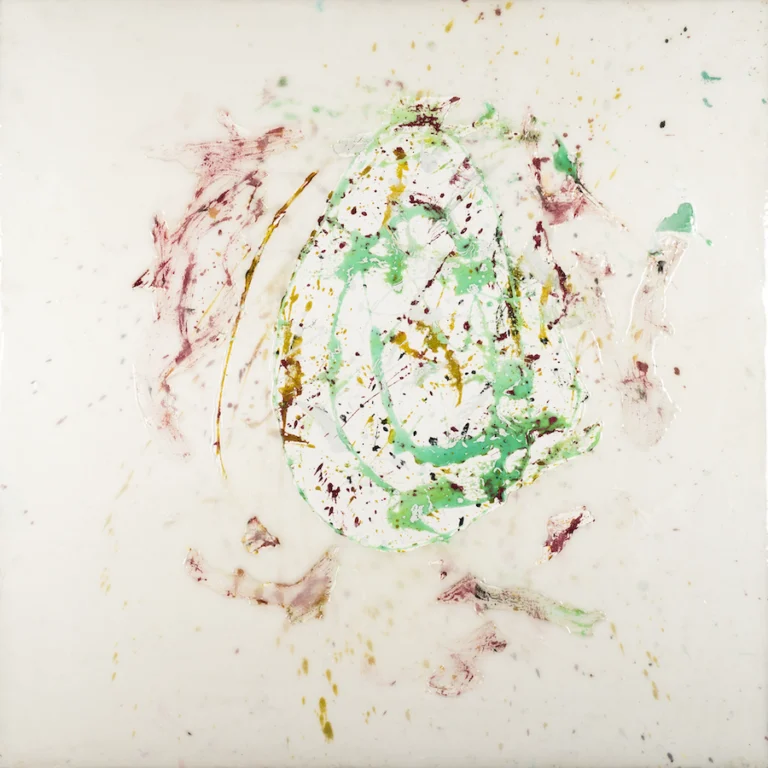
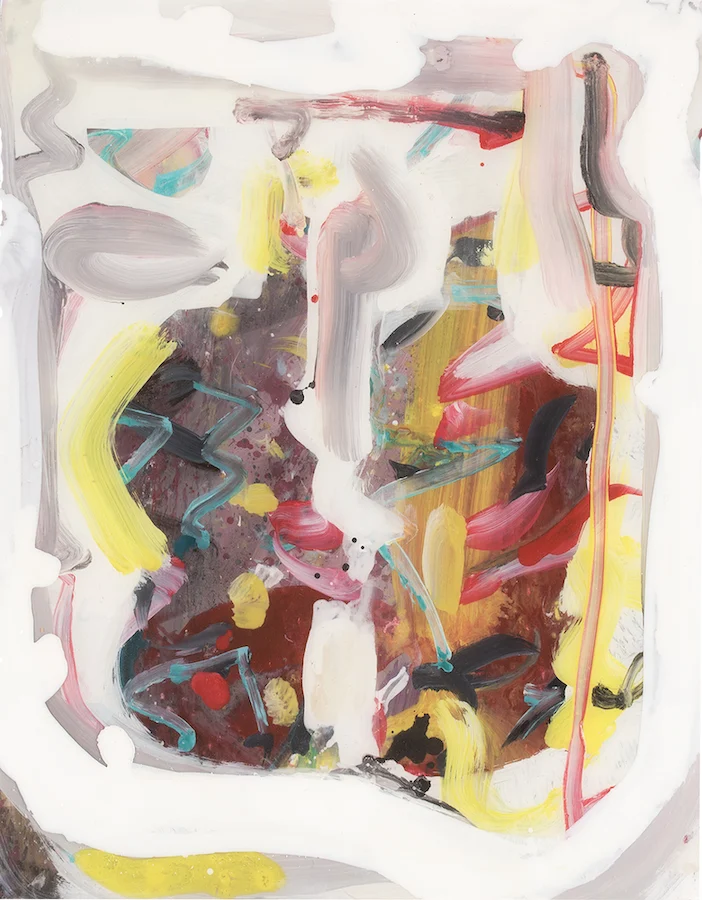
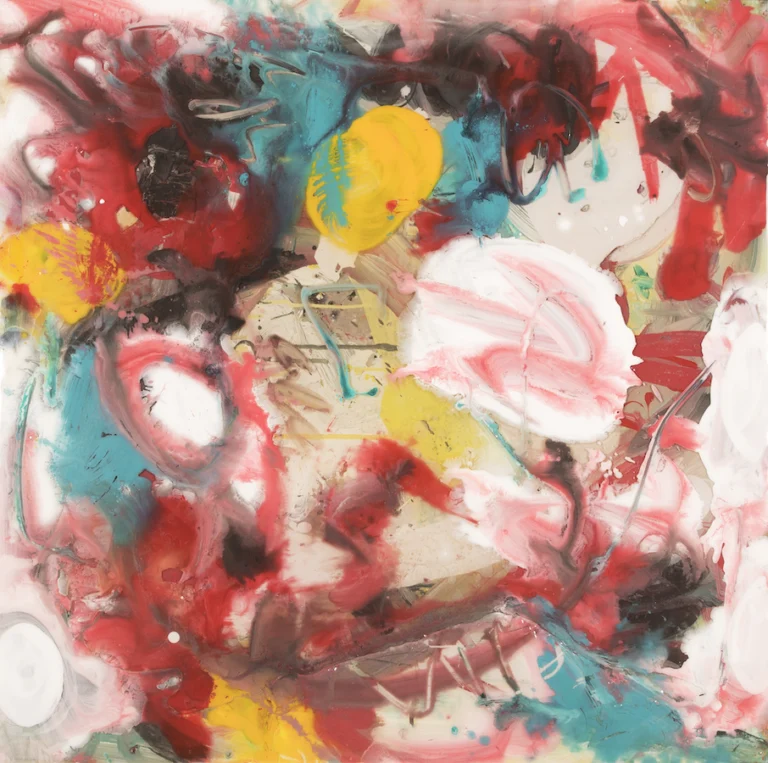
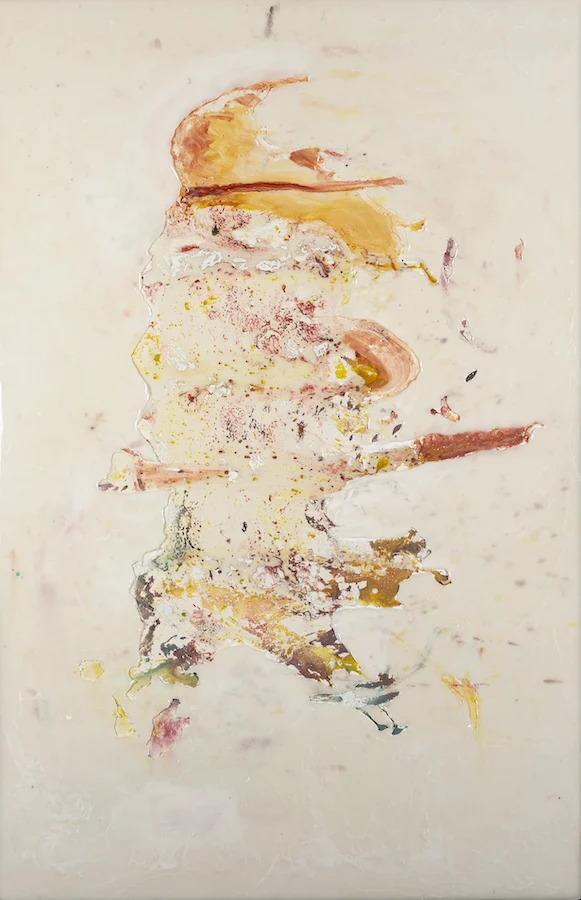
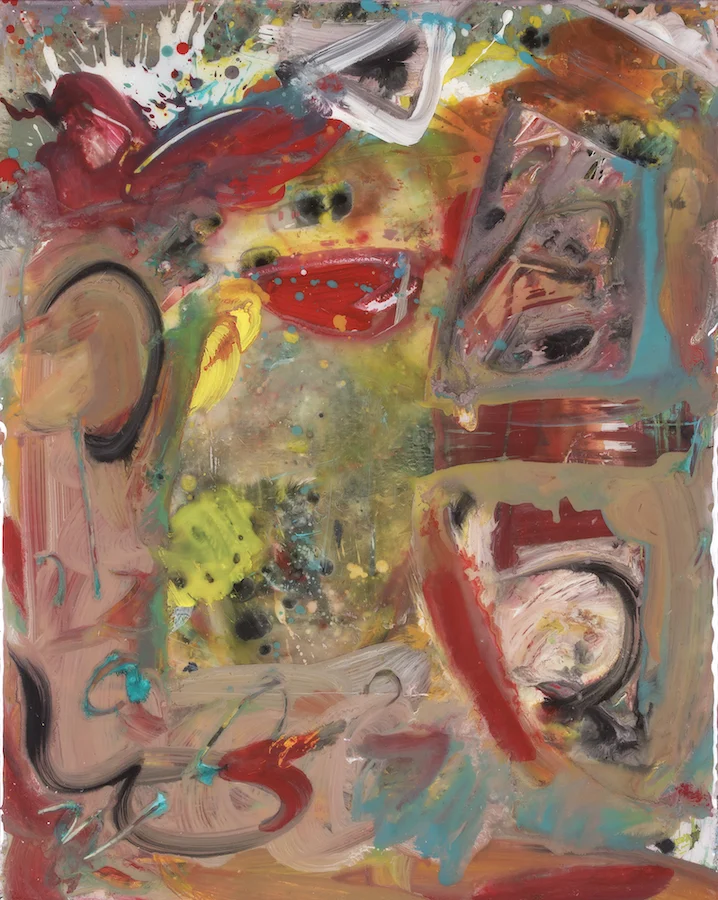
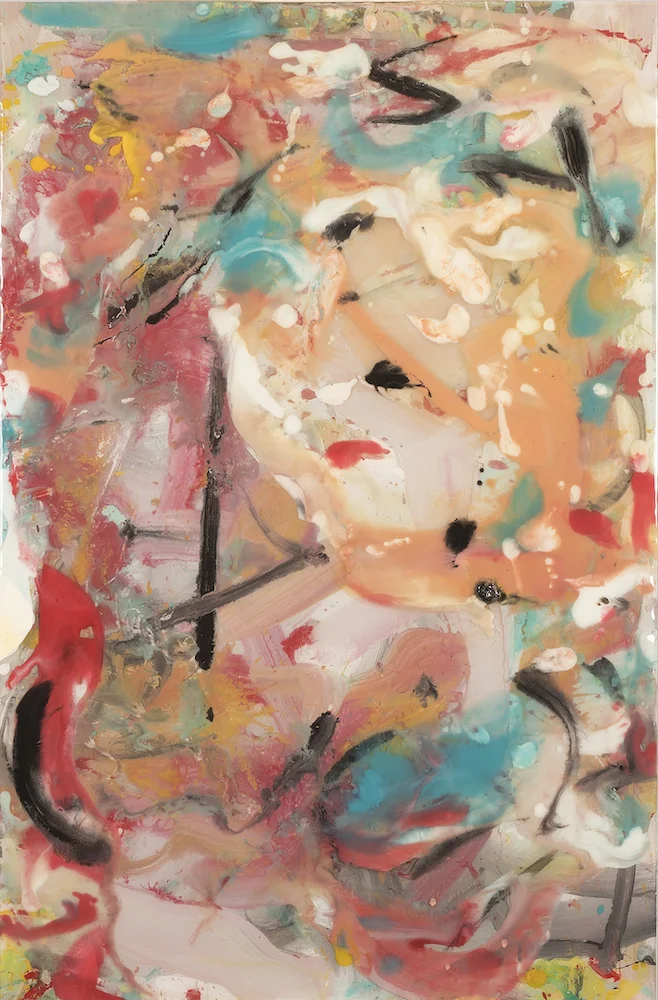
The artistic practice of Mar Ripoll (Mallorca, Spain, 1977) uses painting as her main means of expression. Through this discipline, the artist explores from a very intuitive pictorial technique -acrylic on resin- a series of themes that in her body of work, run amok. The use of resin between layers allows her a three-dimensional perspective, where the interior and the exterior are united in a single dimension to explore the very construction of the experience of human existence. Within an abstract visual language, his body of work is positioned on the current affective conditions of the world.
The artistic project that I wish to develop consists of an investigation on female power figures in the recent history of Berlin. This includes women and persons identified as such. The project seeks to explore, through painting, the sociopolitical and historical conditions of the construction of “woman” and “femininity” in the heteropatriarchal framework to subvert such relationships in the process of showing that there are many other ways in which femininity is expressed.
The research is accompanied by a critical review of the bibliography on feminist art theory and history and a review of the structures that perpetuate different types of violence.
That research will focus on a plastic experimentation in terms of colors, surfaces, tones and layers, seeking to produce deep dimensions on surfaces on and around the aforementioned themes.
Painting
CV Summary
EDUCATION
2001: University degree in Economics, University of the Balearic Islands
2003: Higher professional photography. CEF. Audio visual Art School. Palma.
2005: Certificate of higher education of Fine Arts and Artistic Photography Design. High school of Art and Design. Palma.
2019: First prize “XXXI Son Carrió International Art Competition”, Sant Llorenç des Cardassar”, Mallorca, Spain
2019: Finalist “X International Art Competition Dijous Bo”, Inca, Mallorca, Spain
2019: Finalist “41 Vila de Binissalem Visual and Plastic Painting International Art Competition”, Mallorca, Spain
2019: Finalist “XXXII Sant Marçal International Art Competition”. C.C. S’Escorxador cultural of Marratxí, Mallorca, Spain
2017: Finalist “V Vila de Santanyí Francisco Bernaregi Visual International Arts Award 2017”. Ses Cases Noves Culture Centre. Santanyí, Mallorca, Spain
2013: Finalist “XI Vila de Ses Salines International Art Competition”, Ses Salines, Mallorca, Spain
2013: Finalist “XXV Son Carrió International Art Competition”, Son Carrió, Mallorca, Spain
Artist workshops
2021: Lithograph printing in 6a editions, 6a Art Gallery, Palma, Mallorca, Spain
2017: Work analysis and production workshop with Joan Morey and Nekane Aramburu. Can Oliver, Menorca, Spain
2018: Video art workshop with Robert Cahen. Art residence in Serra Tramuntana, Mallorca, Spain
2017: Master Class by Javier Vallhonrat “Exploring the process”. Es Baluard, Museum of Modern and Contemporary Art of Palma, Mallorca, Spain
2015: Course with Santiago Morilla. “Flight plans”. Pilar i Joan Miro Foundation, Palma, Mallorca, Spain
2015: Course “Aesthetic-Poetic Pulse” with Ana Laura Alaez. CAC Ses Voltes, Palma, Mallorca, Spain
2014: Mood Board Course with Guillermo Mora. Es Baluard, Museum of Modern and Contemporary Art of Palma, Mallorca, Spain
2014: Master Class Course with Olga Mesa. Es Baluard, Museum of Modern and Contemporary Art of Palma, Mallorca, Spain
2013: Course “Cliniques d’Es Baluard”. Es Baluard, Museum of Modern and Contemporary Art of Palma.
2013: “To write about (your) art: a workshop of artistic literature for artists”, by Fernando Gomez de la Cuesta. Aatomic Lab Artistes Visuals
2011: “The photographic image in contemporary engraving”. Polymer photoengraving workshop by Juan Lara Hierro. Pilar i Joan Miro Foundation, Palma
2005-2004: Higher education of Fine Arts and Artistic Photography Design. High school of Art and Design, Palma, Mallorca, Spain
2003-2002: Higher professional photography. CEF. Audio visual Art School, Palma, Mallorca, Spain
2002: Stamping and engraving workshop by Marcos Vidal. Can Gelabert, Binissalem, Mallorca, Spain
2001: Silkscreen printing course by Jokin Aizpurua. Contemporary Art Museum, Sa Pobla, Mallorca, Spain
1995: Human body drawing. Escola Masana, Barcelona, Spain
1988-1994: Drawing and painting lessons with the water-colourist Miquel Navarro Galcerán. Casal Balaguer, Palma, Spain
Sofia Mendiondo is GlogauAIR resident from April, 2023 to June, 2023
Sofia welcomes me into her studio, articulately dressed to match both the fashion of the city, and honor her own personal style. I walk into her room and I am greeted by enticing, strange materials dripping from the walls, faintly reminding me of a dream catcher. Black dots pepper her studio floor, all made out of a strange solid/liquid material, screaming to be touched.
A few minutes later we are settled, delving into the materiality of her work, and her obsession with the mysterious world of dreams.
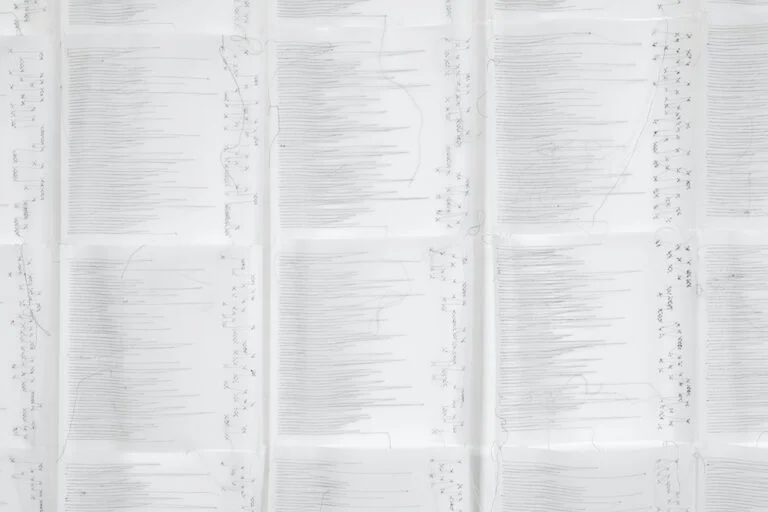
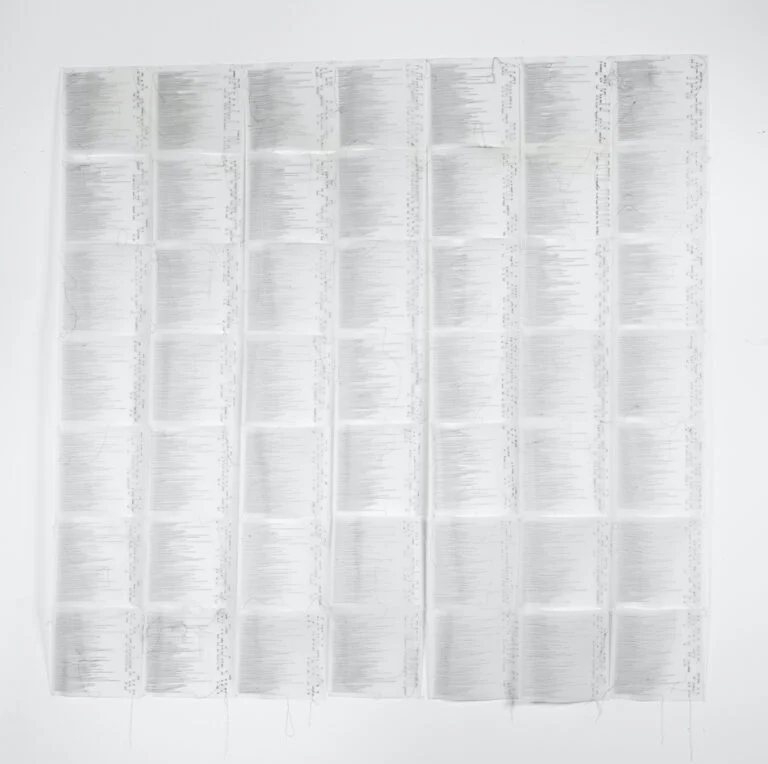
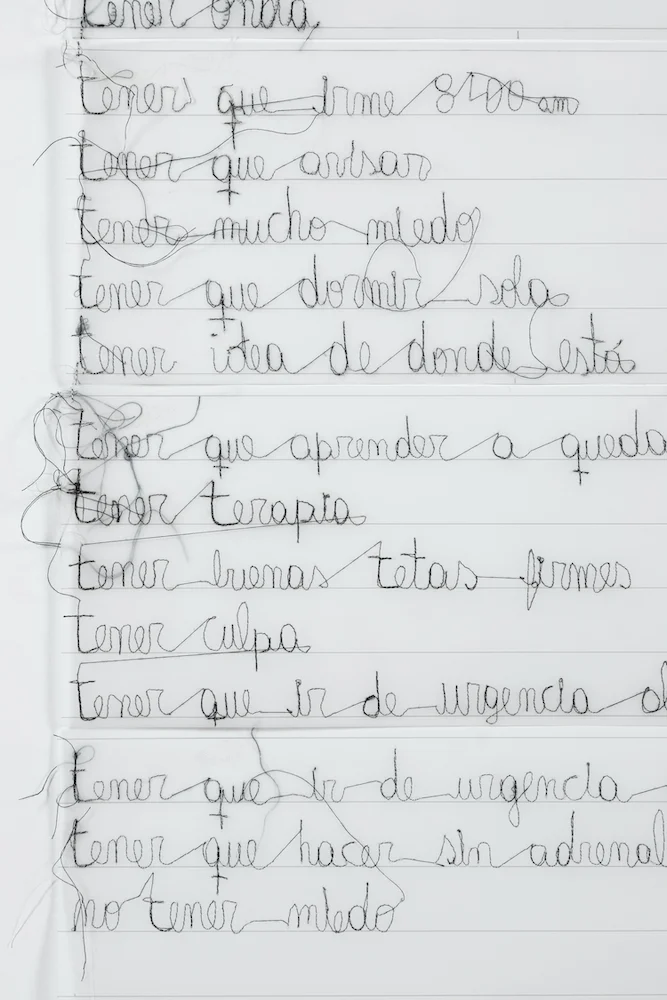
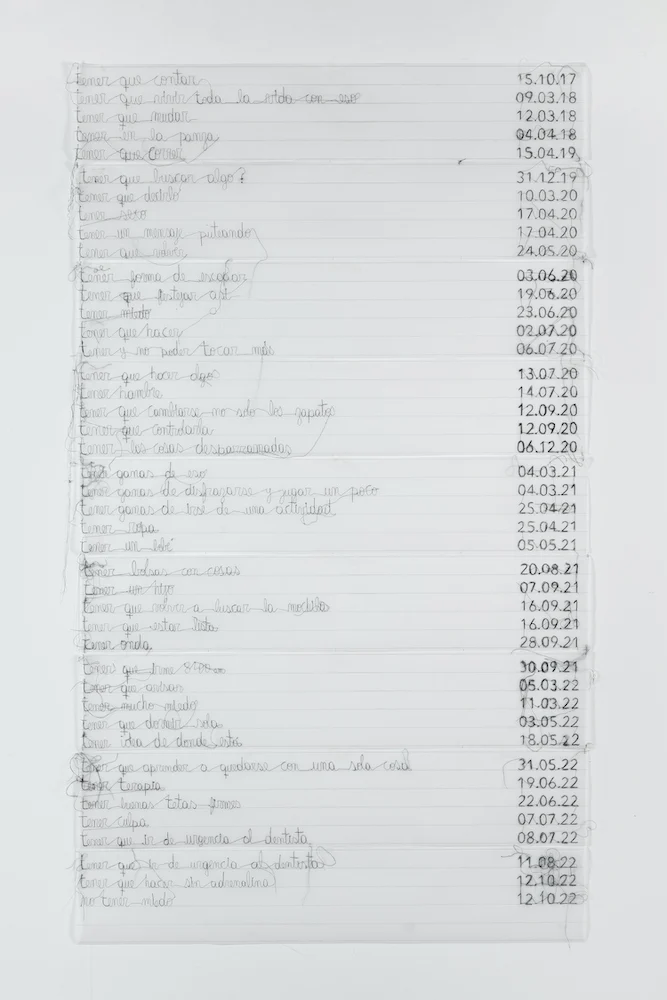
Sofia’s artistic practice is grounded in the two trades that makes her formative journey: psychoanalysis and sewing, which have led her to delve into concepts such as repetition, variation, measurement, series, point, and cut.
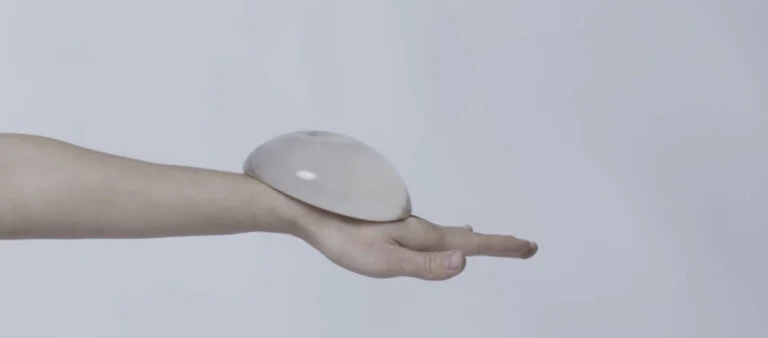
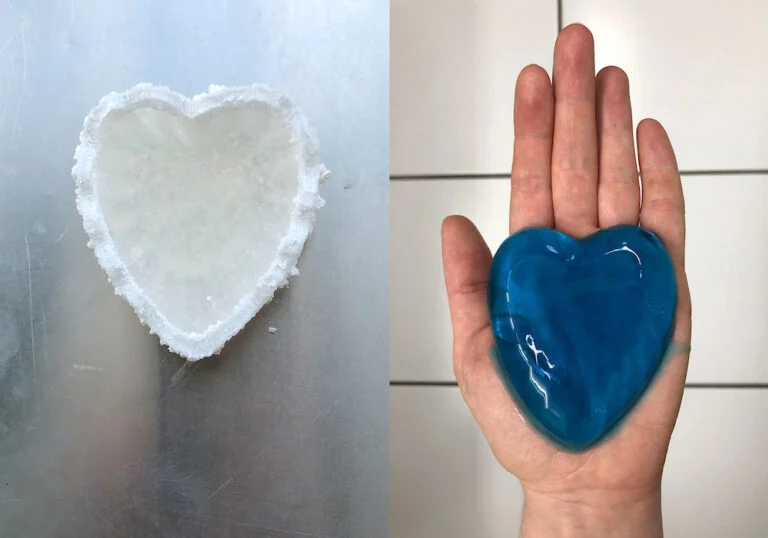
Her current research line is focused on dreams as archives and psychopathological diagnoses, as part of a project called dream x insight, which employs data processing, sewing machine as translation tool, and the creation of a website with artificial intelligence. She also investigates embodied memory in certain movements of the human body and in a specific object – unused breast prostheses – using video for recording and documentation.
Meet the Artist
What brought you here to GlogauAIR?
It was the residency. I was going to go to Leipzig for another residency, and then I learnt about GlogauAIR and then I decided to come here. I really love the city. For me it’s also really important to see a lot of art and different types, and there is certainly a lot of opportunity to see these kinds of things in Berlin.
I agree. I feel that everyone that wants to can explore and they can show their work in any place at any time, and there are so many great abandoned buildings which make excellent exhibition spaces.
Not commercial either, or elitist. It has been refreshing to discover somewhere free. I have realized I can do my things I really want to with my work.
How did you stop using the breast implant material?
I started quite a while ago. I have been collecting them for about 15 years .
My father is a plastic surgeon so I was in contact with them from a really young age, and they always called my attention, my eyes always wandered towards them. I asked my dad if he could give me the ones that are unused. The ones that I saw, and have collected, were always taken from the bodies of women who no longer needed them. They were seen as trash because people cannot use them again, but I saw this potential in them.
For a long time I just collected them and kept them in the box. Until a few years ago I started to get them out, to question what I want to do with this amazing material. It was a really slow process. I started by dissecting them and introducing some threads on it. At a certain point I was like okay, why am I breaking? I love them just the way they are.
So instead I started using video to register them. Capturing the movements they made and then I started doing little choreographies between some of them, and then placed them in water. Then in the human body to measure resistance and equilibrium. I started to be connected to them. It’s impossible to travel with them, they are really really heavy. So it’s a work in process all the time.
So your fascination is about video, because if it’s not about showing them, what is it?
No, it’s about being obsessed. I don’t know if fascinated is the word. I’m really attracted to the material. For me, they are preachers, they are invertible creatures. And I’m really attracted to the material and not like plastic surgery.
So It’s more about the materiality
Yes, my interest is in taking a material from its complexities. They are traditionally part of plastic surgeries, but they can be something else. When you video sometimes this becomes more apparent, and it has been amazing to see the materials outside their traditional role.
You’re interested in exhibiting them in a way and taking them out of their context?
Yeah, of course,. they are oppressed if they are left unused. I want to extract the material and use it in a way that allows it to be productive.
Does it interest you that they were in a human body?
Yes, and the fact that these materials were alive.
It’s really interesting, because I have a lot of questions about body memory. Objects have body memories. For 20 years these materials are inside the body. I am interested in what they get from there, for so long they were in contact with neurons, cells, and blood. They were all the time in contact with these basic bodily things. So for me, they are suspended in a kind of bodily choreography. I like to think about what they get from the body and somehow capture this is how I use them outside the body.
I guess that kind of goes into your work with dreams?
Yes, that really goes into it for me, it’s really connected.
How did you kind of get into investigating dreams?
I really got into dreams when I was really little. Some months ago I found a text I wrote when I was 11 years old called dreams. It was a text on which I put dream examples and tried to justify why that was a dream and not a wakeful state. I was playing the dream detective. So I think it was born really early.
Dreams can be quite surrealist?
Yeah, and I was really investigating this at the time. I was interested in hearing the dreams fro other people. Then I started studying psychology, I think, because of my interest in dreams. I really like to take note of my dreams from a long time ago, and I still do this now. Every time I remember them, even if it is only one scene or two words. I take note of the date.
I have a really long diary now. Around 70 pages of just dreams.
Do you ever read them back? Yes,
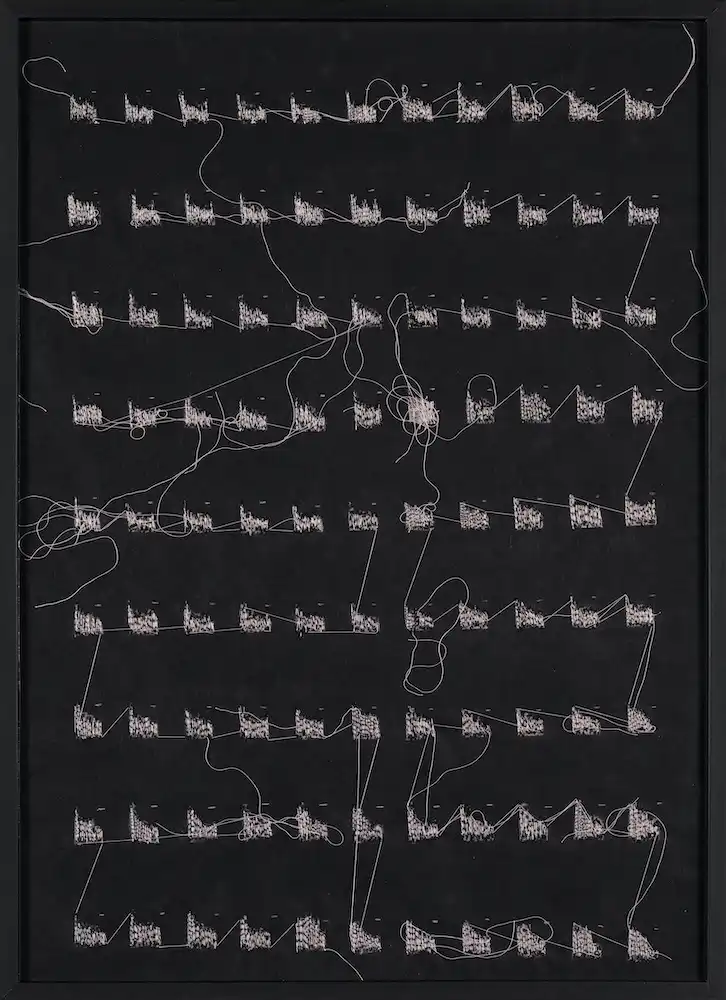
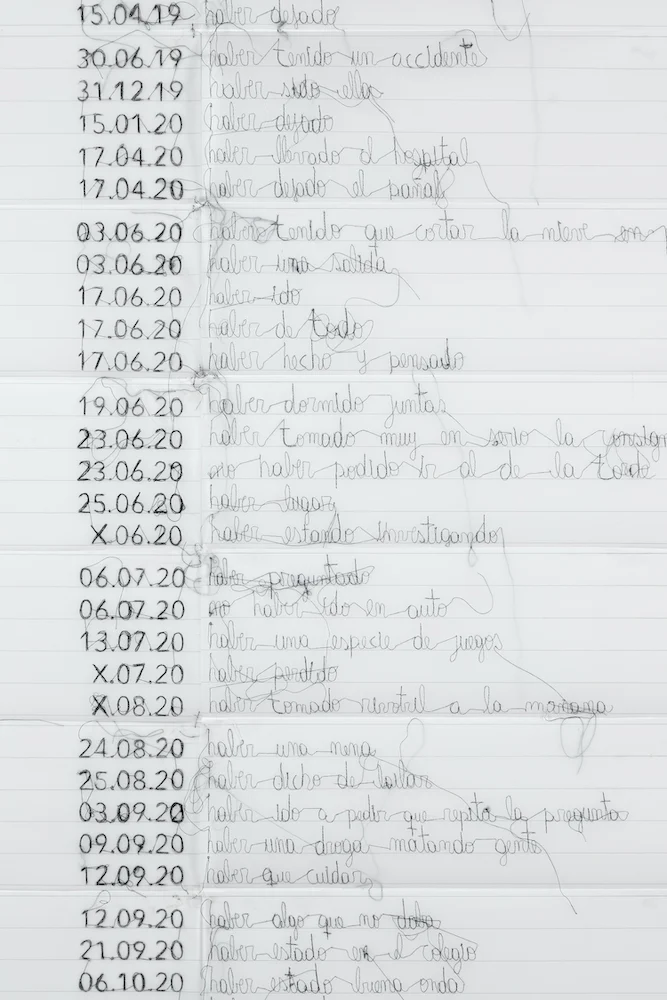
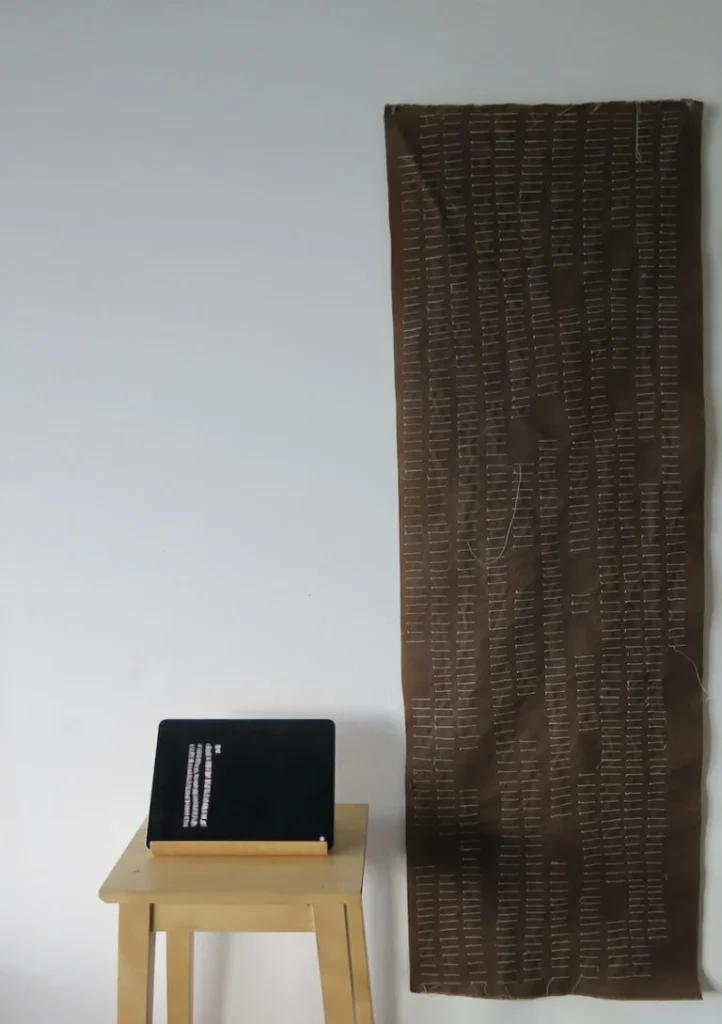
I have made a sewing work out of some of them. I would look at a page in my dairy, then articulate the most common verb I had used to describe a dream. Then, place those at the top of the piece and move down by concentration. The piece is called awareness.
How long did that take?
It was with a sewing machine. But it took me a long time. It’s three meters by two meters. So it’s really big. I like finding words and repeating. I’m interested in repetition, and the amount of time a dream is repeated between different people. This is also what the website I am creating is for, to track dream repetition.
I was quite interested in the dream website. You’re going to make it, would you explain a bit more?
The Dream Incubator, functions as a digital platform where people can enter their dreams and interact with them. Built on the repetition of words, the project aims to encourage the remembrance of dreams, their potential impact on us, and to create a collective archive of dream experiences.
You will have your user ID and password and You login and your space where you record your dreams. There are three ways to interact with your subconscious world. One is to extract a repeated word you like, then there is also the ability to throw the dreams you are exhausted with away. I am hoping to expand the interaction in the future.
So it allows you to play with your dream? Yeah. You people go on right down the dream they have had and then they can play with it?
Yeah. Then you have your dream archive, you have your diary organized. You will have information about the symbolism also. The idea is also aimed to generate a collective archive of ordinary life. A record of what people dream in 2023 compared to 2020 ETC.
I want to investigate Historic factors that happen using dreams, and bring new information on how different events affect the subconscious. Especially during events like COVID. I was listening to my friends, my patients. All of the words were new in 2020. I don’t know how these will then affect our dream scapes but I am interested to find out.
As you said, You did psychology.
Yeah, I studied and I worked five years in a hospital.
So how did you get into art?
I think I never went away from it. I studied fashion design for some years. I am also always doing textiles or art workshops. Then I started studying contemporary art through these workshops. So For me art is something that is always present one way or another.
And how did you move into more sculptural art, because you did a lot of textiles before
I don’t know, I think I’m just discovering something about my work. When I have an idea of something then I want to search for the medium of it. I realized sewing does not fit with all of my ideas. I did that at the beginning. I was passing my idea into the sewing machine. I have these interesting dreams. I realized I didn’t necessarily want to attach to textiles.
So then I started to ask what? What material do I need if I want to think about the substance in dreams, what they are made of? I don’t know. Maybe they are not meant to be made with sewing. They were more jelly things. Things that will disappear.
So you found a new material.
Yeah, to express an idea. Because they’re quite bodily. I was inspired by my breast material because I wanted to make some bigger and change some to smaller.
I started thinking about my dreams. Maybe I have repeated dreams, or a repeated dreaming sensation. Things get smaller and bigger all the time, maybe I wanted to remove something, or add two dreams together. The material of the breast prosthesis felt like something which could achieve this.
Do you sort of play with your own dreamscape?
Yes, now I started playing with my own dreams, in other ways as well that are not just based on words.
Yes, because sculptures can take different shapes.
For me, they are different shapes, because there are differences in dreams. They are subconscious landscapes which transform all the time. I like to play with that also. I was interested in what they are made of. Dreams are never the same. They are made of the same material, But they have different forms. I like to play with that person.
Because you’re also a psychologist Do you think that affected your work a lot?
Oh, yes. Especially my work in the hospital. I worked for five years and a half, and from nine to five in the hospital. So yes, it was a big inspiration for me. A sewing machine and being psychologists are both are big reference points.
Because I feel like dreams are very psychological. Some people think their dreams have meaning. I think you dream about things that you worry about.
Yes. In really cryptic ways. That’s like the aim of the webpage, to give to us or to give people an insight into something about the intelligence of dreams. To start really being connected with them because they are really important. They can save our lives. Especially If you hear them, and if you start to listen. Sometimes I realize dreams tell us things, then we have to respond to help us achieve happiness in reality.
Do you kind of analyze your own dreams a lot?
Yes, I like to talk about a lot of my dreams in therapy. And yes, it’s a big place I analyze because I think that they are more intelligent than me. So I started getting into looking at dreams. I’m not like analyzing it in terms of this means that. This is where repetition comes, it’s like, okay, what am I dreaming of all the time? I’m not so much interested in the symbolism, but more the core subject, and I think repetition really highlights the fundamental meaning of the dream.
This is what is telling you something.
Was it difficult to move into using sculpture? because obviously you did a lot of textiles based things. Was it difficult to move into using a new material?
Yes, it was. Sometimes I was like, Okay, why? Why have I decided to change this now?
Do you think you’ll go back to textiles?
Yes. It’s what I said before, I use videos. So for me, the medium it’s a way of transmitting something. It’s not like I’m married to one form of media. If I need a video because I want to hear a voice, I will use video. I always do things where I like to put voices on them or frames, if I need the voice, I need the voice. If I need the video because I want to register the best practice, I need the video. Maybe the video had more body than the materiality of sewing.
This material I use here, during the residency, is very bodily. I don’t think you can achieve the same with sewing.
I was interested in starting to think about materials and composition. I don’t also have this guilty consciousness about waste. With sewing, it’s a lot of thread,or a lot of paper. Why are we producing so many things, and why am I using so many things? Maybe if I fit some materials with less waste, but then it could take years. I’m really interested in using less material. `here is not a laboratory. So I’m dealing with this issue as well.
Does the inspiration behind this material come from the breast prosthesis?
Yeah, I was really searching. I try with different formulas to make the materials. And I was really searching for something that has a protective layer, but inside was more wet. I’m happy because I think I found something that is effective, and fits what I was looking for.
What are some key moments that have shaped your artistic career?
I think the one was when I was starting to do clothes. One of my teachers told me, ‘you are not interested in molding’. You don’t want to waste your time. You like to be using the sewing machine, but you are interested in literally drawing with a sewing machine. So you should investigate this. Everything you want to interpret, interpret with textiles. I realized, Whoa, yes, it’s true. So I started using the sewing machine to draw, not to make clothes but to draw in a different way. I was really into it. Then I started being interested in procedures implicated in the use of the sewing machine, and procedures implicated in the machine. So I started filming the needle and recording the sounds of the sewing machine repeating each stitch.
So you drew with it, but also made videos out of it.
Yeah. So that was already important. On this one also, because I changed material or material. Now I am open to that formula that it has become more a question of what media can I use to transmit this? If I need video, I need a video. If I need to use video. I don’t know, I never painted but if I need painting, I will use paints.
You started to see like, the art world is everything rather than just one, you’re interested in the concept. And material will fulfill the concept rather than having a material first.
But I really like materiality because it gives me a lot of things. It was like when I started doing this, I was thinking I was only going on to breast prosthesis. And then I started experimenting. I thought the threads could be thicker if I used another thing and then I got tied to it, and it gave me materials that started to give me new ideas all the time. I love that about getting into materials. They start to give ideas when I start working with them.
What are some key elements in your process as an artist
Maybe to be all the time thinking about it with something to write just like all the time for me it’s worth it and thinking of new ideas. On other subjects I think that it’s really important for me, getting into what materials and what materials can give me. That is really important in my procedure. To relate things. I work in the hospital and I started seeing electrocardiograms, which also became interesting for me.
I found some information about this paper, then I did some prints with the paper. Just getting information from different areas of knowledge. That is the most attractive and important thing in my work.
Do you think all your work sort of relates to dreams?
Not in an intentional way. But underneath I think they do.
How do you overcome moments when your creativity is not flowing? How do you resinspire yourself?
In making new associations, writing, participating in groups of artists to help me think about different things. I think I find more trouble on finishing words, not on ideas.
What is some of the best advice you have ever received?
When I am neurotic, ask why and for what reason. And then just to do. Something, anything, but just to do. From a tutor and Eva hesse.
Her artistic practice is grounded in the two trades that makes her formative journey: psychoanalysis and sewing, which have led her to delve into concepts such as repetition, variation, measurement, series, point, and cut.
Her current research line is focused on dreams as archives and psychopathological diagnoses, as part of a project called dream x insight, which employs data processing, sewing machine as translation tool, and the creation of a website with artificial intelligence. She also investigates embodied memory in certain movements of the human body and in a specific object – unused breast prostheses – using video for recording and documentation.
Dream x Insights involves designing a web page with artificial intelligence where people can enter their dreams, keep a digital file, receive results, and interact with them. The goal of D x I is to give dreams a voice and possibilities to act on us, pointing out that first, it is necessary to remember them. This project also involves its translation into textiles, with the aim of making it an electronic and interactive textile.
Object memory inventory involves registering and documenting the tests conducted on a specific object – discontinued breast prostheses – during the study of its corporal memory. The intention is to continue the investigation through video documentation and by creating a scaled replica of the object.
Installation and Video
CV Summary
EDUCATION
Hangar CIA Residency (2023)
Proyecto ACE Residency (2023)
Artistic workshop with Leila Tschopp (2023)
Belgrade Studio Residency (2022)
Material-laboratory of elements with Manuel Fernández and Agustina Triquell (2022)
Artistic practices with Lorena Fernández (2022, 2021, 2020)
Bachelor’s degree in Psychology from the University of Buenos Aires (2013-2017)
Fashion design at the University of Buenos Aires (2009-2012)
Studies in textile experimentation at Escuela MT (2013-2019)
Art clinic with Rosa Skific (2016-2018)
Art clinic with Andrea Moccio (2016)
Workshops in biomaterials, screen printing, cyanotype, sublimation, relief, and drawing.
EXHIBITIONS
Boomer, London (2022)
4th collective exhibition of women artists at Fusion Art (2022)
Ache de: cycle of artists (2021)
Highlife, Buenos Aires (2017)
OTHER ACTIVITIES
Creating Hilando. Creator and coordinator. Project of cross-linking health between mental and artistic practices directed at adolescents. Supported by Fundación Kaleidos/ Children’s and Action and the Mental Health Department of the City of Buenos Aires. (2017-2021)
Assistant to plastic artist and sculptor Celina Saubidet. (2012-2018)
Art installation with Celina Saubidet for Fuerza Bruta Japan (2017-2018)
Assistant to plastic artist Felipe Giménez (2013-2018)
Residency in Clinical Psychology. At the Dr. Cosme Argerich General Acute Hospital. Buenos Aires, Argentina. (2018-2022)
Taryn Kneteman is GlogauAIR resident from April, 2023 to June, 2023
I climbed the stairs to Taryn’s studio, situated on the GlogauAIR third floor. I was greeted by a mysterious tapping noise as water flowed through her world. I knocked and entered into her world of found objects, water, and mesmerizing reflections.
Meet the Artist
What brought you here to GlogauAIR?
Mainly friends. One artist I know, Annelies Kamen, did this residency. Yes. And then another friend from Edmonton. Gabrielle Paré moved here into a printmaking studio called Keystone Editions, when I came to visit her here in Berlin, I had a chance to experience printmaking as well.
So you have also done a printmaking course here in Berlin?
Yes, back in 2015. That was my first real experience of the city, but I was mostly learning new printing techniques. I wanted to come back, have a studio, be amongst other artists who are here to make projects.
How has Berlin nurtured your practice, if it has done in any way?
I think in the last year I’ve been consciously challenging myself to use more found objects. Things like furniture, old plates, cups, mainly domestic things. I’m kind of constructing a home. Like these light fixtures cover and the shelving of this car radiator. I want to combine things that are familiar when you look at the installations, yet also indented with this sense of subversion.
Do you want an element of familiarity?
Yes. Yeah, that’s then shifted by the videos.
Where did your idea for this piece come from?
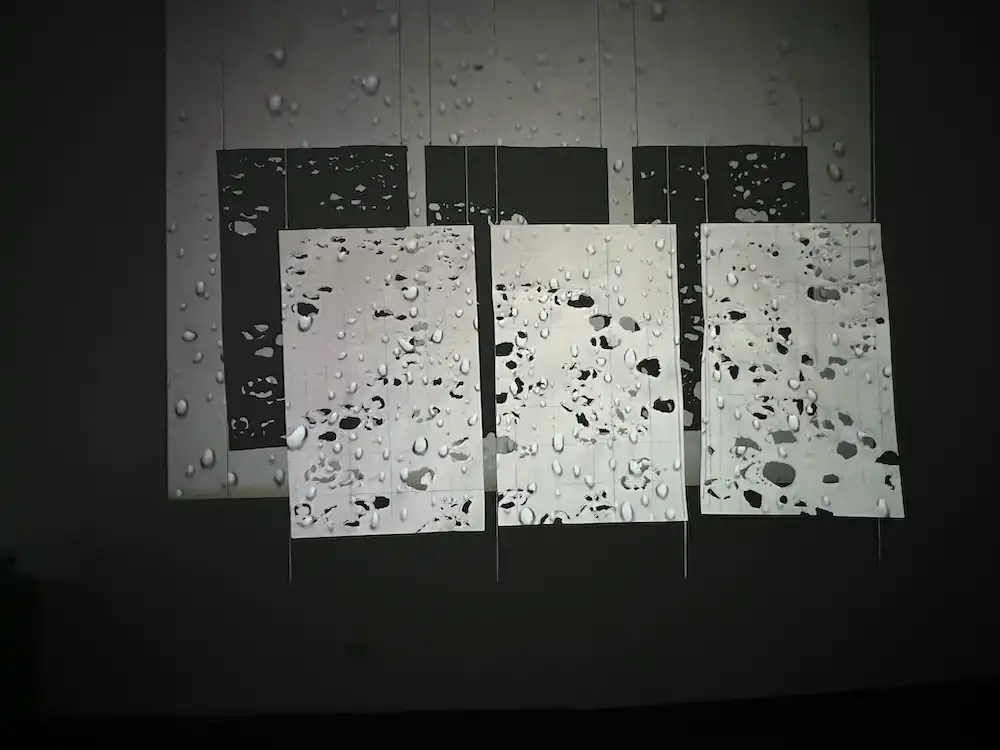
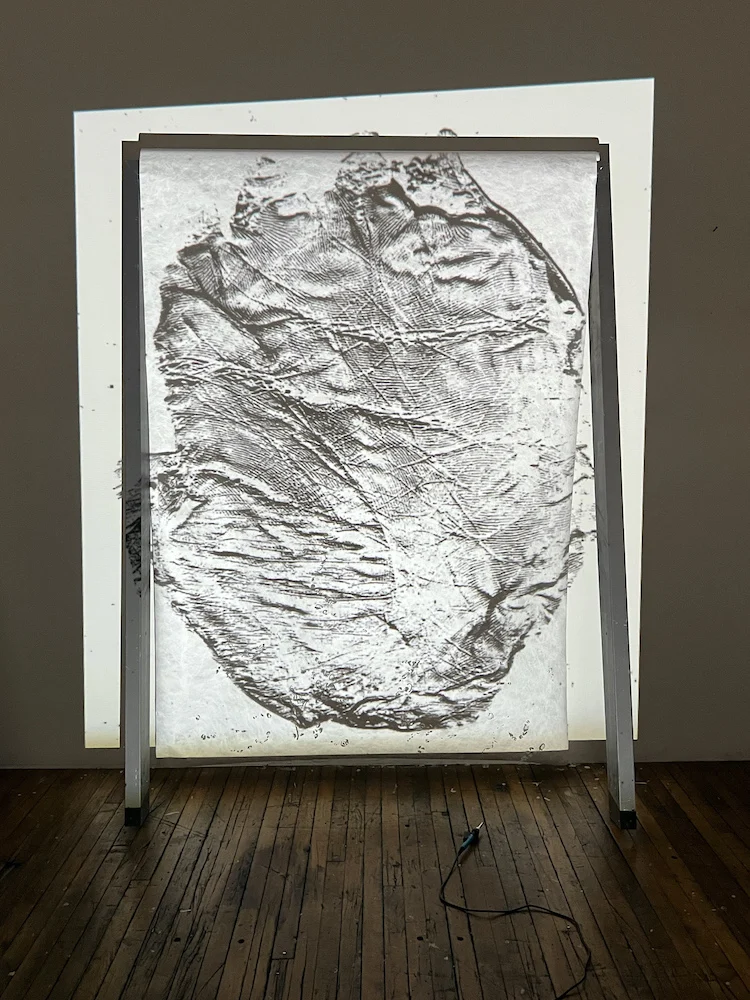
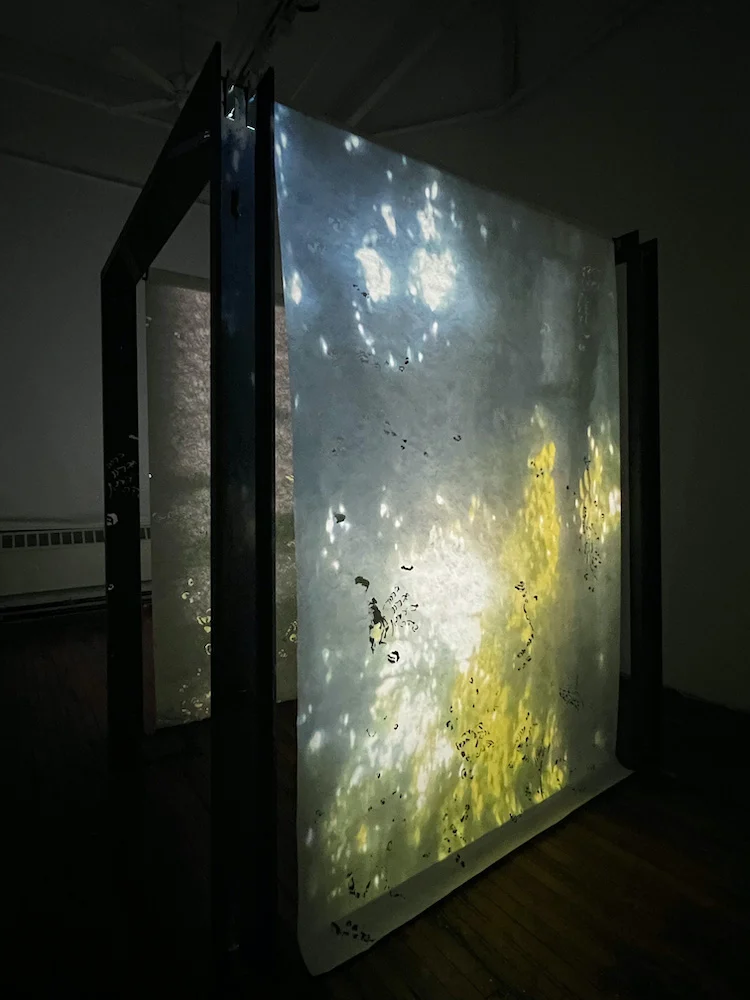
I made a previous piece where I used suspended paper. My transition to installation was projecting onto the paper itself. Tearing holes and experimenting with the projected light.
Which you developed when you were printmaking
Yes. There’s so much care taken with the surface of the paper in printmaking, and so much care to make this flat surface really have such a depth. I was feeling a bit claustrophobic, I think, in my person. I thought maybe I wanted to try and use all the different planes of the paper.
Then the video work is a way to use different layers in space, I think. And I was starting to use the paper because often when we watch a movie at the cinema, you almost lose your body and you’re totally immersed in the film. And then the projection surface disappears. But I want to make the projection surface have this tactile quality that makes you really aware that it’s physical. And that we are physical too.
Yeah. And this strong interest in water. And like that kind of substance? How does that fit in?
I grew up doing a lot of swimming. And doing a lot of water skiing.I spent a lot of time at lakes with my family. A bit of a bit of time, also in the ocean growing up. And so there’s a strong familiarity.
You think it started in childhood?
Yeah. The childhood familiarity. I love the feeling of floating in water, feeling that release of gravity and weightlessness.
With Water skiing, you get to move so fast across the surface of the water in a way that’s not possible without the speed.. So it really feels almost like a flying kind of feeling.
Why do you like working with it as a medium?
I think because it connects the exterior world with the interior. Through eating and drinking. And to me, it feels like a material that kind of flows through us. And connects us with nature.
Yes, and babies are suspended in a sack of water.
There was this artist who made this whole piece about l humans being related to the sea.
Yes, they are mini oceans, the amniotic fluid.
I think the idea of water and weather is really interesting. We observe it so much in the world. I like thinking about weather as a metaphor for emotions and physiological changes, too.
you did all those really cool videos, jumping on and off the chair. What do you do with those?
Those are new. I have studied dance for a long time. Ballet, jazz, and some contemporary movements. And it was very choreographed. And so now with the jumping and the falling, I’m trying to record them, and then use video to make a choreography of movements that doesn’t really exist in the world but exists in the video. My thinking is that I like doing pieces with projection and shadows, maybe using some silhouettes of movement in a future version of the work.
Or movements that aren’t only in the video, maybe someone is walking in front of the projector. But then it’s, there’s actually no one there, leaving the question of what’s actually happening in the real moment. It is very airy in a way.
Because In a way you’re observing this person. But you don’t know who they are? you’re kind of looking into their life, but they’re a bit closed.
Yeah. I’m interested in the feeling that maybe you’re inside looking out, but you could also be outside looking, that kind of duality.
Did you just find that blind on the street?
Yeah Another way that Berlin has nurtured my practice is that there are all these interesting objects lying around. It kind of feels like objects in people’s homes spill out onto the street a bit. Also the basement here at GlogauAIR is filled with many interesting things. So I think, for me, the unexpected items found have been a good addition to my work. It disrupts my routine or my original plan.
So you kind of didn’t really have a plan?
I had a plan. Well, sort of had a plan.
Sounds and stuff have changed, but I had an initial idea.
I want to make more of a narrative video piece about water and about tears. About a person who gives up their tear ducts to an object so that they can’t cry, or don’t have to cry anymore. But then the object takes on the pain. So I think that I’m still gearing up to do that, but have made some sculptures that are maybe the objects that are doing that. Like the last one. The radio antenna fountain.
Yeah. Because when it’s turned on, it has that really eerie sound. Constantly dripping water, which can be quite off putting in a good sea, works well running in here. Because when you hear running water, I think even though it’s supposed to be something natural. I think now when we hear running water, we think there’s a problem.
Yes. And it can be. I think this sound is very important, it reminds us and connects us to the world around us. I find it often creates a sense of nostalgia, especially with all these droughts at the moment.
Has the change in water here, and all the canals and stuff, and the frequency of rain here changed your relationship with water, and water movement?
Certainly. At home, there’s a river that goes through the center of the city. One main river that’s quite wide and the valley Banks are very steep. There are branches across it. But biking, you have to go through this big incline. And there’s a river valley park that’s quite forested. So it’s beautiful.
Here, it’s different. There are so many different little rivers and canals. People sitting right at the water edge. Drinking Radler or drinking a beer, holding the bottle. So I feel like looking at the bottles in the light is also a big inspiration for me. How they reflect light. Also looking at the water through the bottles creates this wonderful array of reflections. It was a big inspiration for this piece too. All the glasses and bottles left on the canal edges as well. They show that someone was there.
Yeah, the piece sort of suggests that there’s someone there that you’ve never seen?
Yeah, Often I think about how a chair is an object like an empty chair. It suggests the absence of a person.
Like an empty coffee cup. I guess that feeling of a lost memory. Or like a past life?
I think also, we learned that Chema Alvargonzalez lived on this third floor. And so I’ve been experimenting with the marbles, and glass objects. Also looking at his works with the open suitcases that have one side with a mirror and one side with a light box image. Looking at a lot of reflections using different materials.
You use this heavy kind of imagery of tears? Do you find them quite heavy?
I think they can be really beautiful. But they can also be very, very loaded. There is also this question of what empathy is directly based on. I think it can be violent sometimes too.
At the same time, I’ve been thinking about tears as a bodily fluid, but I don’t think they have the same kind of density as other fluids. If you see sweat sweat or hair or like urine or blood, there’s this revulsion where. It was inside the body that’s now separate from the body. It has disconnected from the self. It’s like this other thing, and it has this repulsive quality.
Whereas you don’t have that so much with tears.
No one really knows why we cried. In a way, they can be quite attractive.
They glisten. They’re salty. They taste nice. They do. When you see someone crying, you don’t feel repulsed. You automatically feel upset. And I don’t know, maybe not for everyone, but I think some people can find them quite attractive, and are attracted to that kind of pain or a kind of melancholic feeling they elicit.
I didn’t think about that. But they’re the one kind of thing that comes out of us that maybe we aren’t that repulsed by
Maybe it feels like it’s just the water cycle flowing through us, and that can be very beautiful.
You’ve talked a bit about your process. How do you work?
I work mainly by recording.
When did this video recording start?
It started 10 years ago, but very slowly. It kind of crept up over time, I often find something that I enjoy recording and then it becomes a seasonal thing. I’ll record it at the same time every year. Back home, there’s a certain shape of ice that happens the first week of November. I’ll usually go back and take a recording.
I now have this library of similar things happening across time. All these fugitive moments. Usually this happens outdoors and then in the studio, I’ll record more meticulous setups with little sculptures that melt or change and dissolve.
How to start this process?
The sculpture making relates back to printmaking where you make a matrix, and then you can make multiples from that.
I think I wanted to create the sculptures as little actors in the videos. Thinking about them having a life. Especially in the series of videos that are set in an apartment, or set in living spaces that have a kitchen, bathroom. I wanted to think about the spirit of the objects.
There is also a depth to the human touch, how that transfers onto these objects as well.
What is your process after that?
So now it’s experimenting with projection. I want to make these installations where the projection can be experienced. From all different angles. It’s more immersive. I think my process here has been gathering lost things, and then also imagining things that were inside my own house growing up.
I’ve also started to imagine things that were in the backyard. I’ve been thinking a lot in relation to Berlin, because I grew up in a backyard that was like the one at GlogauAIR. Lots of Nature, a space that had wild trees. But then the grass was very, very manicured and cared for and that takes a lot of water. And it was this kind of outdoor oasis, very private. There are also all the parks here, lots of different members of the public moving through.
I’ve also been thinking alot about hoses and sprinklers. All that domestic infrastructure which makes up an artificial water system.
You’re also interested in dreams. I wonder where this inspiration came from.
Like with the tears, there isn’t a definitive answer to why we dream, but there’s a lot of thinking about it over time. And a lot of like power associated with dreams and a lot of wandering. I think I love them because they’re unexplained phenomena. And they can’t be forced.
They’re not fake.
There are objects and services associated with sleep, but they’re not monetized or capitalized on as much yet. They feel a bit free to me that way.
I’ve enjoyed reading about them as a collage where. The mind is putting these things together and then creating these worlds. It has these surreal juxtapositions. Personally I’m not so interested in unraveling the specific symbolism of dreams. But I am more so in an idea of them as an ongoing experiment.
So you like that authenticity?
Yeah, Because you can’t force yourself to dream. And they can’t be controlled. They’ve got a freedom that we can’t grasp.
I’m also thinking about how talking about dreams is free. I’ve had friends who have had recurrent, recurrent nightmares, so you can also be trapped by your dreams.
You’re not so much interested in the symbolism?
I guess I’m interested in how humans really want to find the meaning in all of these symbols. Here in Berlin, for the first time I went I did a tarot card reading.
And was it good?
Yes.
And was it like, kind of realistic?
I was in a group. And then I posed a question, then the person doing the reading, they interpreted the cards in relation to my question, it was a way of talking.
We’re doing it as a group because it was kind of a workshop situation. And so it was a way of talking through the question using the symbols of the cards in a way that we wouldn’t never have ever talked about without the cards. I felt like there was less stress just like talking together.
What kind of questions do people ask?
One was very, very direct and kind of practical questions about the person’s relationship and some challenges they were more work related.
It was a really open way of thinking and talking. I appreciated it a lot.
Do you keep a dream diary?
No, I don’t. I have a journal. But I don’t have a dream journal. I let them come and go.
I think we are meant to leave them. Your body’s trying to get rid of something, to hold on to that seems almost wrong
Your dreams happen in a private world. And it feels a bit wrong to chain it.
What one moment in your life has had a profound impact.
This is a really difficult question for me actually.
I started drawing when I was really young. And my. My aunt’s sister, Charlene Folkinga, was an art teacher. I did classes with her all throughout grade school. That’s how I learned to draw, I learned about color and how it was a lens to see the world through.
Going back to the question of the moment. Trying to find that moment, I felt a lot of stress about that. Because then I started to have these insecurities that oh, that means that my work is empty or like because I don’t have this defining moment, and maybe it still needs to come. But I guess I was super worried about that. But now I know it is not so important.
I think for me, it just flows.
I was just interested to know if someone had like, some people have that moment where they felt they were defined
True, Yes. I read one of the Haruki Murakami novels in which he was talking about being at a baseball game and like the crack. The crack of the bat, and then that’s when he realized that he needed to switch to be a writer. But I don’t know if I have had that. I’ve been thinking about it too, I guess maybe for me creativity is more an accumulation of small raindrops, that one big moment
We have reached the last question, what role does art play in your life?
I feel so lucky to be an artist because I get to learn a huge variety of things through the lens of projects and artwork. Many topics can be researched and be filtered into the work you create.
Art/ creativity is a vessel which brings together all my disparate, different interests and paths.
Taryn Kneteman creates installations with video, sculpture, and works on paper in which moving bodies and changes of state are momentarily suspended. Using tactile, process-intensive working methods that offer chances for unexpected intervention – from materials, weather, digital glitches, and feedback – she combines stretches of habitual routine with gestures of dream-like divergence. Her work considers the cyclical nature of seemingly permanent materials and reflects on the intricacies of their transitions.
Taryn has been a resident Artist at GlogauaAIR since April. She is based in Edmonton, Canada. To find out more about her work see the links below to her website and Instagram.
Taryn Kneteman creates installations with video, sculpture, and works on paper in which moving bodies and changes of state are momentarily suspended. Using tactile, process-intensive working methods that offer chances for unexpected intervention – from materials, weather, digital glitches, and feedback – she combines stretches of habitual routine with gestures of dream-like divergence. Her work considers the cyclical nature of seemingly permanent materials and reflects on the intricacies of their transitions.
Starting with the phrase lacrimae rerum (there are tears of/for things), I will create a video piece about tears as familiar yet difficult to translate secretions. The video will contrast naturally occurring tears with footage and research into eyedrop production. It will consider the movement of tears across the thresholds of inner and outer worlds. Filmed in my studio, living space, and among Berlin’s canals, the narrative will feel dreamlike – like transitioning between being above and below the surface of the water.
Installation, New media, and Video
CV Summary
Education
2012: Bachelor of Fine Arts, University of Alberta, amiskwacîwâskahikan / Edmonton, Canada
Exhibitions
2024: (upcoming) Art Incubator Gallery, Harcourt House, Edmonton AB
2021: The Scene, curators Lindsey Sharman and Danielle Siemens, Art Gallery of Alberta, Edmonton AB
2018: Breathing, Antimatter [media art], Victoria BC
2017: for the time being, curators Peta Rake and Kristy Trinier, Walter Phillips Gallery, Banff AB
2015: After Aurora, Intersite Visual Arts Festival, Calgary AB
2015: Everyday Rituals: survival tactics, SNAP Community Gallery, Edmonton AB
Residencies
2022: International Studio & Curatorial Program, New York USA
2017: Public Art and Social Practice Workshop Series, The City of Calgary Public Art Program and Illingworth Kerr Gallery, Calgary AB
2014: Re: Making thematic residency, Banff Centre for Arts and Creativity, Banff AB
Yev Kazannik is a visual artist whose practice primarily involves analogue printing techniques, sound, and wood. He holds a degree in photography from the London College of Communication (University of the Arts London) and worked as a commercial photographer for over 15 years, with his work appearing in publications such as the Guardian, FT, Wire, Wax Poetics, NME, XLR8R, and others. In 2019, Yev shifted his focus away from commercial photography and began exploring new analogue photographic processes such as collage, lumen printing, photograms, and more.
Yev’s work explores the human mind and its constructions, as well as the ways in which our environment and external elements affect our mental states. He uses exclusively analogue and camera-less techniques, often incorporating ready-made objects and reclaimed materials into his work. Yev’s art has been exhibited internationally and is featured in private and museum collections.
My art project delves into the concept of belonging, inspired by my own experience of relocating to a new city and country. By exploring shared architectural features between my home city and Berlin, my new city, I aim to create a body of work that reflects on how urban development and the presence of nature can affect our mental states. Through my creative process, I will develop a visual language that explores the complex mental constructs and connections that contribute to our sense of belonging.
As a visual artist, I am fascinated by the human mind and how our environment can shape our mental states. I strive to capture these nuanced and complex experiences through my analogue photographic processes and other mediums, utilizing ready-made objects and reclaimed materials to create thought-provoking and visually striking pieces.
Photography
CV Summary
Education
2005-2007 Photography | London College of Communications (UAL), London
2003 Campaign Photography | Westminster College, London
Selected solo shows
2022 Gravity that binds, GLS / London
2010 Selected Works Stroud Green Library / London
2008 Plastic People, Favela Chic / London
2007 46cm closer to heaven, The Very Good Room / London
2006 Heroes Now, DC / Kaliningrad
2005 Plastic People The Lincoln Lounge / London
2003 The Sky of London, Kyberda / Kaliningrad
Selected group shows
2023 The Immortal Week, Hoxton Gallery / London
2022 Visionary Projects, New York / Online
2022 Samsara (as part of 48 Hours Neuköln), FK-Kollectiv / Berlin
2022 Cluster Photography and Print, Oxo Tower/ London
2022 Final Show, Artele Residency, Finland
2021 Open Studios Show, BKN, Bjorko / Sweden
2021 Will We Ever Know The Meaning Of Objects, Gallery46 / London
2021 Apocalypse Biennale, Studio d’Arte Claudia Coròthroughout / Venice
2020 AOP Open, Association of Photographers / London
2020 In between, Kaliningrad Festival of Photography ФотON, Vorota / Kaliningrad
2017 The Hedge, Green Lens Studios / London
2013 Fuck Christmas, Hoxton Gallery / London
2011 Семь Я. Портрет – Автопортрет, House of Nationals / Moscow
2010 Krains Green Lens Studios / London
2009 Razz My Berries, Art out of a Gallery / London
2009 Luxury Goods – The Value of Art, Courtyard Theatre / London
2008 Portfolio, Association of Photographers / London
2006 Graduates Show, LCC / London
2006 Mini Print, ARTLINK, Centre for Community Arts / Hull
2005 Graduates Show, LCC / London
2004 The Art instead of Photography, Kaliningrad State Art Gallery / Kaliningrad
2003 Photomania, State Fine Art Gallery / Kaliningrad
Recognition
2022 Rock me, always, Anon magazine, Milan
2021 Pretty Red Dress feature film, unit photography/ London, UK
2017 Making Shapes Lighting installation / Glastonbury Festival, UK
Perfect Space / Wax Poetics, New York, USA
2016 Gost Dog / Bonafied Magazine, London
Victoria Centre Christmas Lighting Installation, Llandudno, UK
2015 Talking all that Jazz, 22a / Bonafied Magazine, London, UK