Archives: Artists

  • Jacqueline Huskisson

    Jacqueline Huskisson

    Jacqueline Huskisson is GlogauAIR resident
    from October, 2023 to December, 2023 and January, 2024 to March, 2024

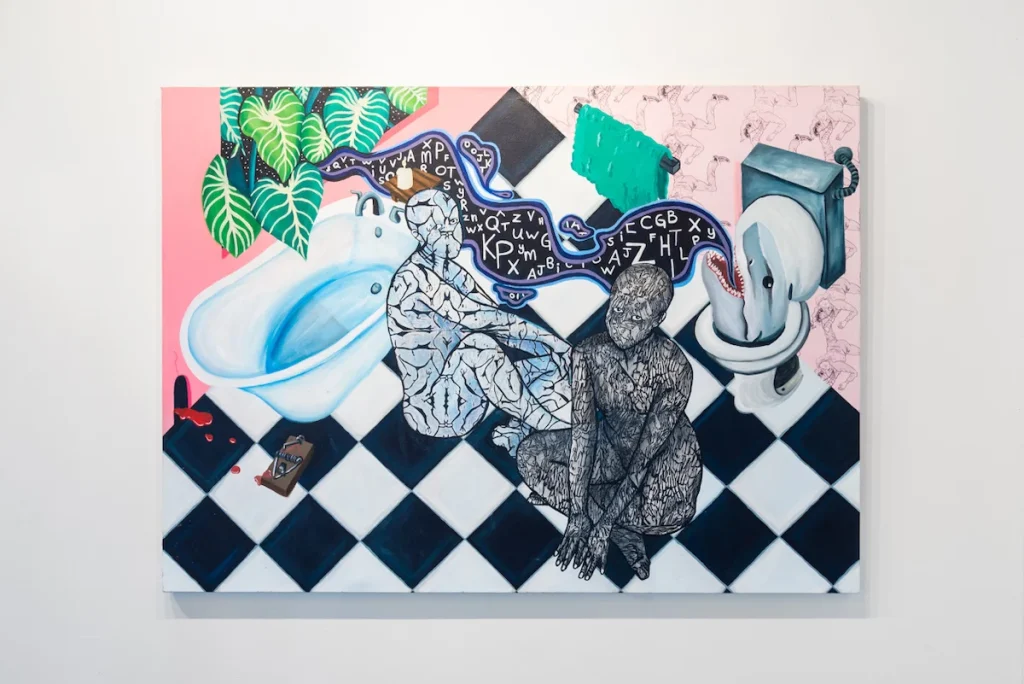
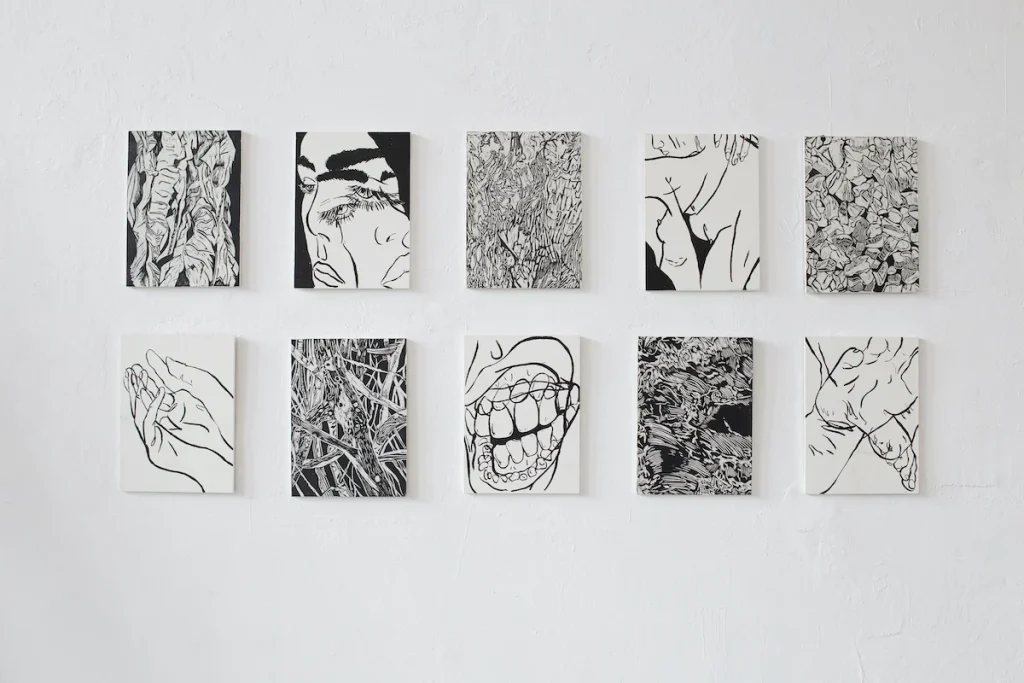
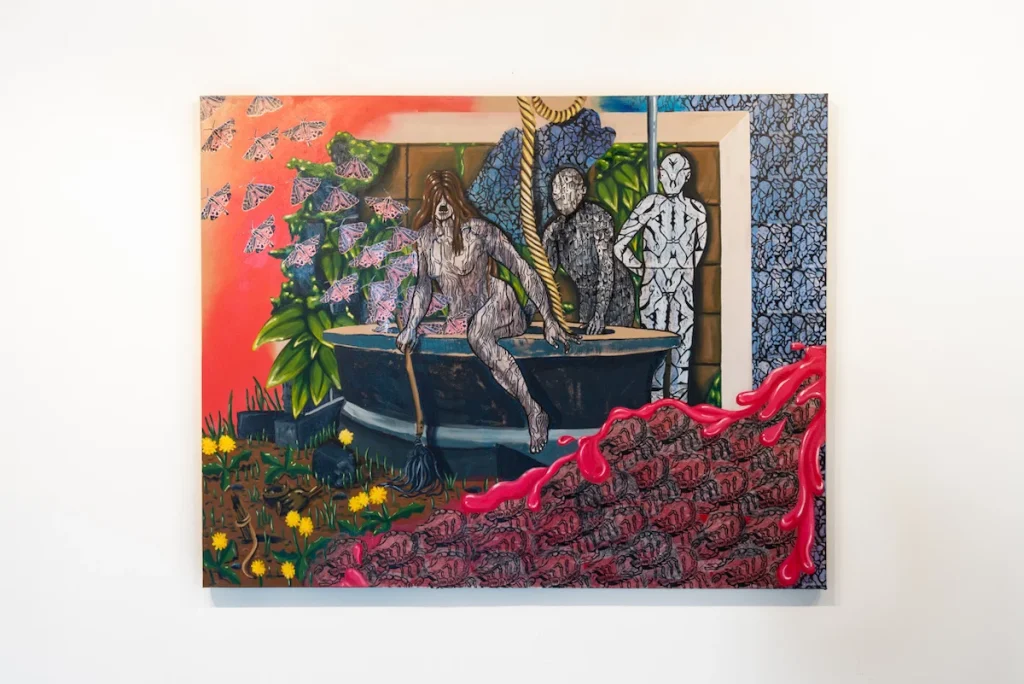
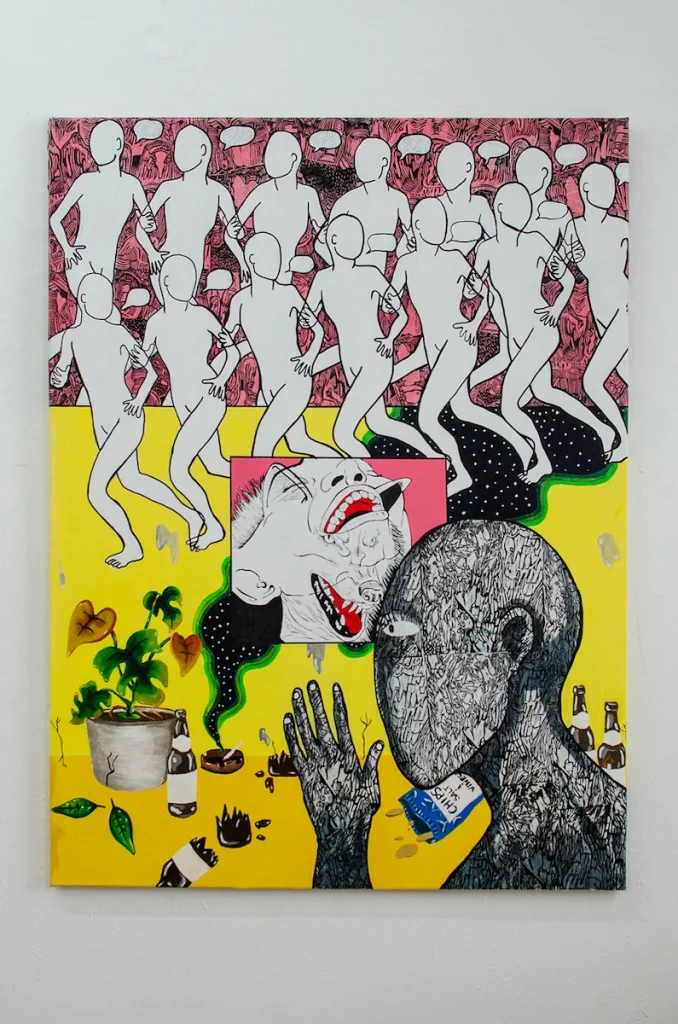
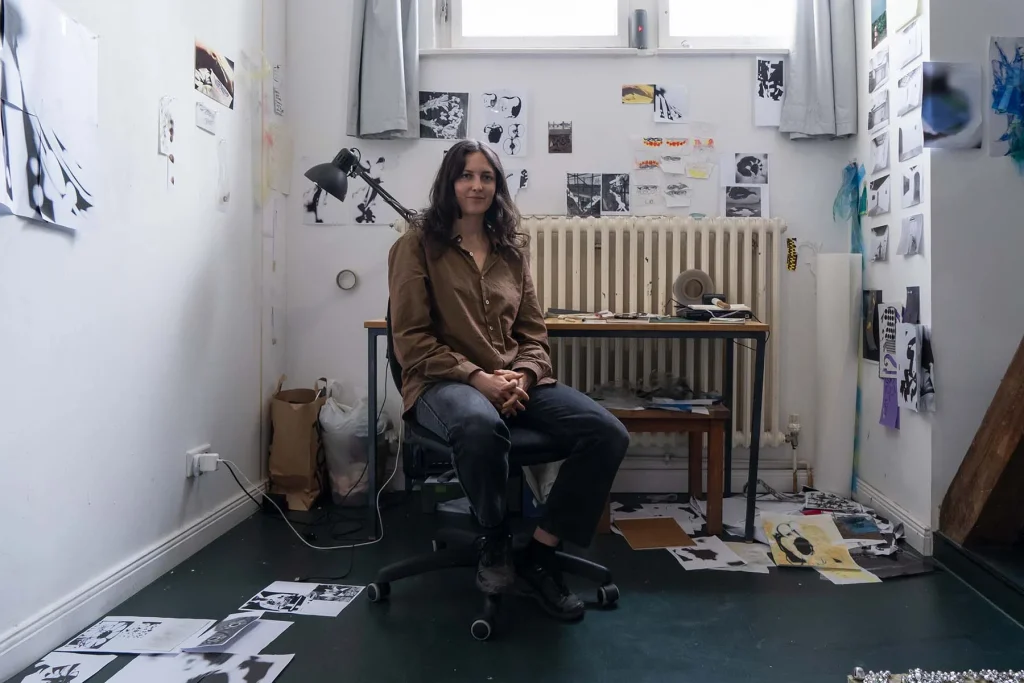
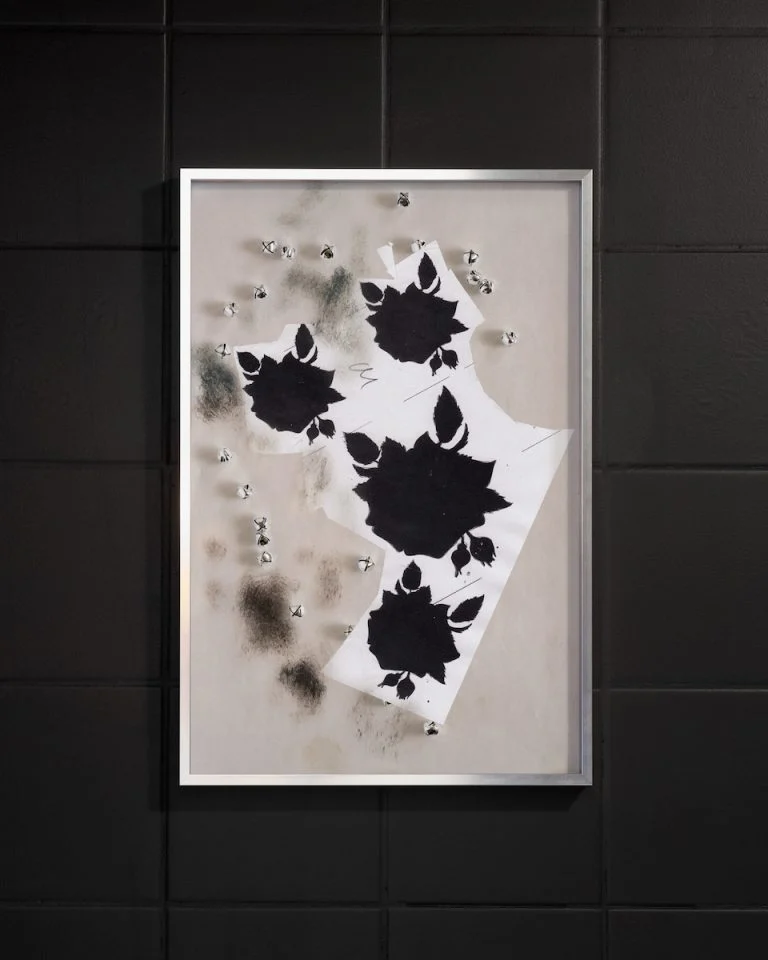
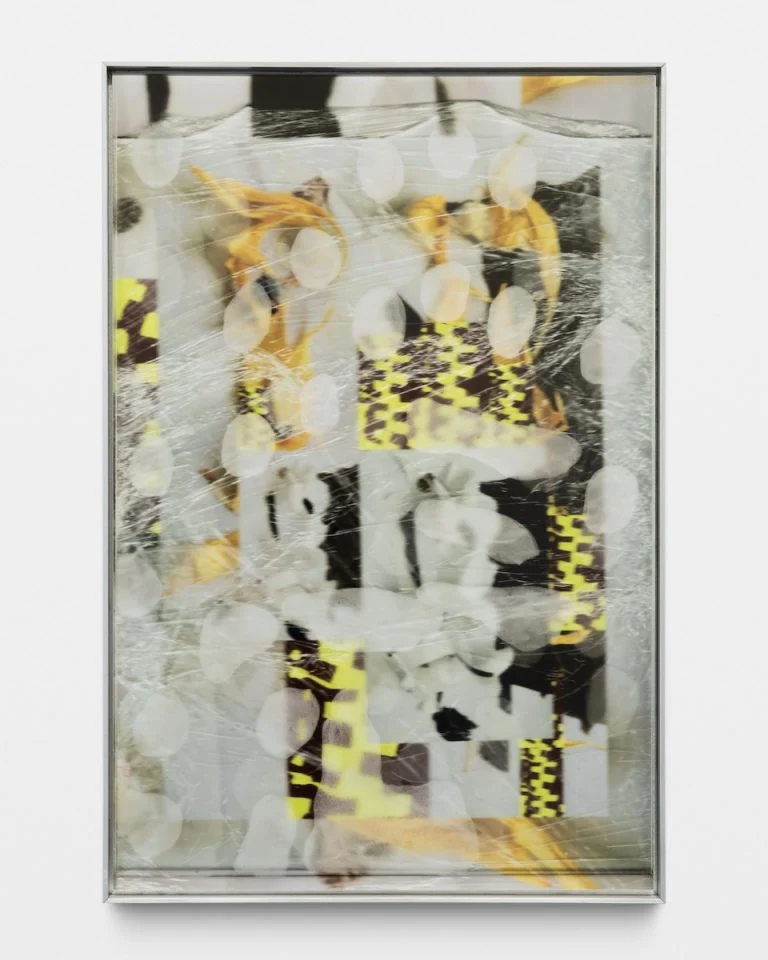
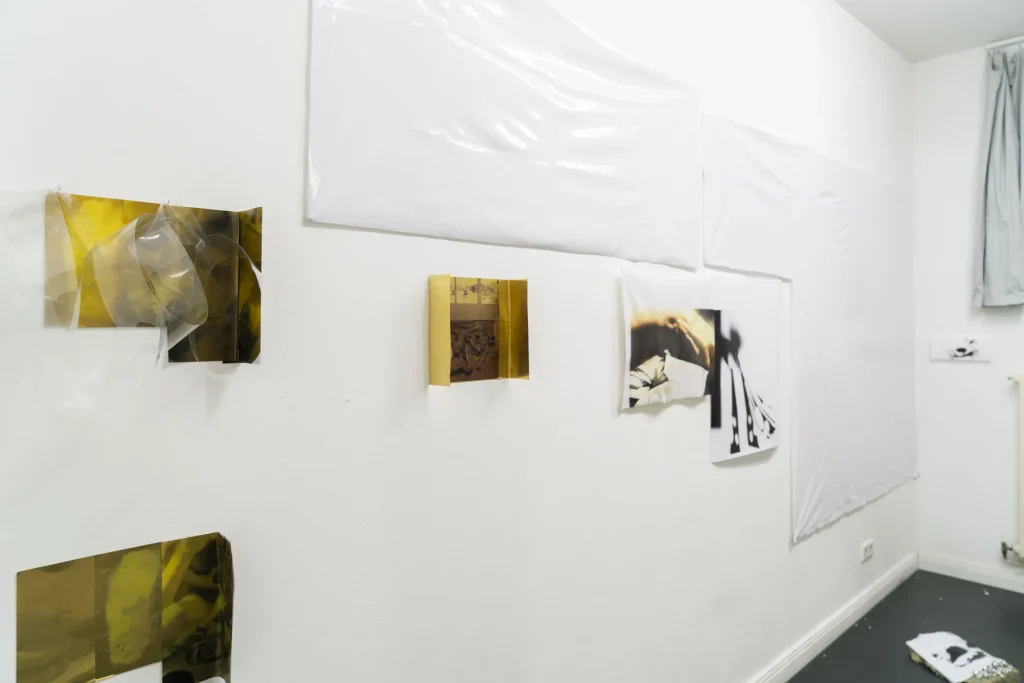
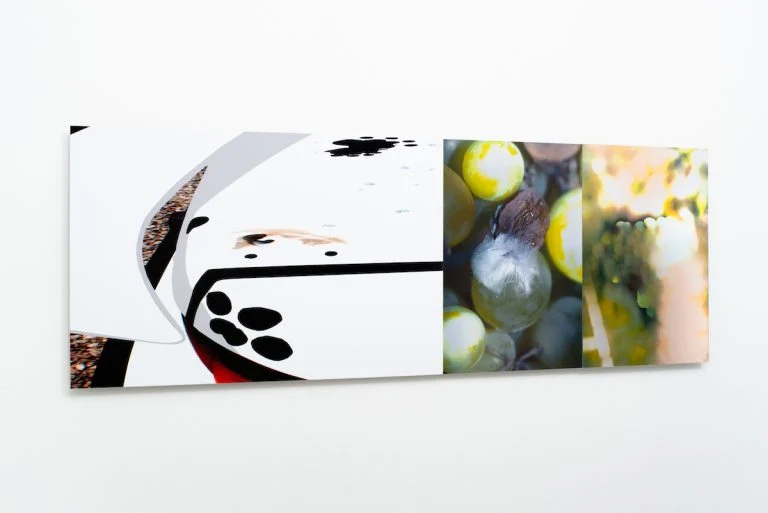
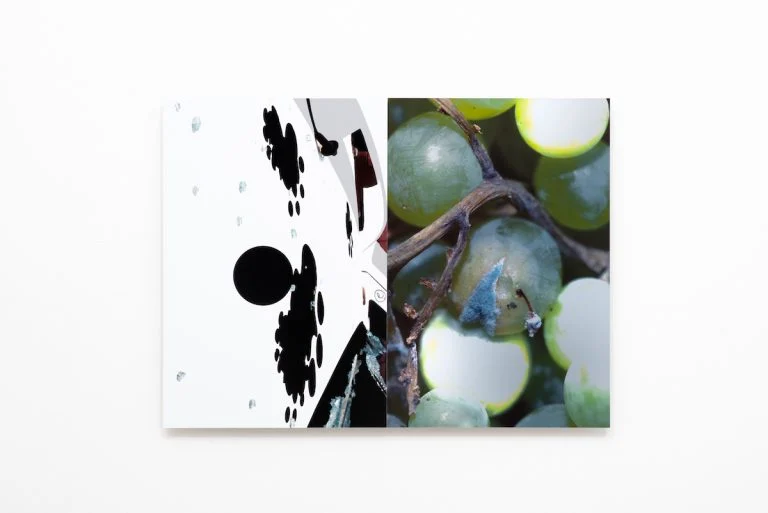
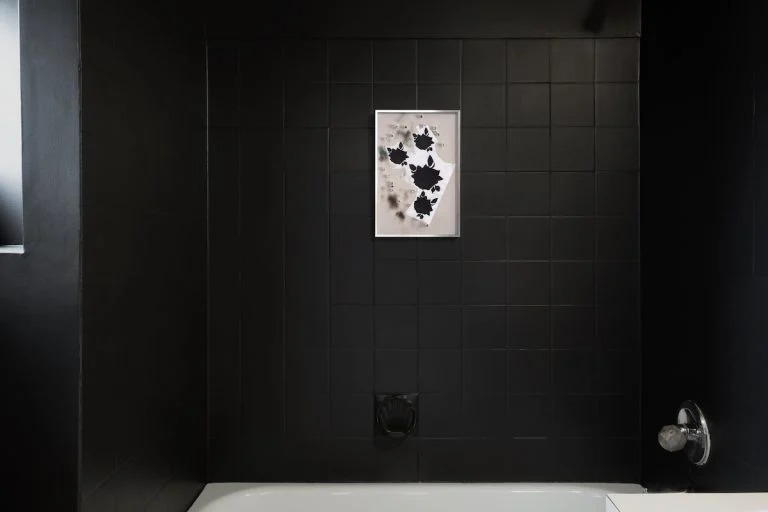
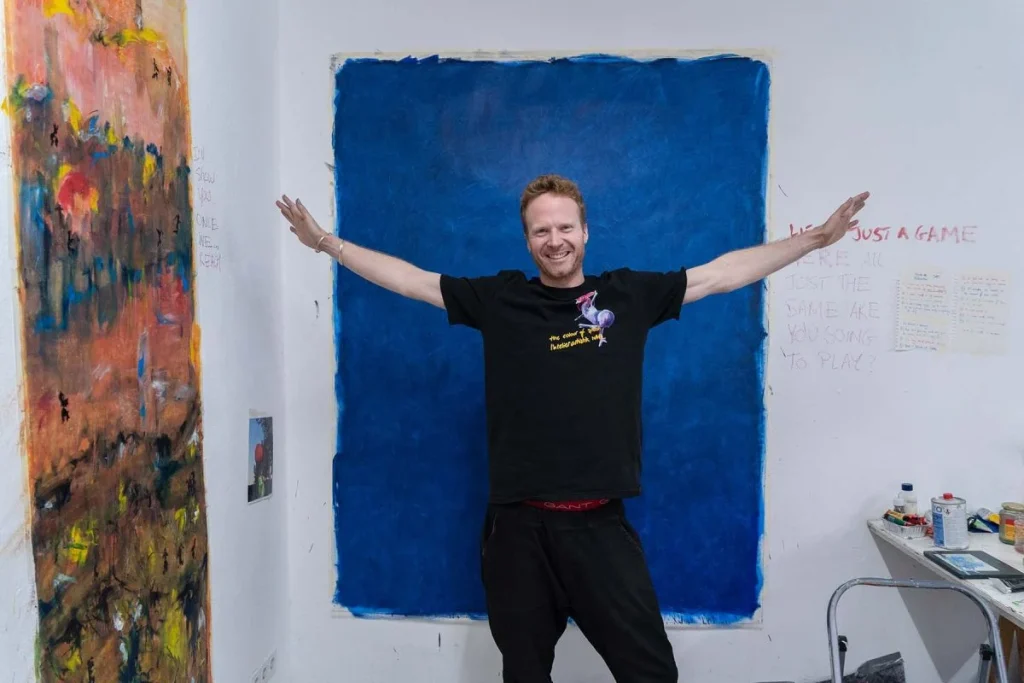
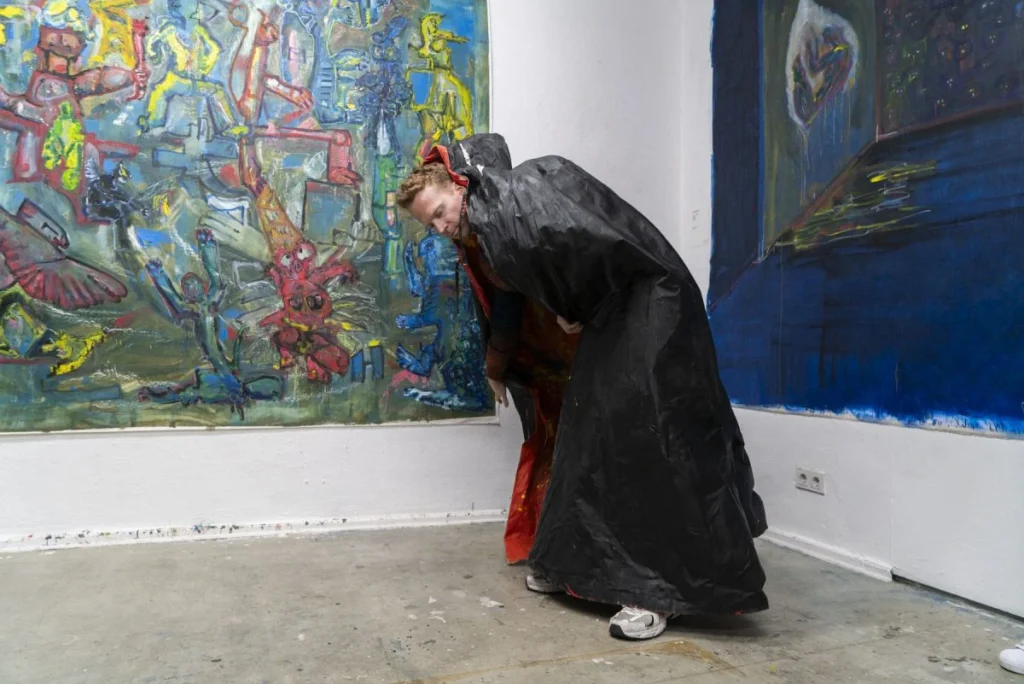
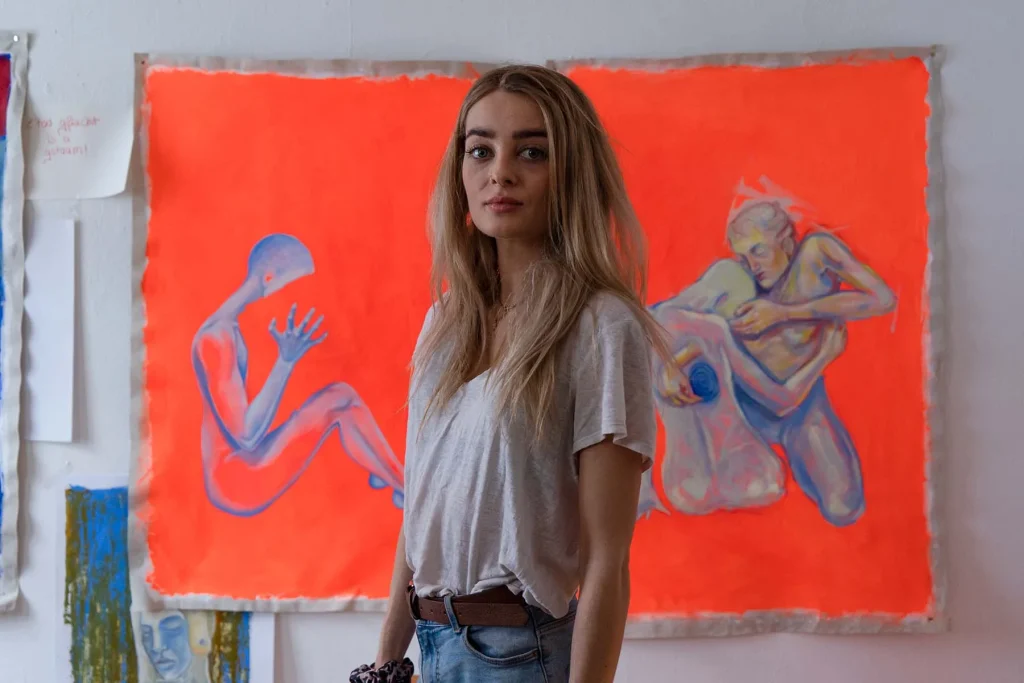
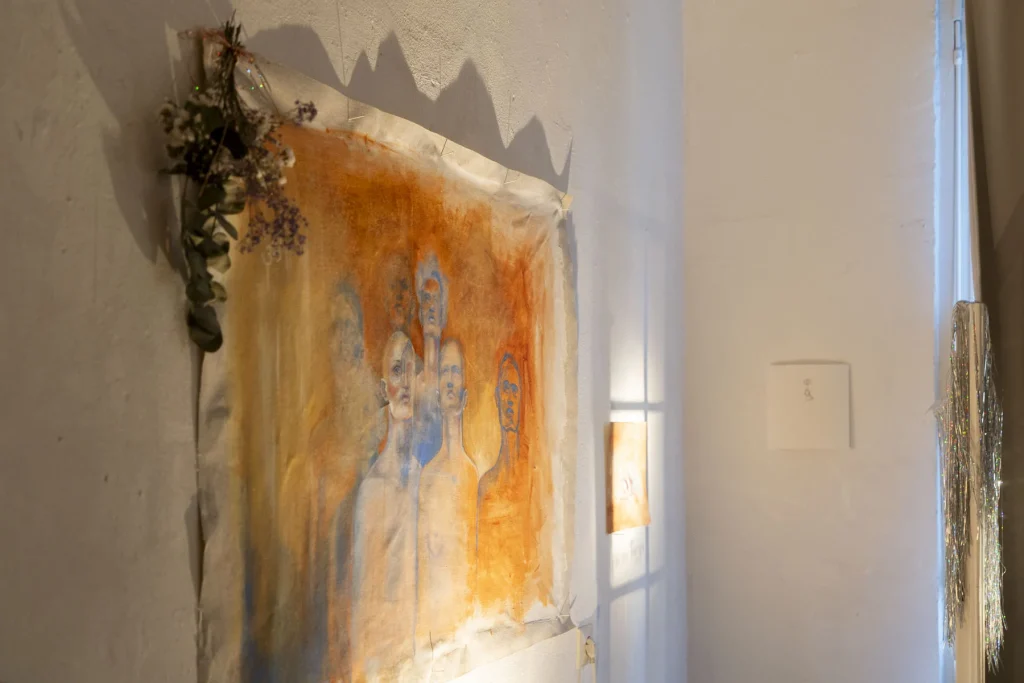
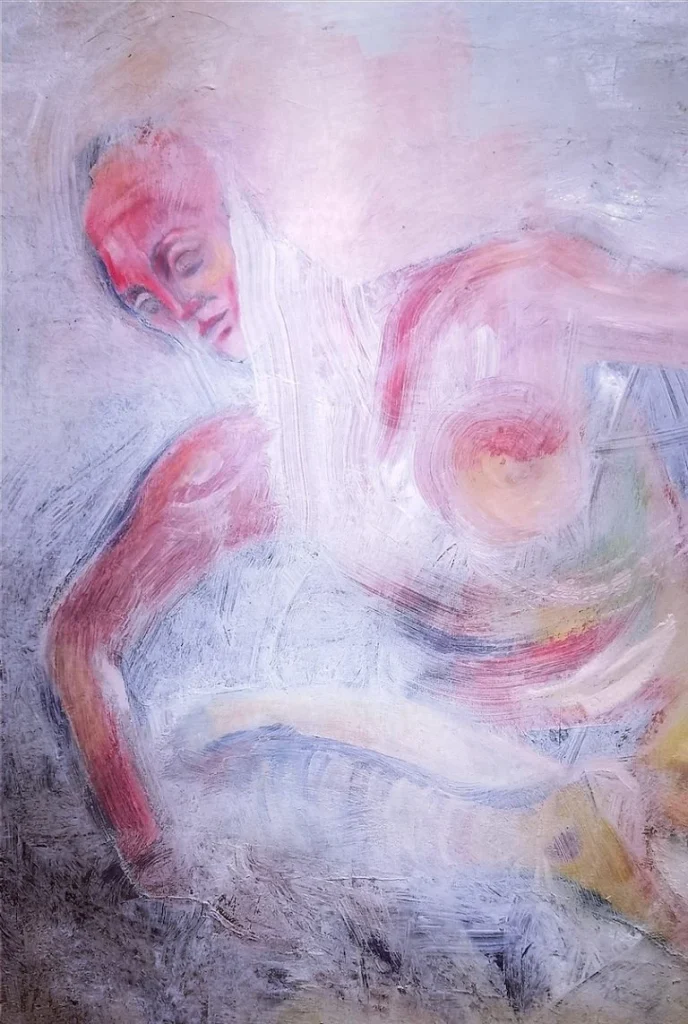
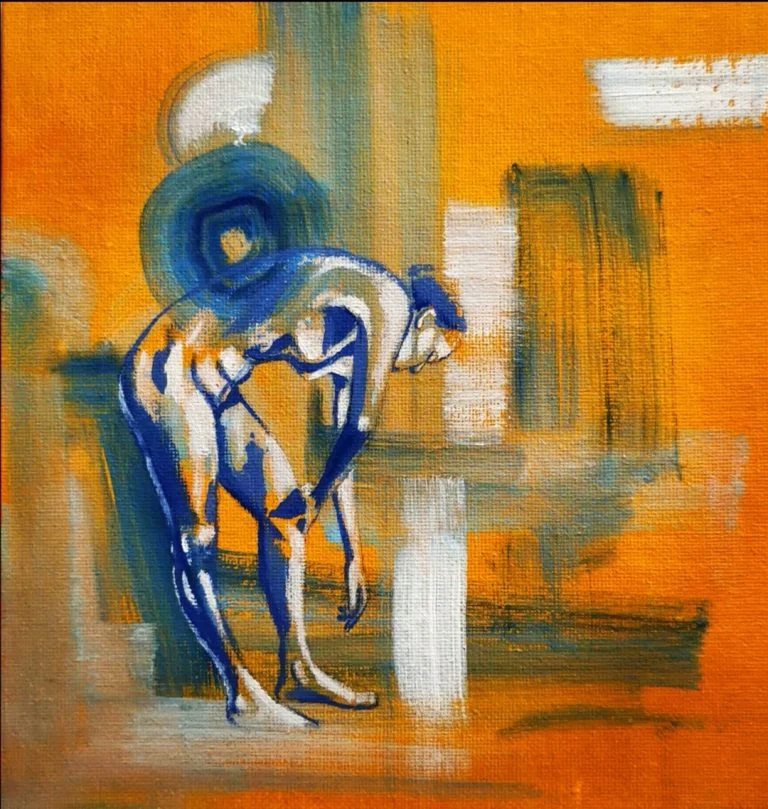
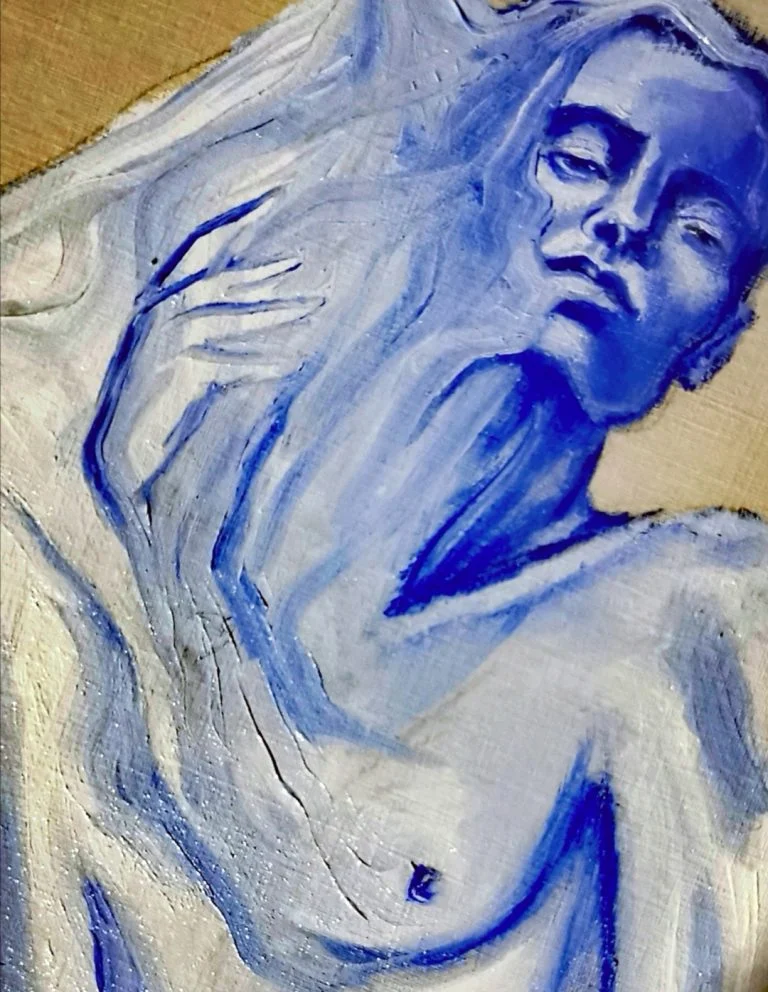
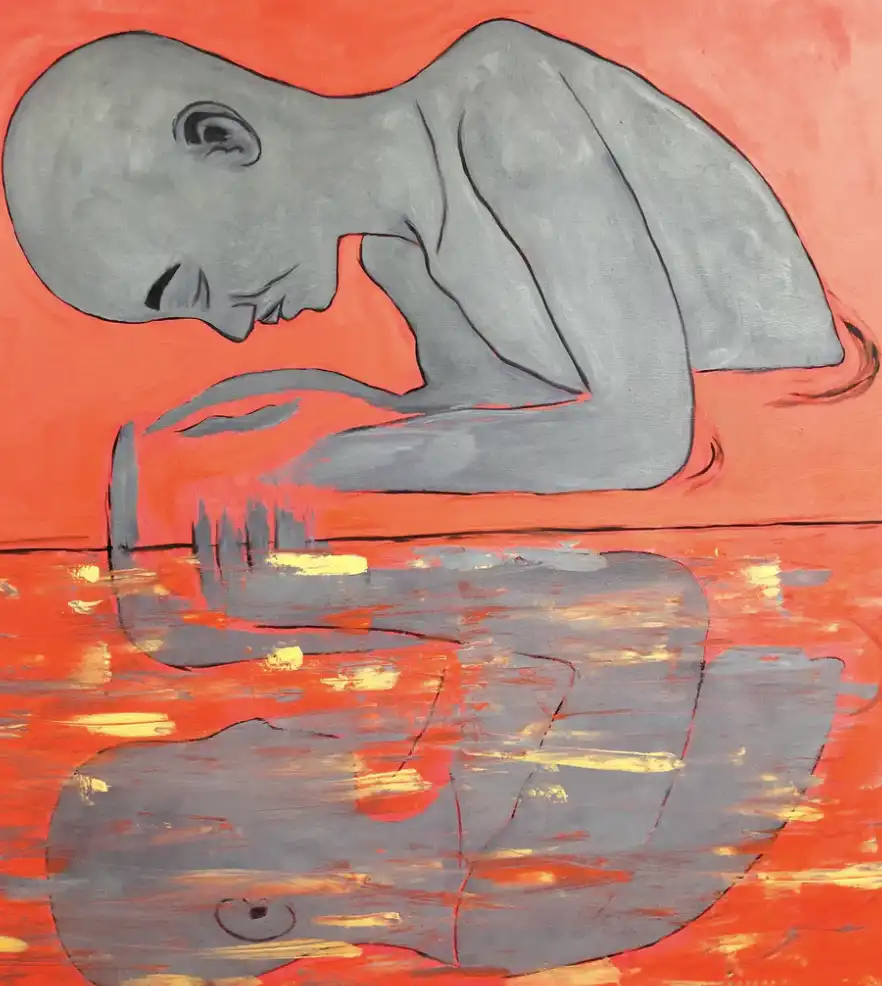
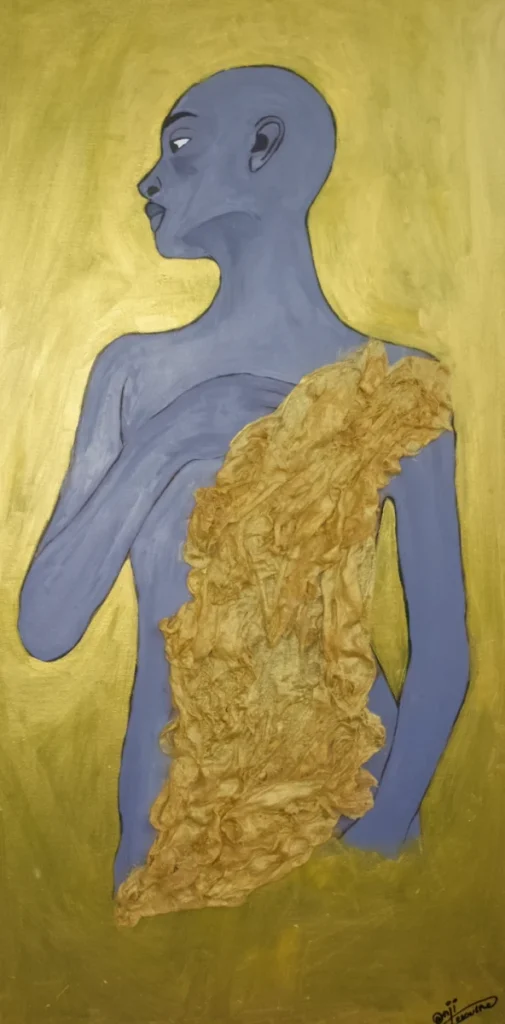
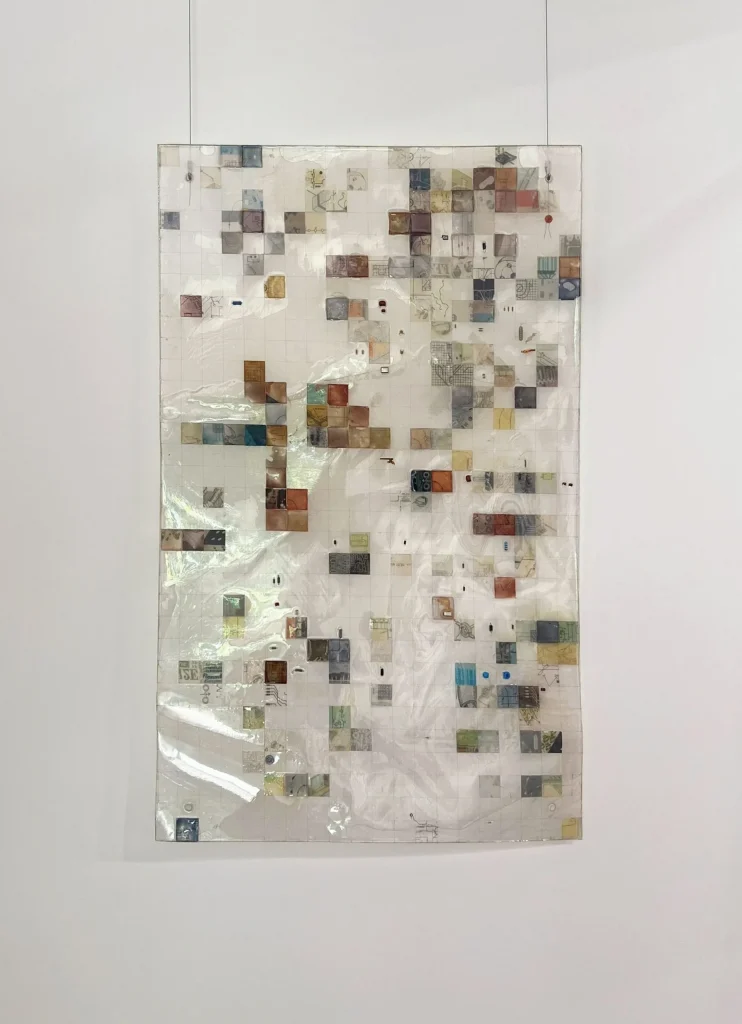
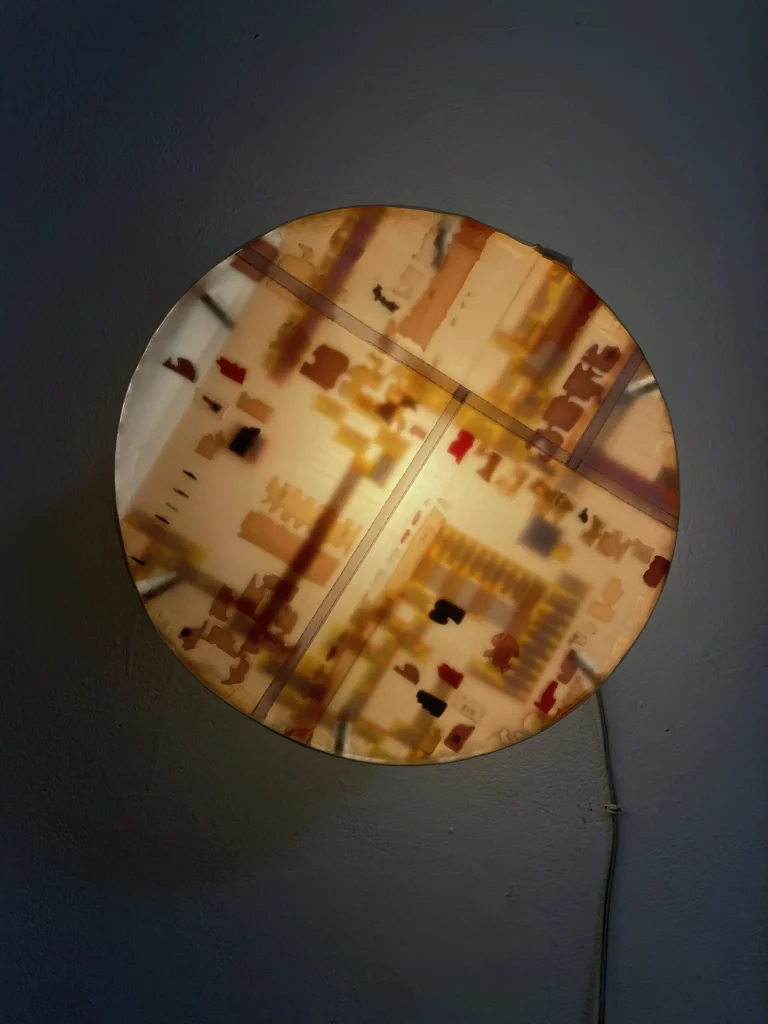
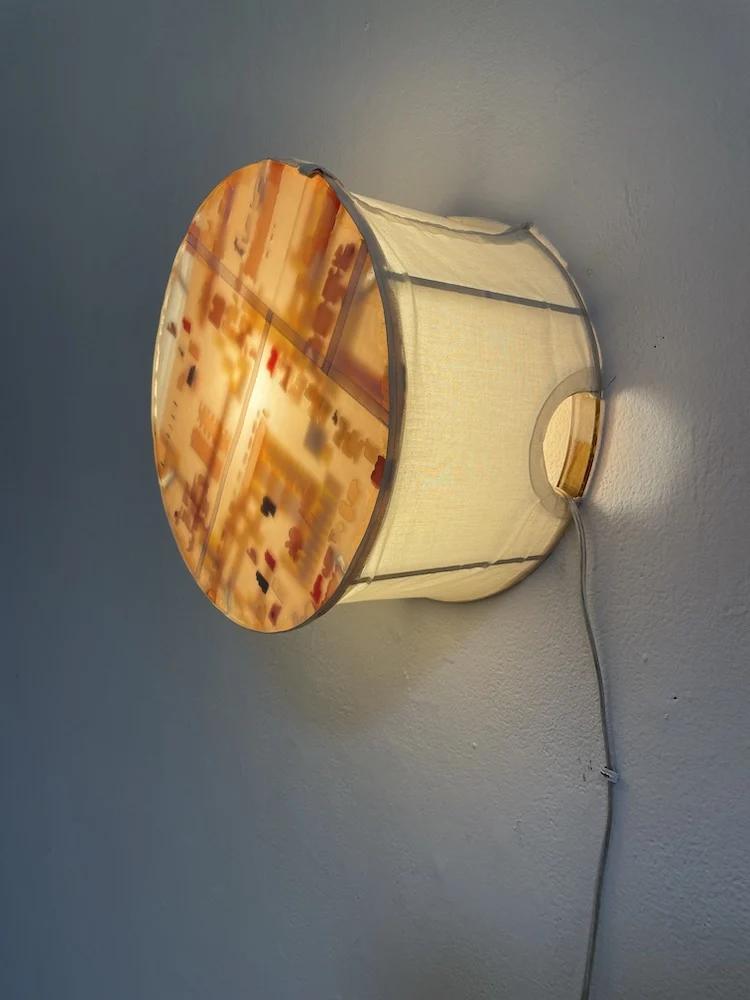
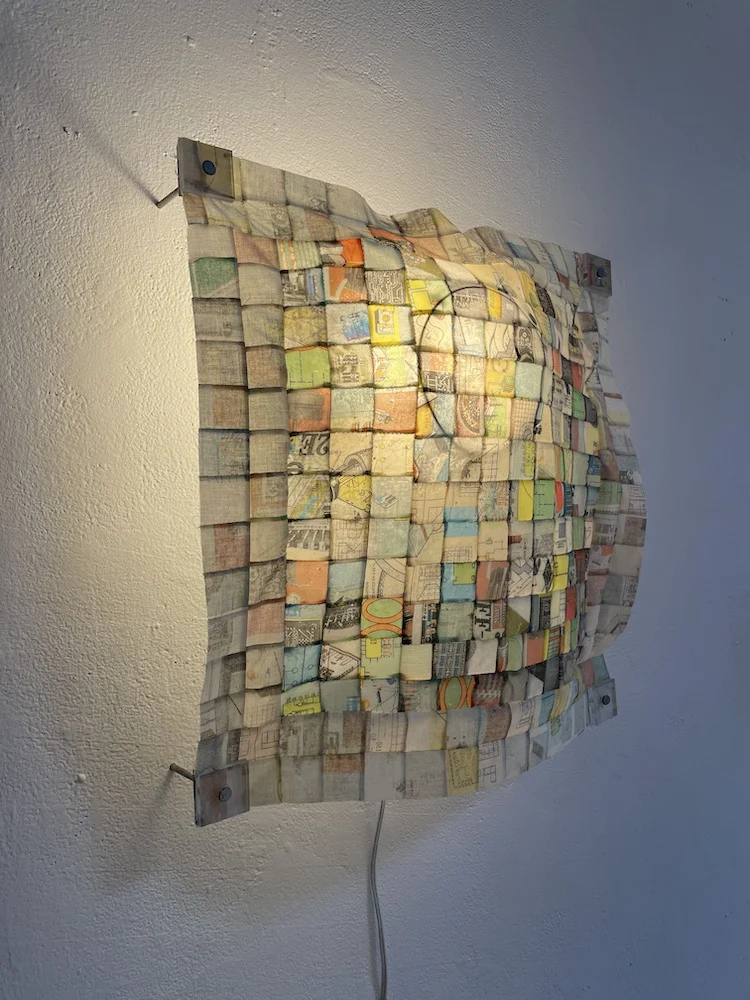
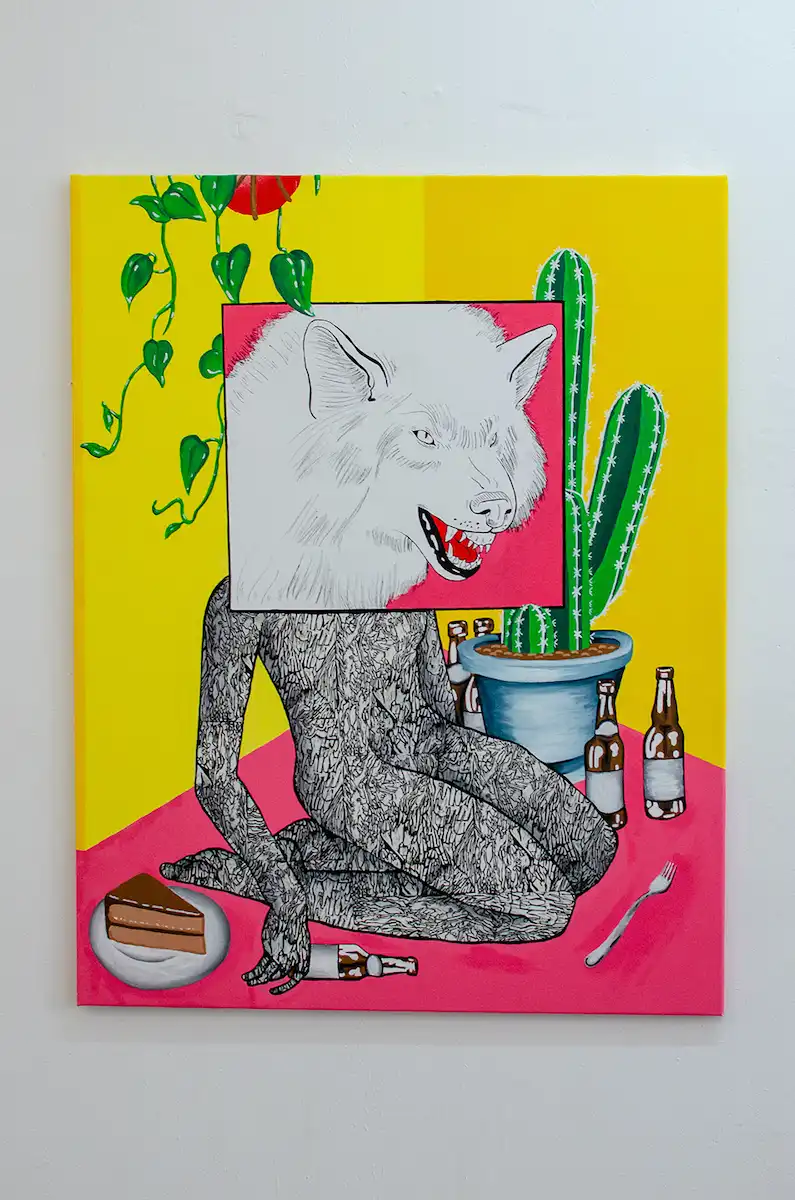
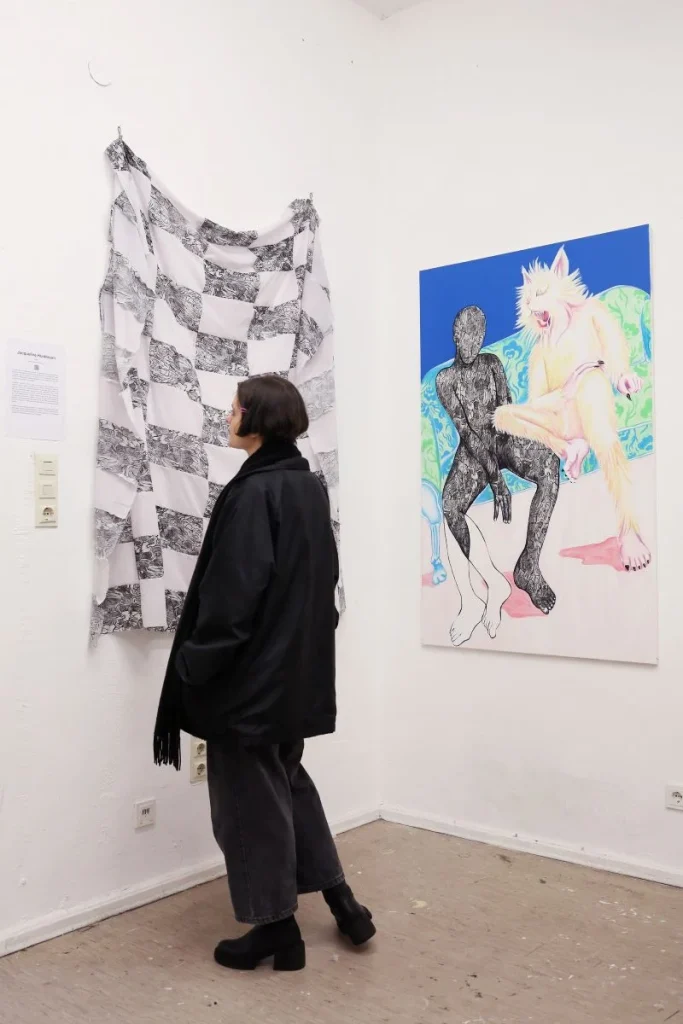
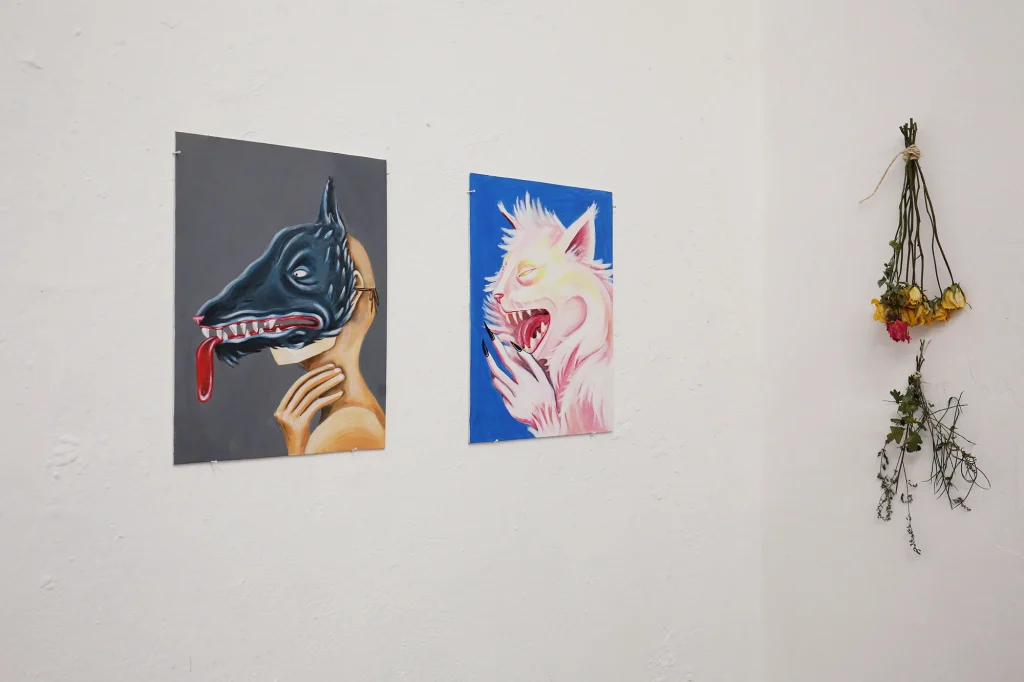
    Jacqueline Huskisson is an interdisciplinary artist from Calgary, Alberta Canada. Primarily considering herself a “comic” artist, her practice relies on the dissection of narratives, whether they be abstract or linear. “I like to merge and play with mediums and use comics theory to produce artworks that examine our historic and societal relationships to the natural world while using the human body as context and narrative”.
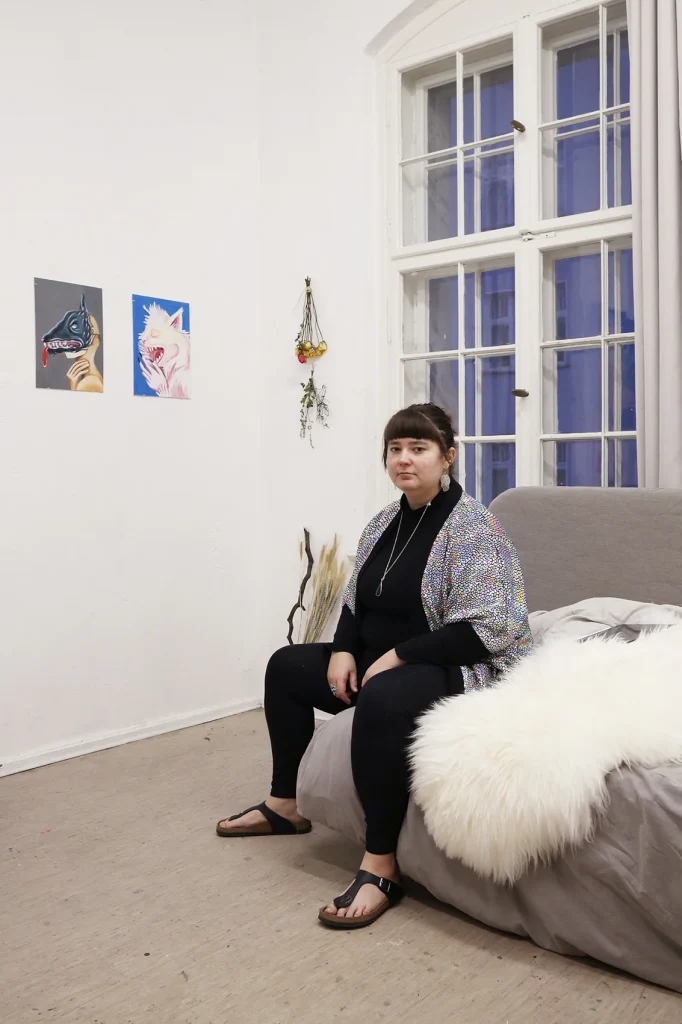

    Meet the Artist

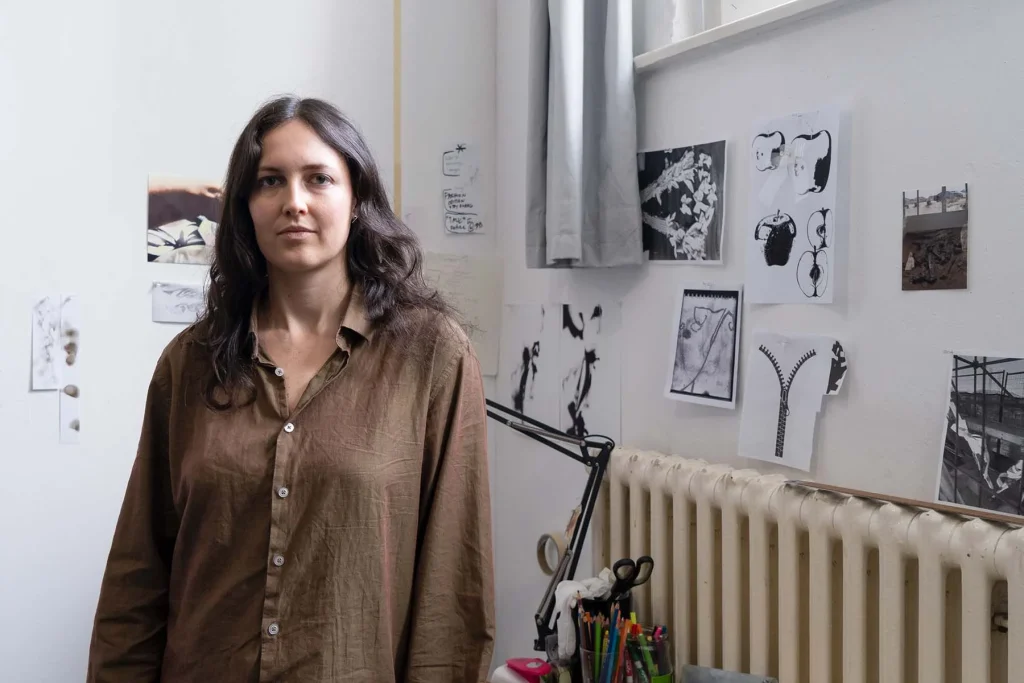
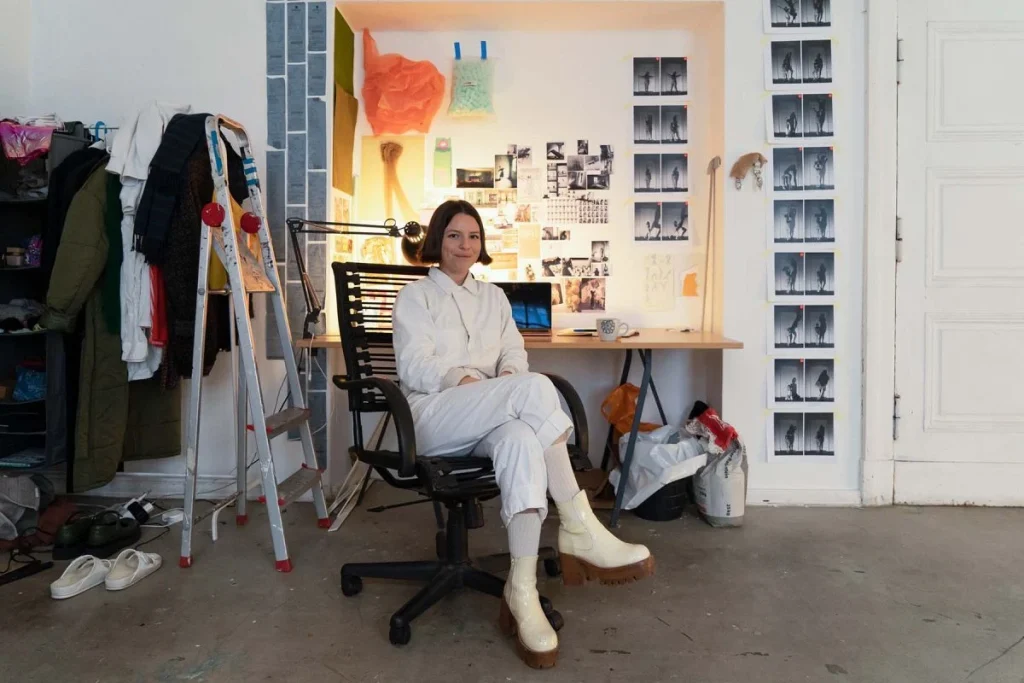
    Good afternoon Jacqueline, thank you for having me in your studio at GlogauAIR. 

    Can you tell us how you started your artistic journey? 

    I started painting and drawing when I was a kid, at first as a competition with my sister, to see who would be better at it. I guess I professionally started when I went to the Alberta College of Art and Design (now called AUArts because it got University status). I graduated in 2011 with a degree in print media. From there I didn’t do as much for the few following years. I don’t think my career really went off until I graduated from my Master’s in 2017, from the Belfast School of Art. Since then I’ve been doing a lot of residencies in Europe, in Canada, and doing exhibitions around Canada. 

    How would you describe your practice? 

    Right now I call myself an interdisciplinary artist. I started off with printmaking but it was more because I wanted to learn a specific skills set. Even though I love print! I would say I’m interested in exploring the human body, the human form, our relation to the Earth, everything around us and how we react to everything around us, the narrative of the self… I do a lot of different kinds of work, like painting, drawing, printmaking, comics, and I’m starting to break into sculpture. I’ve done a lot of media work as well. 
    You’ve been working with many different mediums, is there a medium in particular you would like to explore further during your time at GlogauAir? 

    I would like to work more with sculpture! I’m trying to make kilts, fabrics, and maybe some sculpture castings. I started already a bit when I was back home, but not very extensively. I’d like to use my time here to really develop a new narrative, but also incorporating elements that were in my paintings and making them 3D. I think that would be really cool. 

    What are your inspirations for your project here? 

    Right now I’m inspired by the concept of “home”, from my latest few projects back home. I’m also inspired by the narrative of the self, like dealing with illness, and many other things. I want to create new narratives, because I feel like I didn’t have my own folklore growing up, and I would like to establish my own folklore in a way. I’m asking myself, “what is my folklore, compared to my home, to my culture?”. It felt strange growing up in a mix of different cultures, like “What is your own? What is it to be a Canadian?”. I am here to kind of investigate family ties, but also create my own narrative, using pop culture and referencing witchcraft, as I was very interested in this as a kid. 
    It’s interesting that you are working on the theme of “home”, and yet you are moving so much for residencies. Do you think the city of Berlin in particular has an influence on your work? 

    I think so! For me “home” isn’t necessarily a place where you grew up, it could be a state of mind, or people you surround yourself with. My family is from Germany, so it was a place I wanted to come back to, to explore a little more. I really love Berlin for its art influence, comics culture, and its ability to let you do what you want freely; so I really wanted to come here to explore and experience the German art scene. 

    Besides the city of Berlin, what motivated you to apply for a residency at GlogauAIR? 

    A friend recommended GlogauAIR to me. I really like that it is in a nice popular area, that you get your own studio and you also get to live in it, and the opportunity to meet lots of different international artists. I thought it would be really fun.

    Statement

    My name is Jacqueline Huskisson, and I am an interdisciplinary artist from Calgary, Alberta Canada. In 2011 I revived a BFA in print media from the Alberta College of Art and Design (Now AU Arts.) In 2017 I received my MFA in studio arts from the Belfast School of Art in Northern Ireland. I primarily consider myself a “comic” artist, my practice relies on the dissection of narratives, whether they be abstract or linear. I like to merge and play with mediums and use comics theory to produce artworks that examine our historic and societal relationships to the natural world while using the human body as context and narrative.

    GlogauAIR Project

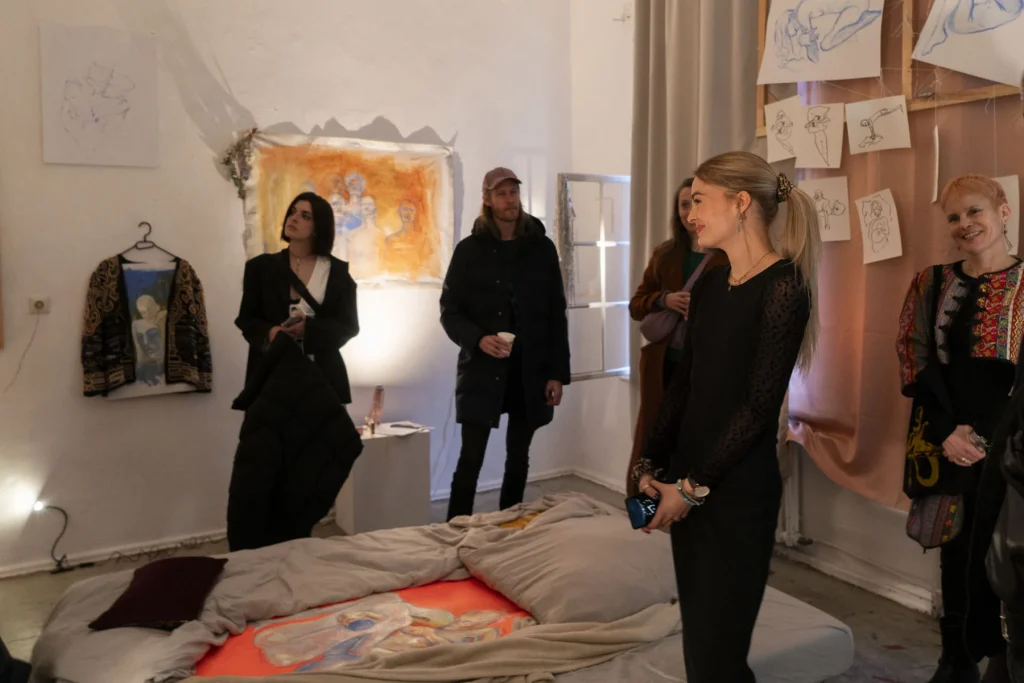
    I chose the name Miasma for this project as I was inspired the concept of the Miasma theory. Up until modern medicine the medical commuinty believed that “bad” smells and other elements surrounding us is what made us ill. This narrative will explore my story around illness, disability and adaptation told through comics made of paintings, drawings and printmaking. During the time at this Residency I will research, draw, paint and network. This project is an investigation into how we interpret illness and disability in our modern times.

    CV Summary

    EDUCATION

    • 2017 M.F.A Studio Arts Program, Belfast School of Art, Northern Ireland
    • 2011 B.F.A Print Media Major, Alberta College of Art and Design (AU Arts)

    SOLO EXHIBITIONS

    • 2023 Liminal Spaces, Art Gallery of St. Albert, Alberta. (November-February 2023-2024)
    • Structure of Bones, Artpoint Gallery Calgary, March 2023
    • 2022 Beyond the Static Frame, Lowlands Clubhouse, Edmonton Alberta
    • Memory Lines Helmut Gallery, Leipzig Germany
    • 2018 Absurd Walls Main Space Gallery Alberta Printmakers Calgary Alberta
    • Artist in Residence Exhibition, Poolside Gallery Winnipeg, Manitoba
    • “URRGH” “ARRGH” “UUUMMM” Small Space Gallery, Calgary Alberta
    • A Dandy Exhibition and Comic Launch, Dandy Brewery Calgary Alberta

    SELECTED GROUP EXHIBITIONS

    • 2023 OctoxOdyssey Mapperz at Beakerhead. Sponsored by the University of Calgary Science Department
    • The Directors Cut, Online Exhibition for the Woolwich Contemporary Printmaking Art Fair, London UK
    • Hispanic Arts Resiliency project, Telus convention centre Calgary, AB
    • Particle Wave, Media Arts Festival EMMEDIA, Calgary Alberta
    • 2022 People’s Portrait Prize Contemporary Calgary
    • The Hand at Fenix Arts “The Hand at Fenix Arts” Fayetteville Arkansas USA
    • Lasting Impressions Alberta Printmakers (August 20-Sept 23 Calgary AB)
    • Human Abstract, joint exhibition with Doro Buch, Artpoint Gallery Calgary Alberta
    • Mini Gallery’s Summer Edition, Crescent Heights Association, Calgary AB
    • Particle Wave, Media Arts Festival Truck U Hall Space, Calgary Alberta
    • SSNAP Touring Finalists Exhibition, Victoria Arts Council BC
    • SSNAP Touring Finalists Exhibition, Pendulum Gallery, Vancouver BC
    • 2021 SSNAP 2021/2022 Salt Spring Art Prize Finalists Exhibition, Salt Spring Island, B.C
    • Art + Poetry Pairing People’s Poetry Festival, Loft 112, Calgary AB
    • Flashy group exhibition with Doro Buch. Sparrow Arts Space, Calgary AB (@flashy_yyc)
    • Cadavre Exquis Loft 112, Calgary Alberta.
    • New Works/New Artists Artpoint Exhibition Space, Calgary Alberta.
    • 2020 A Cold Sweat Lowlands Project Space, Edmonton Alberta.
    • Hard Fluid Betrayal Piltonküeche, Leipzig Germany
    • Almost Tension Alte Handleschule Leipzig, Germany
    • Storylines Art Gallery of Grande Prairie, Alberta (TREX touring exhibition)
    • 2019 Spectral Illuminations IV EMMEDIA Gallery/ Beakerhead, Calgary
    • Futurology Main Space Gallery, Alberta Printmakers, Calgary
    • HY*DRA*TION Liquidate Your A$$ets Truck Contemporary, Calgary
    • 2018 What A Relief! Steamroller Exhibition Prairie Dog Brewery Calgary
    • Overlap(land) Emergency Room Gallery, Houston, Texas USA
    • Spectral Illuminations III EMMEDIA Gallery/ Beakerhead Calgary
    • Comic Blast Exhibition Arteles, Hämeenkyrö, Finland
    • 2017 Not So Mini Print Exhibition Alberta Printmakers, Calgary
    • Spectral Illuminations II EMMEDIA Gallery/ Beakerhead Calgary
    • Art of The Comic Blick Studios, Beflast, N.Ireland
    • Proximity Pollen Studios, Belfast, N.Ireland
    • Masters of Fine Art Studio Exhibition Belfast School of Art, N.Ireland
    • Transmit Platform Arts Belfast, N.Ireland
    • 2016 PXVI Platform Arts Belfast, N.Ireland
    • Gallimaufry Platform Arts Belfast, N.Ireland

    RESIDENCIES

    • 2023-24 Glogauair residency, Berlin, Germany
    • 2023 MAWA Residency June, Winnipeg Manitoba
    • 2021 Fuse 33 Residency, Calgary AB
    • 2020 Pilotenküeche Leipzig Germany
    • 2019 Klondike Institute of Art and Culture, Dawson City Yukon
    • Calgary Allied Arts Foundation, Calgary AB
    • 2018 Arteles Comic Blast Residency, Hameenkryo Finland
    • Dandy Brewing Artist Residency, Calgary AB
    • Scott Leroux Fund for Media Arts Exploration, Videopool, Winnipeg Manitoba
    • 2017 Sparkbox Print Residency Picton Ontario.

    GRANTS/SCHOLARSHIPS/AWARDS

    • 2023 Canada Council for the Arts Abroad Program (Glogauair Residency) -$20,000
    • Calgary Arts Development Authority (Glogauair Residency)- $11,290.18
    • Visual Arts and New Media Individual Project Funding (Mawa Residency, Winnipeg Manitoba) AFA- $1789
    • 2022 Visual Arts and New Media Individual Project Funding (Helmut exhibition, Leipzig Germany) AFA- $4587
    • 2021 Juror Award for Salt Spring National Art Prize- Juror selector Ydessa Hendeles Art Foundation-$3000
    • Alberta Artist in Residence Shortlist Grant -Alberta Ministry of Arts and Culture-$1000
    • Salt Spring National Art Prize Finalist -Salt Spring Island, British Columbia
    • 2020 Pilotenküeche Residency grant -Leipzig, Germany -$12000
    • 2019 Visual Arts and New Media Individual Project Funding (Pilotenküeche Residency)-AFA- $15000
    • 2018 Visual Arts and New Media Individual Project (Arteles Residency) Funding AFA-$5000
    • Opportunity Grants – Calgary Arts Development Authority -$2500
    • Scott Leroux Media arts Exploration Fund– Videopool Winnipeg Manitoba-$1500
    • Arteles Residency Fund-Hämeenkryö Finland -$3000

    PUBLIC ART INSTALLATIONS

    • 2023 Mirror, Mural for Pride Marchs On, Shaw/Rogers and City of Calgary 13th av and 4th SW Calgary
    • Calgary Public Art Banner Program. June 2023-May2024
    • Cosmic Melody, Mural for the Palimpshed Project, 18th and 19th NW Calgary
    • “Hygge” Projection Mapping project for Chinook Blast, For MAPPERZYYC ATB Art Branch
    • 2022 MAPPERZYYC projection project, BU Vintage Shop
    • Roadworks, BUMP and City of Calgary, Mural two road barriers, Mission, Calgary
    • Fuse 33 and International Avenue. Print and Steel lantern. 17 ave and 33 st Calgary
    • 2020 Projection Project: moving image installation October 2020 New Central Library
    • 2018 Northern Reflections: Owl Mural with Augmented reality animation New Central Library
    • 2017 Utility box Program, City of Calgary and Alberta Printmakers. 10th st and 2 ave NW
    • 2016 Utility box Program City of Calgary and Alberta Printmakers. 5th ave and 6th st

    PUBLICATIONS AND COLLECTIONS

    • 2023 Reimaging Fire The Future of Energy. Print collection and publishing, partnered with Natalie Meisner.
    • 2022 Comic for SNAPline, Edmonton Alberta Issue Fake
    • The Hand Magazine Issue 38 (Fenix Arts Special)
    • longcon Magazine Issue 11
    • The Hand Magazine Issue 36
    • Comic for Renegade Alberta Artist collection Home
    • Comic for SNAPline, Edmonton Alberta Issue Punchline
    • 2019 Comic for Spleen: A Canadian and Portuguese Anthology. Published by Trip Comix Montreal.
    • 2018 Phantasmagoria Comic printed with assistance from Alberta Foundation for the Arts. Gytha Press, Issue two. Calgary, Alberta Diagnosis Werewolf (Part one) Comic for the AIR program with Dandy Brewery Calgary Arteles 2018-2015 Catalogue. Hämeenkryö, Finland Comic Blast! A Collection of Artists. Hämeenkryö, Finalnd Illustration for Issue 23 Magical and Mythical Poetry on Ritual NōD Magazine Calgary Alberta

    TEXTS

    • 2022 Artist Feature; longcon Magazine longconmag.com
    • 2019 Artist Expose in Calgary Guardian. Forward by Kate Bailies. calgaryguardian.com
    • 2018 A Room Without Pictures Essay by Dan Shipsides for Absurd Walls Exhibition docs.wixstatic.com
    • 2017 Emboss Magazine Issue 8 “Women Artists” Interview
    • 2016 Artist In Residence interview Chrissy Poitras Sparkbox Studio sparkboxstudio.com
    • Review of Zona 3 Chris Beckett warrior27.net

    Gallery
  • João Motta Guedes

    João Motta Guedes

    João Motta Guedes is GlogauAIR resident
    from January, 2024 to March, 2024

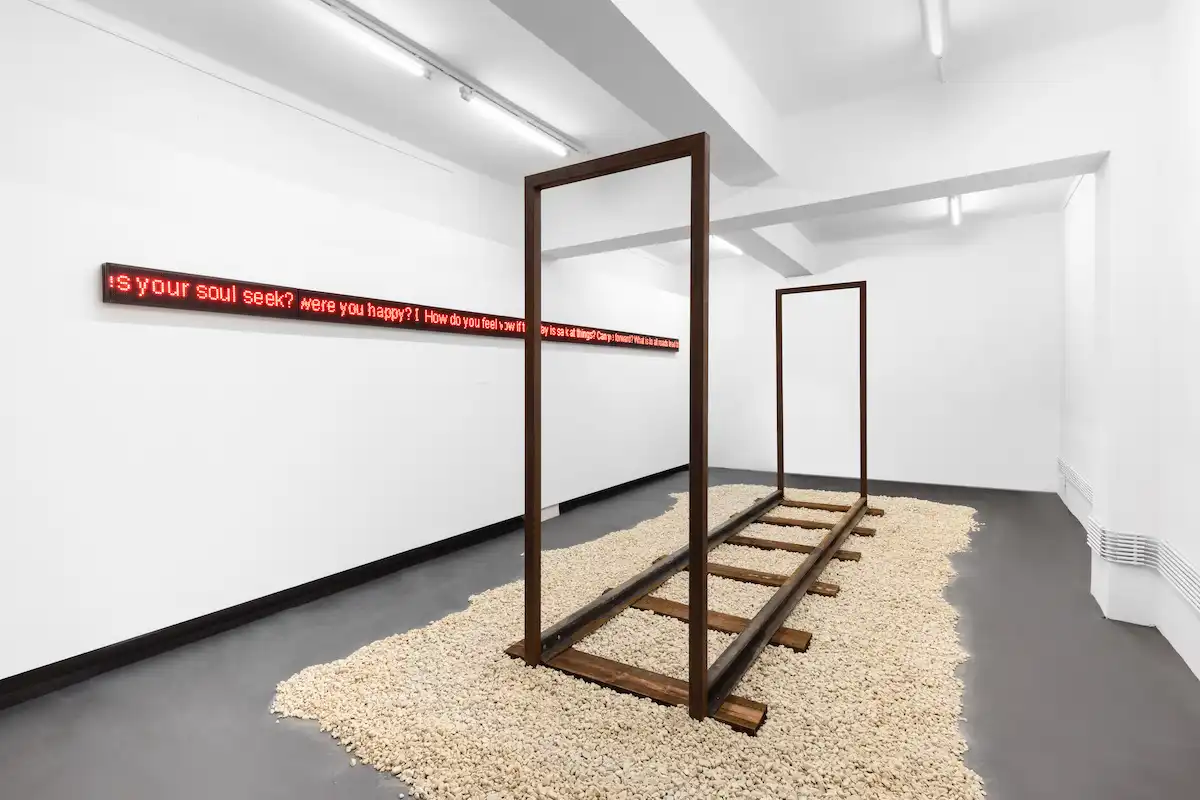
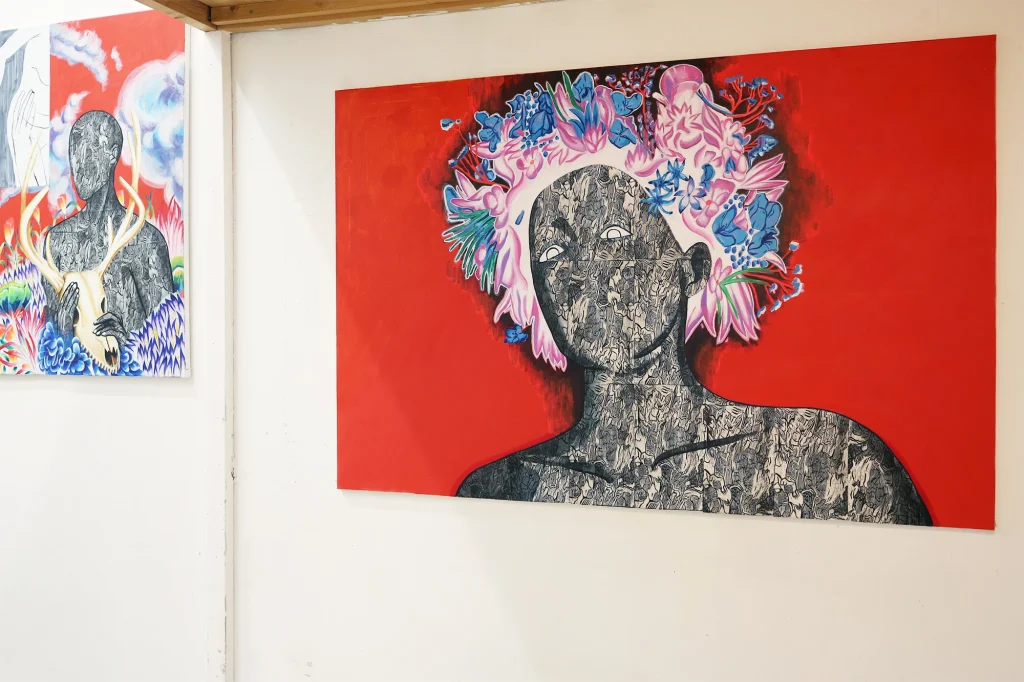
    Introducing João Motta Guedes, a conceptual artist from Portugal who explores themes of freedom, vulnerability, love, and violence through various artistic mediums such as installation, sculpture, photography, drawing, and poetry. His work reflects on life as a metaphorical journey, aiming to uncover and share human experiences and emotions.

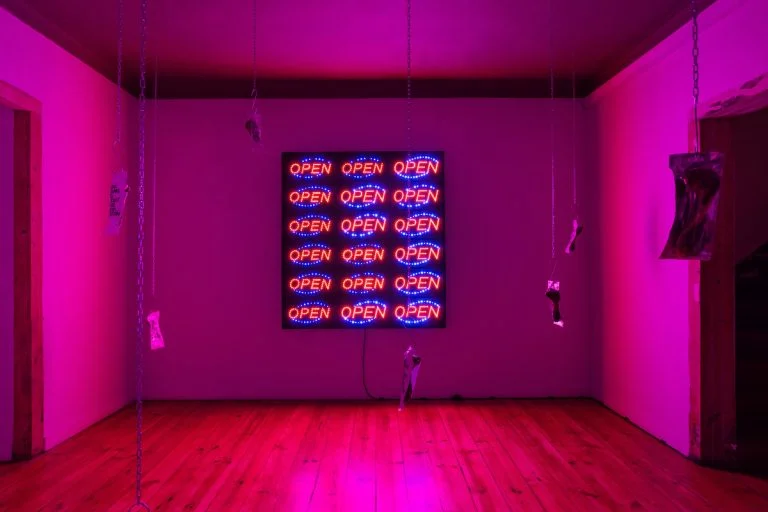
    During his residency in GlogauAIR, he delves into the tensions within rave culture in his project “No feeling is final”. In it, he investigates power dynamics and intimate relations amidst extreme freedom and violence, exploring a wide range of issues including love, sex, drugs, freedom, and vulnerability.


    Meet the Artist

    How do you describe your practice as an artist?

    My name is João Motta Guedes, I’m a Portuguese artist. I’ve done my studies in fine arts but also have some background in law studies from a more philosophical approach. For my work, I usually have a very project-oriented scope. I start from ideas and from these ideas I try to understand how they can come to the real world. So the medium kind of changes very often according to the project I’m working on. I feel I have natural inclinations to sculpture and installation and doing things with words, either in a poetry form or just sentences that I found that have some poetic meaning and try to bring them into a visual form. So in terms of subjects or topics that usually my work falls into, I think it’s like the ideas in a very general way about love and vulnerability and freedom and how these subjects and topics can somehow constitute a poetic discourse on life and about life. So I feel at the core my work is really about a poetic view on the world.

    What inspires your work?

    I think life gives me all the fuel that I need to create stuff because inspiration just comes from people you meet, conversations you have, places you go, other artists that you discover. I want to translate life in a poetic way to the world or into a more broad manifestation in a work.

    How did your artistic journey begin?

    As I mentioned, I did law before, so that was my initial education. But I was always very connected to the arts from my family point of view but also my inner way of expressing myself, which at the time was mainly through poetry and writing.

    Eventually I came to a point in my life, maybe after graduation, I was not really happy about what I was doing and my possible future. So it just came naturally to start or to dig more this path of what it means to be an artist and what it means to create. And I discovered that that is really what I want to do with my time and with my life and what makes really sense with the person that I feel I am.

    I think writing was my first medium since I was a young teenager. Drawing came afterwards because I decided I didn’t want to be connected with law anymore and wanted to explore the world of visual arts from an education point of view. So I started just pulling the string of this novel and just as long as I kept pushing, more things started to unfold such as other mediums that you can try, such as drawing or painting or sculpting or ceramics or whatever.

    That’s why I also feel that my work is not really tied to a specific medium. And I feel like in a way having this law background contributed for me to having a very conceptual, project-based, analytical research project about the ideas that I have.

    My family is also connected with the artistic world and always brought me to see exhibitions and country events. As an artist, it is very important to be curious and to continuously do research about what is going on. I think all art is conceptual, even painting, because it’s a mental thing because it comes from a conscience, it always fits a feeling. Even if it’s intuitive and you’re just painting what you’re feeling, that’s the concept.

    For me, it’s not necessarily being too tied to a formal concept, for me it’s something that is mental,  it requires some sort of thought or emotion. And sometimes there’s physical repercussions, but for me it starts as a thing in the mind or in the feelings.

    In my work there’s this concept or idea which is very central to the project, but I also like or try not to be too tied to it because I don’t want my work to be unilateral. I want to have the potential of many meanings, so it’s always kind of a challenge to try balancing that between what I do and what I want to say and regardless of what people will understand, I don’t want at all to force one meaning or one intention. I want them to be open to what each one may discover in it.

    Do you have any memorable anecdote or story from your artistic journey that had an impact on you?

    I never wanted to be a lawyer. But I think it was just something that suddenly made a lot of sense in my life, just to understand that this is what I wanted to do and that I wanted to spend my energy in. That was so clear, even though it sounds kind of an abrupt transition from one field to a very distant field.

    It just made  sense with who I am and who I wanted to be at the heart. I feel like some life experiences probably contributed to this. Some travels I did in South America at the time I was finishing my degree and I was trying other things.

    I feel like, in a way, rave and party culture, which is the theme that I bring to my project here at GlogauAir, also influenced me quite a bit in a way. Not just about the environment, but about this idea of liberation and self-discovery.

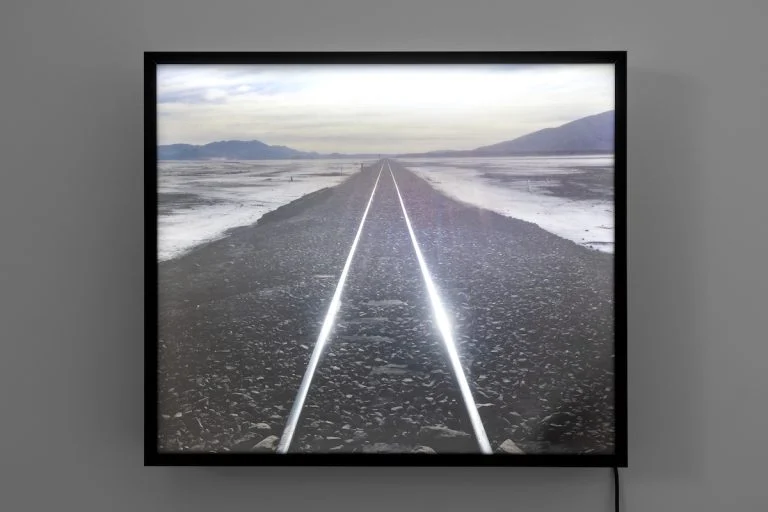
    On the other hand, recently I had my first big solo at a commercial gallery. It was a big challenge, because obviously it was the first, but I had this very clear view or idea of what I wanted to do. The exhibition is precisely about the journey and the way forward. It’s been some years now, like four or five, but coming from this background into another thing and wanting to pursue this other path, it made much sense for me that my first solo with my gallery would be about the path or the journey in this both physically and interior thing. So I was very sure that I wanted to preserve that kind of work.

    How do you see the role of contemporary art in today’s society? How does your work have to do with this? Do you see yourself in a contemporary art market?

    I feel that the contemporary art market is a different thing from the kind of contemporary art that really shakes you up. And what my work in general pursues is to be something that can question you. For me, a good work is not the one that gives you answers, that you just keep looking at and seeing more and more. Contemporary art is obviously very important to us as humans. Art has a really important connection with society and with the times that we live in.

    And I feel in general contemporary art, especially in this timeline and with these very hot topics that are present, sometimes people try to repeat this idea of just revealing what is not going too well with our world, by denouncing some situations of injustice or systematic violence.

    And even though I feel like as an artist it’s very important to be aware of the world that you are living in, it’s also much about showing your inner world and how these two worlds coexist. So for instance, in my work I try not to manifest too many political views or political ideas. So I try to bring a multitude of possible directions and try to maybe show a more utopian, oniric, poetic view on the world rather than perhaps this path of denouncing and criticizing, which is obviously legit, because in contemporary art there is room for everything. Maybe I like to focus more on pointing the direction in a more optimistic way.

    Do you feel like the city of Berlin is having an impact on your work?

    Coming here to GlogauAir made total sense for me and my project which conceptually is about raves or, to be more specific, about this environment that holds so much polymerised ideas such as a space for freedom and dancing and ecstasy and love, but at the same time it is an environment that can be very oppressive.

    So I felt I was very interested in seeing how these two elements could coexist in such a paradox and taking this to a more poetic or in-between realm idea, so the concept of being awake but also being dreaming at the same time.

    For me, this is obviously something that had a huge influence on my personal growth in the past, and the way I see life and work. So it just made total sense about addressing these issues here, in Berlin.

    One of the things that I like most about Berlin There is a lot of culture, everything is always happening at the same time. What fascinated me the most is how these different fields of the arts;  fashion and music and architecture and visual arts and cinema, influence each other. It is something very interesting and for sure that makes the city even more appealing to be in the middle of this creative tornado.

    How is the residency and living with other artists affecting your work?

    I feel like in general artists are like sponges, they just absorb what surrounds them and being able to be in the residency offers the opportunity for you to be in a daily contact with other artists which are also discovering the city, also working on their projects and obviously having these people so close to you, living together, doing stuff together, influences a lot your thoughts and because you are continuously changing ideas about art, about life, about work, so this daily living is something that is contributing to  new ways of thinking about the work.

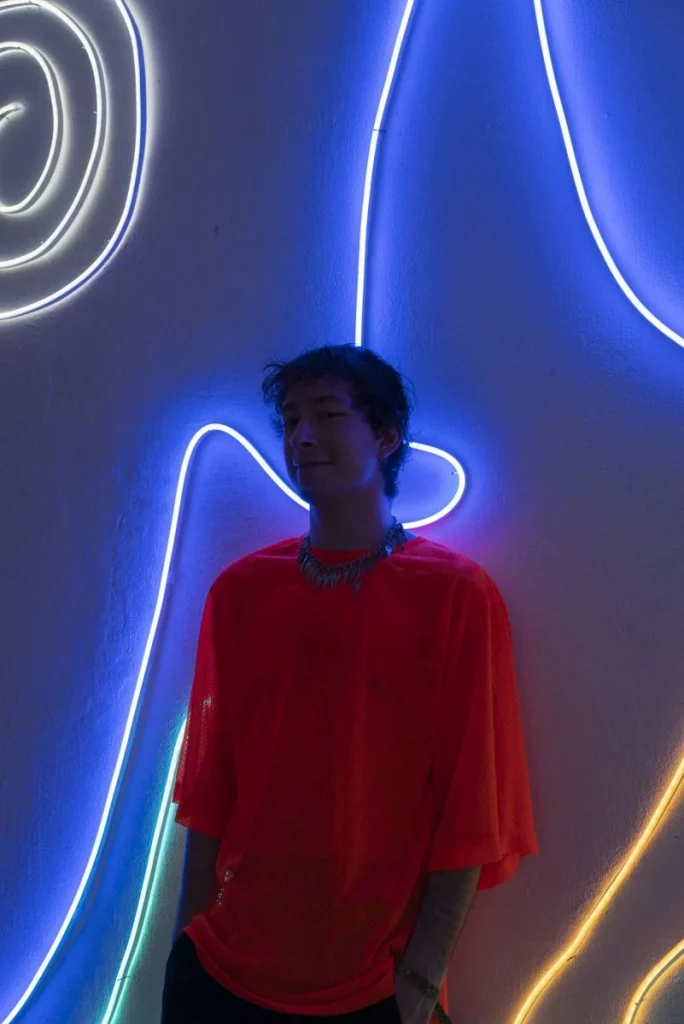
    I think this general topic about the body that is presented here by different artists is perhaps not so much my topic of work, but in a way this also brings new ideas and new reflections on how that could make sense within my practice. For example I made this self portrait, even though it’s not the first time that I represented myself in a photograph, it just came naturally to make this representation because for me the photograph is  about this limbo state between worlds, between dreaming and being awake. It makes sense also in the context that we talked about, my project here about rave culture and this idea of returning home and being in this limbo state that you are just perhaps here but not here at the same time.

    And obviously being in a residency in Berlin also is a very appealing factor because I wanted to come here for a long time .

    What are your plans afterwards?

    I’m planning another solo exhibition in the month of April in Lisbon. So that’s the next big task I am working on. It is happening very soon,  in one month and a half and I’m very excited about it. It’s my first institutional exhibition so I also feel a bit of responsibility and from there I have some other collective shows throughout the year so I feel like I have to focus on these exhibitions as well.

    But something that is very clear to me is that I want to keep doing residencies in other places because I found this experience so constructive for my artistic practice.

    Statement

    João Motta Guedes, Lisbon, 1995.

    João Motta Guedes explores concepts of freedom, vulnerability, love and violence. His artistic productions reflect on life as a metaphor for a journey where different paths emerge, allowing the discovery and sharing of experiences about the meaning of feeling and being human.

    His artistic language appears in media such as installation, sculpture, photography, drawing, written words and poetry, and has a predominantly projectual and experimentalist nature.

    Based on a poetic discourse and narratives, it seeks to question the way forward through oniric expressions that elevate the observer to a utopian look at society and life, resulting in a comprehensive record of symbolic and metaphorical images that enhance poetry as the answer to the formulated questions.

    GlogauAIR Project

    The project No feeling is final investigates the tensions between freedom, love, and violence in the context of rave culture. it seeks to inquire and artistically expand on the power dynamics and intimate relations in situations of extreme violence and absolute freedom of rave environments. It is from this polarity that it is opened a wide range of issues where oppressed and oppressing forces collide, ranging from a variety of topics such as love, sex, drugs, tripping, freedom, violence and vulnerability.

    Installation

    CV Summary

    • Holds a BA and MA in Law, and a MFA in painting.
    • Member of the research project, “Cosmopolitanism: Justice, Democracy and Citizenship without borders”, having participated in several conferences and academic publications.
    • Exhibited regularly since 2019, integrating group exhibitions such as “0/1, o zero e o um”, at MUNHAC, “Wanderlust” at Galeria Mota-Galiza, or “The Garden of forking paths” at Buraco.
    • In 2023 he had two solo exhibitions, “You came to start the revolution” at Galeria Zé dos Bois, and “How to live?” at Galeria NAVE.
    • In 2020, he was awarded the “alunos da fbaul na ermida” prize and also the 1st prize in the video category of the award “Filo-Lisboa 2020”; and in 2023, the award “Arte Jovem Fundação Millennium BCP”.
    • Represented by Galeria NAVE.

    Gallery
  • Natasha Katedralis

    Natasha Katedralis

    Natasha Katedralis is GlogauAIR resident
    from January, 2024 to March, 2024

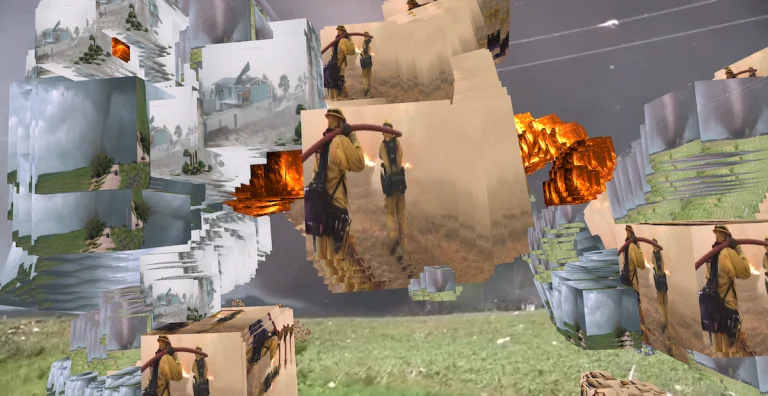
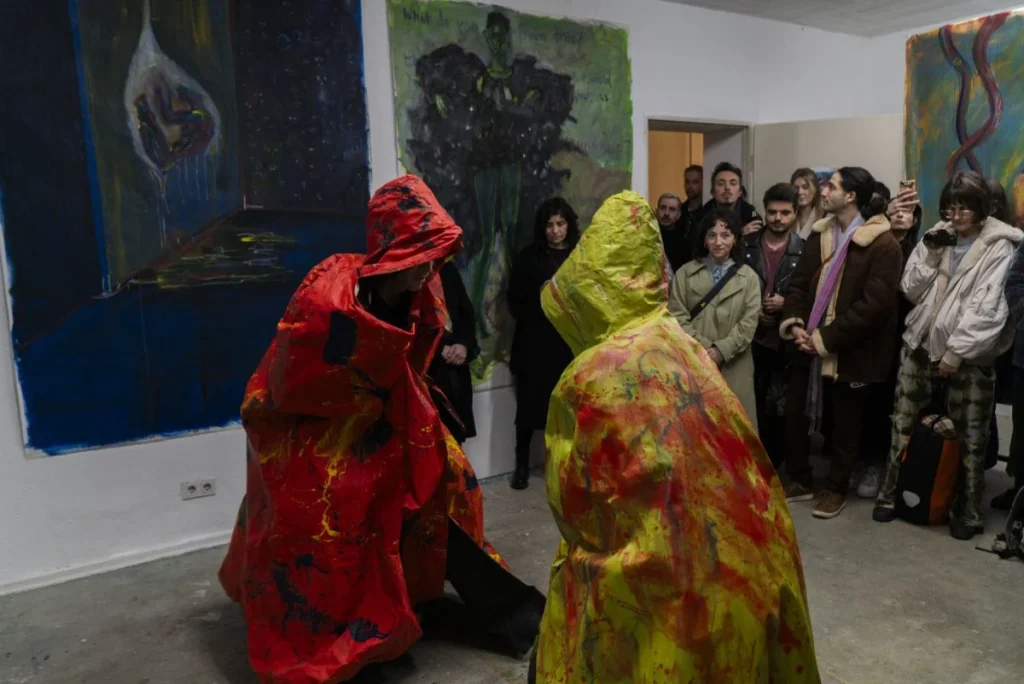
    Natasha Katedralis is a visual artist based in Vancouver, Canada. Working with digital photography, material forms and often the meeting of the two, Katedralis’ practice is motivated by the perceptual and formal relationships possible within and in-dialogue-with the virtual space of images. Using the language of collage and abstraction, her work prioritizes sensory feeling, an orientation of close-looking and a material reading of the world. 


    Meet the Artist

    How do you describe your practice as an artist and what inspires your work?

    My name is Natasha Katedralis. I’m from Vancouver, Canada.  I’m primarily a visual artist. I work with digital photography, physical materials, usually in more of a raw form, and I do a lot of collage, drawing and tracing. Sometimes just in the background of my practice, but sometimes it makes its way into the work as well. I certainly have a lot of interest in material and have always just worked across different mediums.

    For the past five years,since the end of my undergrad, I’ve been working and thinking a lot about photography and just images in general. Partially because I’m artistically interested in photography, it’s something I was always interested in since I was a teenager. But I think sociologically, it’s concerning to me or interesting to me just how ubiquitous the tool is in our lives. Everyone has an image-making practice, and it’s just so present in human culture. And I think I’m  in, what are the consequences or, the feeling of living in a space that’s occupied by images and communicated through images so intimately.

    And then just aesthetically, I’m interested in,what a photograph is and, just when you break it down, how it frames light and shadow and can take this fluidity of life and turn it into a surface, surface of the information and contour that’s ultimately very flat but represents this kind of virtual access to something.

    Is there something that inspires your work?

    I love art, and I’m always looking at other art and artists, and most of my close friends are artists, they inspire me a lot.  I’m a very materially motivated person, and I desire a material experience. I think more and more our lives are becoming less material, and I struggle because somehow I’ve ended up working with digital photography, which is incredibly and paradoxically not very materially generous and quite technical.

    So I find this so interesting and working through materials that aren’t photography to try them out and work them more broadly. Maybe it is about a desire to capture things? Because any kind of art practice or writing practice does kind of stem from that impulse to commemorate something or retain it, re-communicate it to others.

    How did your artistic journey begin? Do you have any memorable anecdotes or stories that you want to highlight from this artistic journey?

    I definitely always was artistic as a kid. My aunt has this particular memory of me as a kid where I was working on a colouring book and I was just so completely absorbed by it. I was hunched over and pursing my lips, I was really serious about what I was doing. I just found that funny because I fully still feel that way in the studio. For me, art is very demanding and at the same time, I find it is a completely ridiculous and childlike activity, very outside of other things an adult might do with their time. I appreciate the openness that it offers.

    How do you see yourself, like, in the contemporary art world right now? But also, how do you see yourself in the contemporary art world in the future?

    Contemporary art was very exciting to me as soon as I was  introduced to it.  That was before I formally studied art.

    I probably was encountering it all the time on Tumblr (haha). And I remember being really fascinated by the whole machine of it when I was in school. But I think that’s a tricky question and I think there’s many different art worlds you can be part of.

    I think I’ve been lucky that I didn’t just have some art career happening when I finished school. I moved to this rural place and fully isolated myself, even of an artistic community. I needed time to figure out how art was going to be in my life. I’m really thankful now that I had so much time just to deal with art in the privacy of my life. Careers, your resume and the stuff that goes on, can come and go, but if you want to do art, you really must have some relationship to it that’s really beyond all that.

    I think real art has to come from a place that exceeds society or whatever cultural paradigm you might be living in. So if you’re fixated or so caught up in a contemporary art discourse or just what’s going on in society, you are probably just going to burn out like everybody else, to be honest. An artist has to have tools to create some space between themself and the world so that something truly new can come through them.

    The art that I love shows me something that is beyond what I experience in the regular world. And seeing that, seeing possibility even if it’s just an aesthetic experience, it shows you that a different (real) world is possible. And that’s what is important and what anyone needs in life.

    Does the city of Berlin and the residency have an influence on your production?

    My intention on coming here was pursuing some time off and space to really go into art making and figure out what that feels like. It’s an immense privilege and it’s been a really generous experience for me to be able to carry a thought or an activity from day to day and to get things coming out from that.

    At the same time I love all the museums and galleries and there’s so much here, but I appreciate it in any big city. It is about being able to go to those spaces and you can just be in a completely quiet room and look at something, which, to me, is still very sacred.

    What influenced your decision to come to GlogauAIR?

    Sometimes fate plays a role in things. I kind of just followed the hints from the universe. Before this I was being really pragmatic in my daily life but I realised that the deadline for this residency was the same deadline to ask for the grant and, that to me, was enough of a sign.

    I think this residency, it’s in a really good location and this building has quite an interesting history of it. It’s really fun being on the third floor because we’re in the attic here. Coming from North America, being in a building that’s, like, 200 years old is a completely novel experience. You just don’t have that.

    What are your plans afterwards?

    Ater the residency, I’ll finish here at the end of March and then in the beginning of May I have a solo show in Toronto. All my efforts here are going towards that.

    Statement

    Natasha Katedralis is a multidisciplinary artist based on the unceded Squamish, Tsleil-Waututh and Musqueam territories, colonially known as Vancouver, Canada. Working with photography, collage, sculpture, writing and experiments in fashion, Katedralis’ practice extends a sensitivity to the material world through an orientation of close-looking and a playful approach to form. Drawn to the contrary ways that photography emphasizes, dramatizes, alters, and flattens its subjects, Katedralis is interested in the possibilities within the fraught translation of the “real” into “image.” Recent projects include Prop at City Centre Motor Hotel (2022, Vancouver), Connect Mention Rückenfigur at Liquidation World (2021, Vancouver), and a capsule fashion collection that was exhibited on the P.LU.R.O.M.A. SS23 runway at Liquidation World. Katedralis is a two-time nominee for The Lind Prize (2017, 2022).

    GlogauAIR Project

    Interested in photography’s contemporary imprint, I have been thinking of what it means when the personal and the collective is increasingly communicated and enclosed inside of images. Placing this question within a larger scope of material history, which the personal and collective emerge from, I’ve been conceiving of images as thin, temporary containers that separate themselves off from the environment albeit still requiring an atmosphere to circulate.

    Part personal inquiry, part study into the changing possibilities of the photographic apparatus, Im working with imagery I captured in the fossilized landscape of Dinosaur Provincial Park (Alberta, Canada). Working the photographs into abstract compositions, I’m exploring questions of the body’s origins across themes spanning the matrilineal to the geological, through photographic and material modes.

    Collage, Photography, and Sculpture

    CV Summary

    Education

    • 2018 Bachelor of Fine Arts, University of British Columbia, Vancouver, CA

    Exhibition

    • 2022 P.L.U.R.O.M.A SS23, group show, Liquidation World, Vancouver, CA
    • The Lind Prize, group show, The Polygon Gallery, North Vancouver, CA Shortlist juried by Samuel Roy Bois, Emmy Lee Wall and Richard Hill
    • Prop, two person show with Aamanda Crain-Freeland, City Centre Motor Hotel, Vancouver, CA. Curated by Felix Rapp
    • 2021 Connect, Mention, Ruckenfigur, (upcoming) group show, Liquidation World, Vancouver, CA. Curated by Marisa Kriangwiwat Holmes
    • 2020 100s Day, group show, Hatch Art Gallery, Vancouver, CA Curated by Kiel Torres and Claire Geddes Bailey
    • 2019 Split Ends Cuckoo, group show, Carport, Ladysmith, CA Organized by Natasha Katedralis and Christian Vistan
    • 2018 Works On Paper, group show, AHVA Gallery, Vancouver, CA Organized by AHVA Department Faculty
    • 2017 The Lind Prize, group show, Presentation House Gallery, Vancouver, CA Shortlist juried by Stan Douglas, Grant Arnold and Helga Pakasaar
    • 2016 I thought my discourse was true & pure, you promised!, group show, Audain Art Centre UBC, Vancouver, CA
    • 2016 The Murmuring, group show, Hatch Art Gallery, Vancouver, CA

    Curatorial

    • 2023 P.L.U.R.O.M.A FW23, Liquidation World, Vancouver, CA, Co-organized with Katayoon Yousefbigloo
    • 2019 Split Ends Cuckoo, group show, Carport, Ladysmith, CA Organized by Natasha Katedralis and Christian Vistan

    Awards

    • 2022 Shortlist Nomination, The Phillip B. Lind Emerging Artist prize. Jury: Emmy Lee Wall, Executive Director of the Capture Photography Festival; Richard Hill, The Smith Jarislowsky senior curator of Canadian art at the Vancouver Art Gallery; and Samuel Roy Bois, artist and Associate Professor in Creative Studies at The University of British Columbia, Okanagan.
    • 2018 BMO 1st Art Award Nomination
    • 2017 Shortlist Nomination & Honorable Mention, The Philip B. Lind Emerging Artist Prize. Jury: Stan Douglas, Grant Arnold (Vancouver Art Gallery) , Helga Pakasaar (Presentation House Gallery)
    • 2017 Andrew MacIntosh Memorial Book Prize in Fine Arts for Best in Show, University of British Columbia, Vancouver, CA
    • 2016 Florence Muriel Smeltzer Scholarship, University of British Columbia, Vancouver, CA

    Readings

    • 2023 ‘Juicy Couture Mobius Strip’ performed at screening of Teasers, a film by Tiziana La Melia at nap gallery, Vancouver, CA

    Collections

    • 2015 University of British Columbia Print Media Collection, Vancouver, CA

    Gallery
  • Nicholas Ferguson

    Nicholas Ferguson

    Nicholas Ferguson is GlogauAIR resident
    from January, 2024 to March, 2024

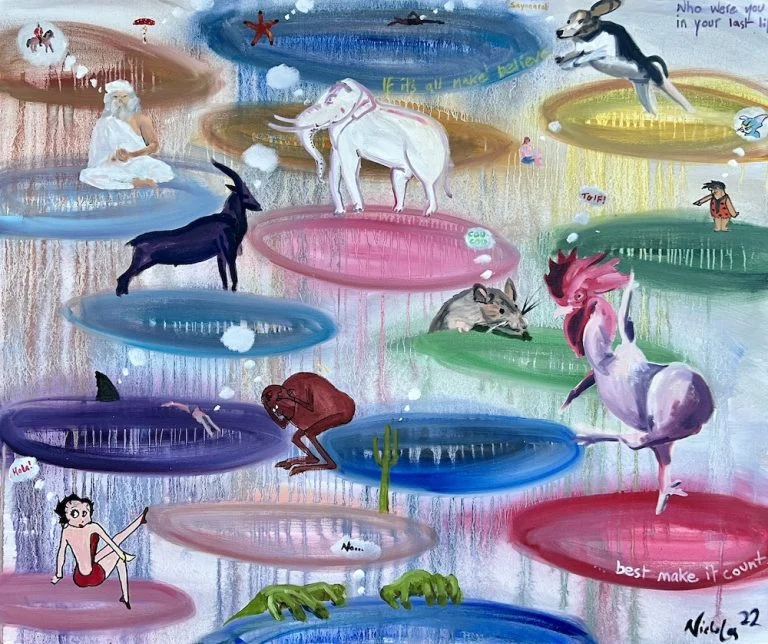
    Introducing Nicholas Ferguson, an artist with a profound belief in humanity’s capacity for superhuman feats, who expresses his vision through playful and occasionally provocative illustrations of life. With a keen sense of humor, he often playfully pokes fun at himself, societal norms, and the quirks of the human experience. Through his artwork, Nicholas invites viewers to reconsider how they perceive the world.

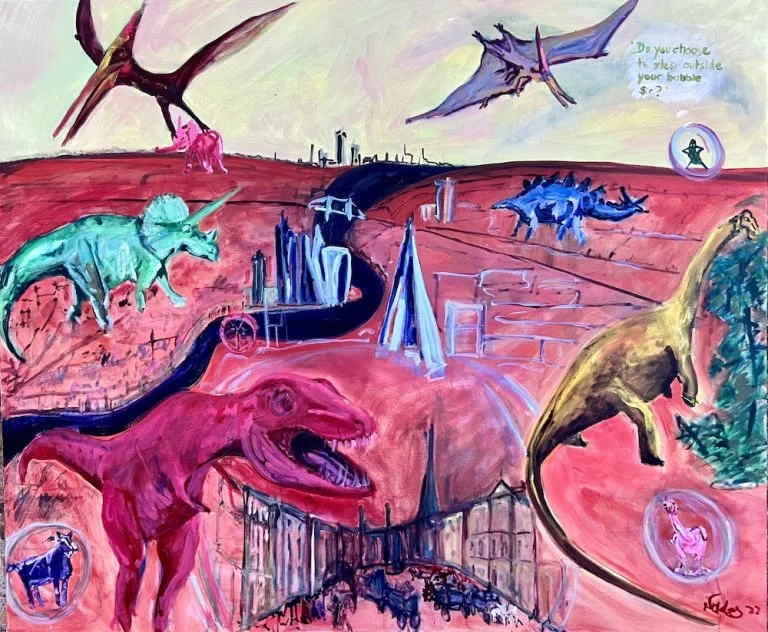
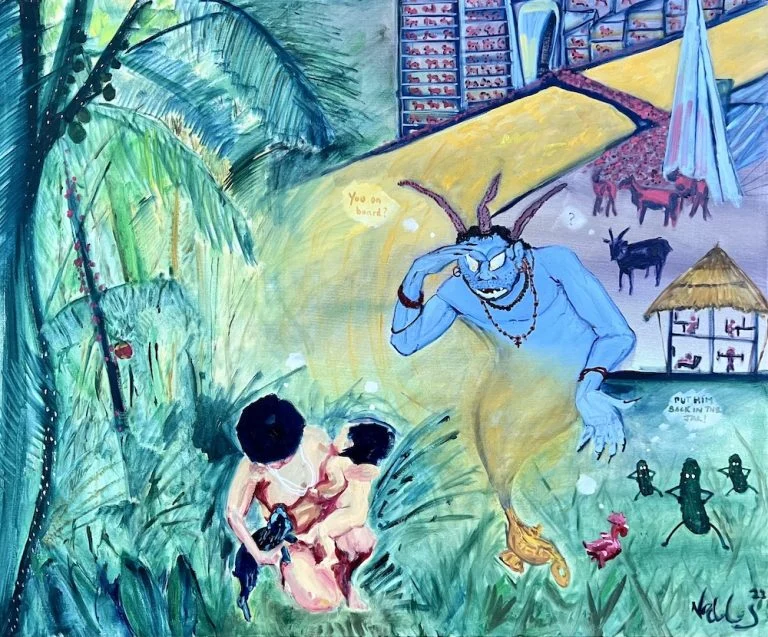
    His creations, painted in oil and accompanied by poetry, emerge intuitively from moments of inspiration, whether sparked by an image, an experience, or a revelation about human behavior. Nicholas’s work reflects the boundless power of imagination to shape our reality.


    Meet the Artist

    Would you want to give us an introduction about yourself?

    My name is Nicholas Ferguson. I’m an artist, I’m a storyteller, a painter, a poet and an occasional collage maker. I’m based in London and I’m British and Swiss.

    I’d say that my pieces are colorful, expressive, occasionally provocative, not always. I like to bring humor into what I create and I like people to walk away thinking or feeling something different than when they start, before they see my work.

    I tend to explore what it means to be me and what it means to be human. It’s always an exploration of different ideas that have either come to me intuitively or from conversations I’ve had with people I’ve met or just from my observations in society.  I don’t like to give people answers, I like for them to come away with questions  and for them to think.  I believe art is about making people think and feel differently.

    What inspires your work?

    There are certainly artists that have inspired me in the past. I like the work for different reasons, some stylistically, some for their messages. For example, I was drawn very much to Francis Bacon when I was much younger and I still am drawn to his work for his ability to catch a movement in paint, but also for his exploration of darkness and sexuality and sexual nature as well. I was a big fan of Lucian Freud as well, who again was an amazing portrait painter. So you’ll see some of that come through when I paint.

    I like to explore abstract work, but it usually tends to be figurative and those artists do come through. Even though I find it a bit obvious in some ways, I love the work of Basquiat and Warhol.

    Warhol, because he had a similar background to me in so much as he came from an advertising perspective, and there’s a commonality between advertising , or at least, , marketing and branding and painting in so much as my goal is to make me feel different. And in the case of advertising, it’s to make you buy into a product, but in the case of art, effectively, I’m also trying to get you to buy into my product. Whether you buy my product or not, I’m trying to get you to buy into my perspective and what I feel.

    Basquiat, on the other hand, I felt like he was very revolutionary for his time. He was a street artist, sure, but he was also exploring what it meant to be a black man in a very white art world. So he was pushing boundaries and he knew how to play those games to a degree, but his work wasn’t appreciated.

    I mean, it became appreciated while he was alive, but it’s very much become appreciated since he’s passed away. Other artists, I quite like the work of Philip Guston. Again, for the same reason, he explores spirituality and also had a bit of a rebellious context in his work.

    And then just another name that comes to me is Marina Abramovich. So a completely different world, much more conceptual, but I think she really removes the barrier of ego. So there’s no Marina Abramovich left. She’s just purely expressing what it means to be an artist, whatever that looks like, to the degree that she’s willing to hurt herself. So there’s no ego whatsoever and I love that about her.

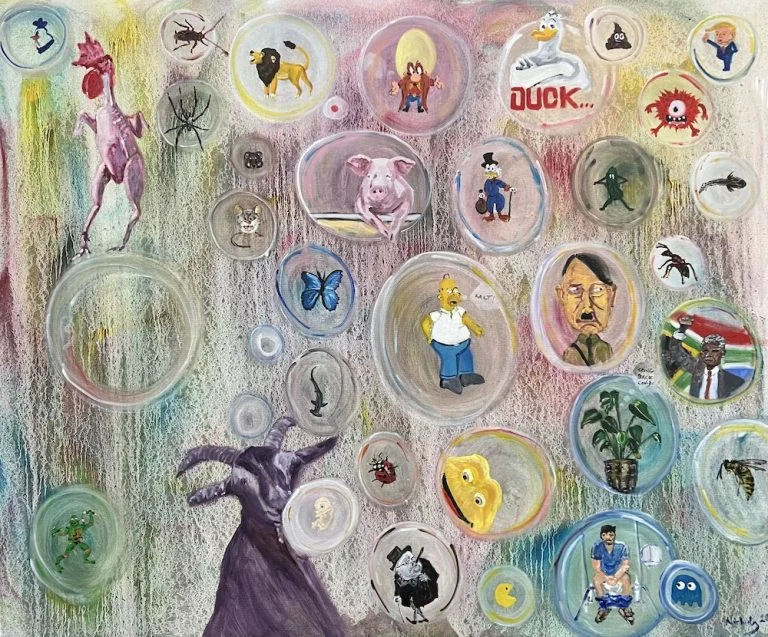
    On the other hand, pop culture has an extreme impact on my work. I come from a marketing background, as I mentioned, and I love brands. I love culture, essentially, in all of its shapes and forms. And so it really depends on what I’m working on, but in a collection that I had at my first solo exhibition in London last summer, which was called Perspectives, that was all about how our perspective shapes our reality. It was about bringing pop stereotypes, Western stereotypes, into my art so that there’s an immediate recognition from the audience that will bring ideas and thoughts to that person who’s looking at it. Preconceived ideas, but then there’s a juxtaposition with whatever is going on in the painting.

    I think our imagination creates our reality. So whatever we imagine becomes true, because we imagine it and then we act on it, we take action. So there is an element of questioning what’s happening today, and how we see the world today. And then at the same time, yes, there is an element of suggesting how the world could be.

    And that comes back to the childhood, childlike element again. It’s like if you’re told, as soon as you’re told you can’t do something, then your world shrinks. And as a child, before you’re told you can’t do something, your world is huge.

    And it’s only when you’re told you can’t do things that your world becomes smaller and your imagination becomes smaller. And so that’s again what my work is about, is opening that up again, and letting people be more curious and playful. Society shapes people. And we co-create society. But at the same time, I feel us artists often don’t fit because we choose not to, or because we can’t.

    How did your artistic journey begin?

    This is a good question. I’ve always, it’s funny, I have a younger brother who’s two and a half years younger. And my brother and I used to spend a lot of time drawing,  we had very inventive imaginations. It was a way for me to express myself and as a way of escapism.

    In school, I did really well in art but then I was advised against going into the art world because I should get a normal job. So I studied hospitality, which is about people. So there’s parallels. And then I went into marketing, as I mentioned, but I always worked on my art on the side.

    What do I mean by that? I painted. And I used to find that I paint particularly when things have happened that caused emotional reactions. So when I lost a job, or when something happened with a partner, or whatever it might have been, I put my emotion into painting. I experimented with different fields like fashion design, architecture, improv, ceramics… But I always came back to painting, painting and writing. Painting and writing are my two constants. Though I always take inspiration from other spaces.

    And so coming back to your question, I’d say it was COVID really, I was starting to get itchy. I was like, I need, you know, it’s like the soul wants what the soul wants. And I just wanted to come back to the freedom of art. I applied for an exhibition in London, I got in with a piece and I won an award. And it was breadcrumbs like that, that led me to where I am today, where I’ve decided to pursue the role of a professional artist.

    And it was at that point in time that I decided, I need to do something that actually makes me feel alive and is meaningful to me. So that was the moment that I really decided.

    How does the city of Berlin influence your production?

    I’ve been to Berlin a couple of times before GlogauAir. And I found something interesting about the city, its rawness, particularly in winter, as is the case now, it’s quite a harsh environment to be in.

    It’s actually been an interesting experience for many reasons, because there’s so much to do here. That it can be quite overwhelming, because on a number of levels, and I think it’s the history that provides that depth, because there are so many layers to this city, from the Prussian Empire, to Weimar Germany, and how forward thinking and liberal the Weimar Republic was before the Second World War. Then, you know, Nazi Germany, and the idealism that came with that, and the horrors that came with that as well. And then communism that came after that, with the idealism that came with that, and then the horrors that came with that as well. And since then, there’s this return to a form of liberalism, counterculture, which is, I think, an expression of all this history that’s taken place, that allows people to be themselves, and to express themselves, and to go against the grain. And I think that is what this opportunity is giving me, is the opportunity to really be with myself, and express what I need to express.

    And I recognize in my art, there have been times when I’ve been mentally involved with what I’m creating, versus spiritually involved. And so I find that when I’m mentally involved, the impact on the audience is less, as to when I’m spiritually involved. And so how do I become more spiritually involved? By being more me and Berlin it’s the perfect place to be yourself.

    How are other residents, or other artists in Berlin affecting your production?

    It’s been a real privilege working with other artists in the same environment. It provoked conversations, and that is so helpful for me to learn about myself, and the reason why I create. You are constantly learning how other people work, and how they treat their practice.

    There’s an osmosis, like an absorption of inspiration. I’m like, oh, yeahEven if we haven’t talked to each other, there are similar ideas coming through, and that’s really quite special.

    For example I was really inspired by our Guest artist, Miriam and she’s a very different artist to me. She works with material, fabrics and 3D elements. When she showed me her studio, she had these beautiful two-dimensional photos on her desk, and they are all arranged in a certain way, and I just wanted to take a photo of it. And it’s funny, because I’d been looking for a collage of nudes for a long time and there it was. So it just made sense, it was just like, perfect.

    And why did you decide to come to GlogauAIR?

    It was March last year, I think, I was looking at a number of different resources to further my art career and a residency was on my mind. And I actually came across GlogauAIR, and I was like, this looks different, cool, intriguing and structured. I liked the work of artists that had been here before. And Berlin was another interesting factor to it, but also Chema and his story.

    So I applied, and I kind of forgot about the fact that I’d applied. Six weeks later, I heard from Mariona that I was accepted. After being accepted, I started mentioning GlogauAIR in my circles, and I was surprised because people knew about GlogauAIR and told me it was a good place to be.

    It’s funny how sometimes you find things at the right time. And I think the caliber of artists here, the curators, the team is great, everybody’s really supportive. And even though it is so structured, it’s very much about self responsibility, at the same time. It’s very much about taking self responsibility as an artist, which is basically what you have to do if you want to be an artist.

    And what are your plans afterwards?

    I’m not, I’m purposefully not focusing on plans, because I know my plans will evolve. At the same time, I will most likely go back to London initially, and then regroup. And I heard somebody once say that once you’ve spent time in Berlin, it gets in your bones, and it doesn’t go away.

    So I wouldn’t be surprised if at some point in time, I come back to Berlin, I will be looking at other residencies, because I found this really valuable. And I’ll be looking at my work and how I can create more inspiring work and present it and share it.

    Statement

    As humans I believe we are capable of incredible super-human feats and through our imagination we create whatever we put our focus on.

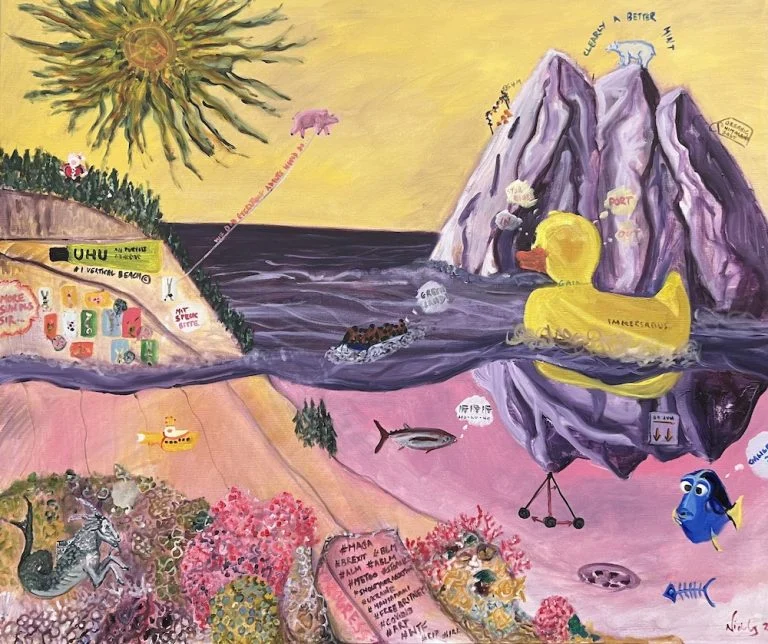
    My work demonstrates this through playful and occasionally provocative illustrations of life, often poking fun at myself, society and our human idiosyncrasies. The intention is to cause the viewer to consider how they’d rather see the world.

    These fantastical storylines come to me intuitively after seeing an image, an experience or coming to a realization about our behaviour. The artworks are painted in oil and are accompanied by poetry.

    GlogauAIR Project

    My proposal is an exploration of how we choose to see the world and how that shapes reality. I see a series of large scale oil paintings with a combination of abstract and figurative inputs exploring dream-like states. I’m drawn to GlogauAIR’s mission of exploring creativity, creating freely and exhibiting outputs as community and I feel Berlin is a city whose history from the culture of Weimar Germany to the overthrow of communism has a heritage of creativity and free thinking.

    I believe this opportunity will bring an extra level of rigour to my practice and exposure to new thinking.

    Painting

    CV Summary

    Exhibitions

    • 2023 The Coningsby Gallery, London (SOLO)
    • 2022 The Holy Art Gallery, London
    • M.A.D.S, Milan / Metaverse
    • Zari Gallery, London.
    • 2021 Downstairs at the Department Store, London.
    • 2004 Ecole hoteliere de Lausanne, Lausanne

    Awards

    Gallery
  • Nina Criswell

    Nina Criswell

    Nina Criswell is GlogauAIR resident
    from January, 2024 to March, 2024

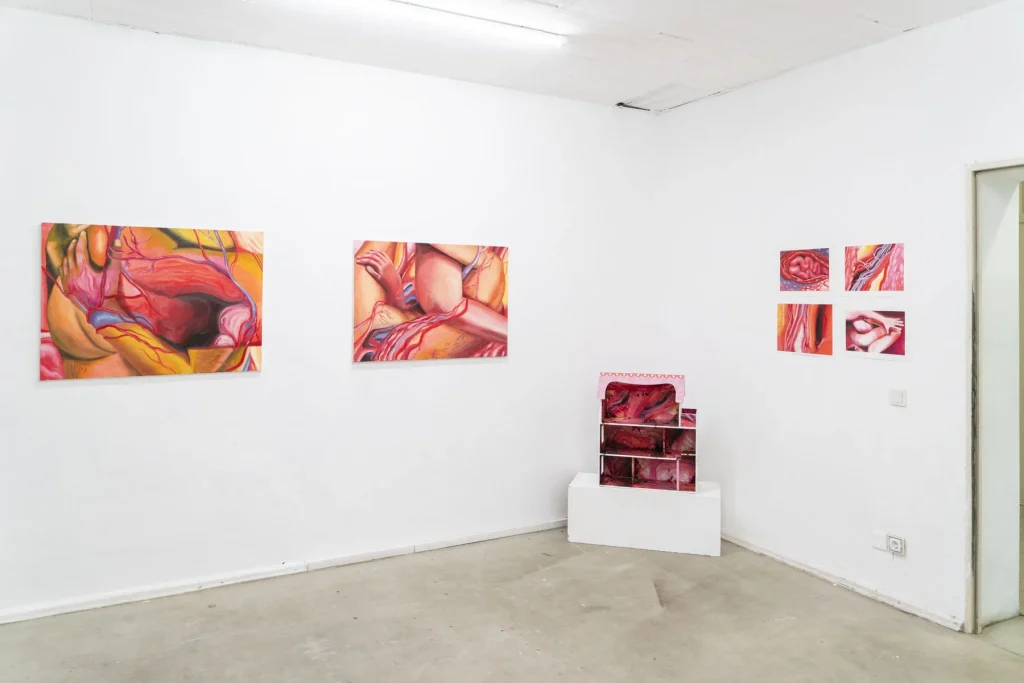
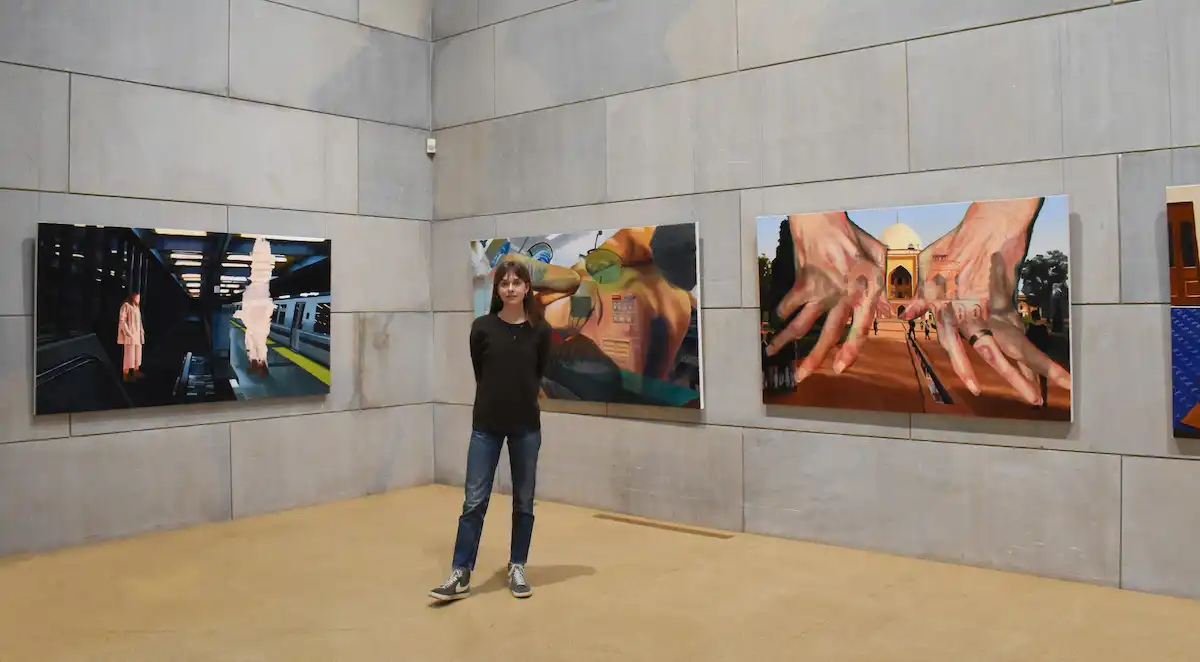
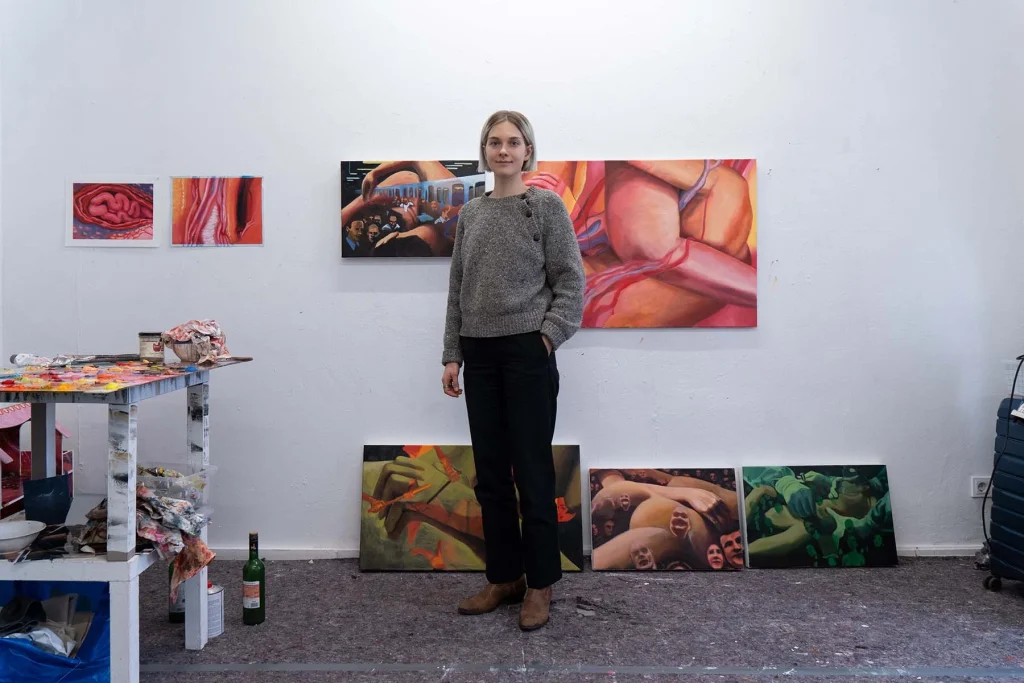
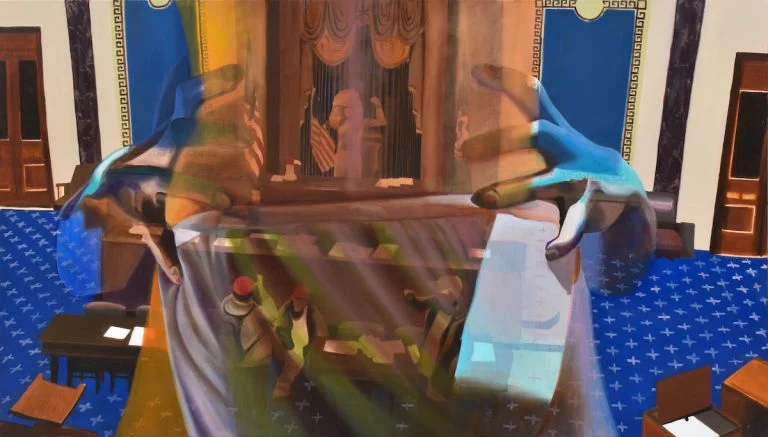
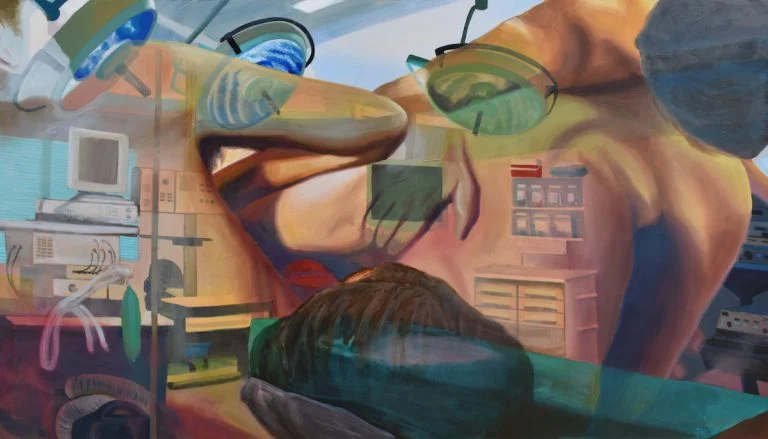
    Nina Criswell,  a Lithuanian-American oil painter, explores the built environment’s relationship with body censorship. Her work challenges viewers to decipher the intertwined bodily and architectural forms, highlighting how societal systems compel bodies to conform.

    During her residency at GlogauAIR, Criswell plans to further investigate this theme through oil paintings that dissect how urban spaces influence and constrain the pleasure-seeking body. Her aim is to reveal the presence of desire and pleasure within communal settings, offering layered compositions that depict the coexistence of public conformity and private intimacy.


    Meet the Artist

    How would you describe your practice as an artist?

    My name is Nina Criswell, I grew up mostly in California, and then studied art and computer science on the East Coast, and then right after that I came to Berlin, and have been working in architecture, but also still doing some painting, so that’s what brought me here, to do some more painting in Berlin.

    I guess I would describe my practice as consisting mostly of oil painting, but I’ve also done some work in some coding projects, and obviously architecture plays a big role in how I think about my work, and what I’m interested in.

    In terms of painting, it’s mostly been a process of first doing a lot of archiving, of images that I see, that I take personally on the street, with people in my life. Also film is a big inspiration for me, so I like saving film shots that I enjoy, and then the painting part has usually been this process of finding ways in which to layer these forms together in a way that is interesting to me, or says something about our embodied experience.

    I think my work has changed some in the past couple of years, with my interests, I used to only paint architectural spaces, and environments devoid of any people, and I was interested in the traces that bodies leave in spaces, the histories that these spaces carry, the ways in which they cater to the public sphere versus private, intimate settings.  I realized that what I was really interested in, and afraid to   tackle, was just the body itself, and how the body interacts with architectural spaces, but also how bodies relate to one another.

    And so lately, especially in the work I’ve been doing here, I’ve been thinking about how we engage with our bodies both in this very private, intimate experience of sex, or of any kind of intimacy in that way, physical intimacy, and how that changes when we’re then exposed to the public sphere, and how the environments that we’re in dictate how we behave. We’re taught to behave a certain way in public, we’re then left  to our own devices to experiment with our bodies in the private space, and I do think that there, or I’ve seen similarities, at least in my personal experience of public spaces and crowds especially, being very intimidating and scary at times, and yet also there’s this sense of comfort of being around other human beings and having this shared engagement with that space. And so relating that to  my personal experiences of intimacy and sex, and how it  has this connotation of violence and also intimacy.

    So I guess that’s all a long-winded way of saying that I am just curious about how we’re taught to behave differently, how our bodies engage with spaces, whether it’s in the public or the private sphere, and how maybe those clashes can be brought to the surface, or how maybe it’s more similar than not.

    Is there something that inspires your work?

    I think I am inspired by dance. Even though it’s not really something that I ever did, my identical twin sister is a dancer, and I’ve had so many conversations with her about how she has taught her body to react to others, and how she has this deep  intunement with the way that her body is moving in a space, or on a dance floor, or whatever it may be, and that was always fascinating to me as someone who has always felt very disengaged from my body and wanting to have as little connection to it as possible.

    I think my other main inspiration is, or something that informs my practice now, is medicine. My mom’s a doctor. She was always bringing home photos of her arthritis patients to me when I was a kid, and I always had that fascination with the grotesque and this curiosity for how the body worked. So again, the ways in which the body was exposed to me growing up and in terms of other artists.

    I’ve always had this admiration for American painters of the 50s and 60s, like Edward Hopper, and a couple months ago I went to this exhibit of Christina Quarles, who is this American painter who is doing these incredible surrealist paintings. Her work really inspires me, as I’ve wanted to kind of go more into the realm of abstraction.

    Do you have any memorable anecdotes or stories from your artistic journey that had an impact on you?

    I was at this school where they would just kind of give you materials and say to do whatever you wanted and just let your creativity run free. It was never about copying and doing still life or anything more traditional. I signed up to do this art exhibition where with a couple other students you’re given a semester and you’re supposed to produce this final work and then show it.

    I had procrastinated and not really done anything for it and then two weeks before the deadline I had this idea, this fully formed painting in my head and I wanted it to be as big as I could possibly make it. So I went to the art supply store and found the largest canvas  I could find and then came to school every morning at six in the morning. Then all of a sudden after two weeks it was done and it was just this large painting of my bedroom.

    It was a really minimal color palette of these warm tones. I think it was the first time where I realized how just the sheer scale of it felt really powerful and I really relished that feeling of empowerment that I could just make something that was so big that you had to look at it and you had to think about it and you had to be surrounded by it. Since then, I only made huge paintings pretty much because I just loved that feeling of power and control.

    How did your artistic journey begin?

    It was right before I finished high school and then I went to college and I was planning on just studying math but then I ended up doing a double concentration which a lot of people do in the U.S. where you graduate with two bachelor’s degrees.

    So I did art and computer science as a way of having both but that was, you know… I had never thought about studying art before that point. So I guess that’s where it began.

    How do you see yourself in the contemporary art world? How do you see your work fitting there?

    I think I struggle to see myself in the contemporary art world because my paintings are more figurative and I think that figurative painting is having a little bit of a comeback but I still feel… or I worry that sometimes my painting style is too traditional, quote-unquote. And so I think that the way in which I’ve been able to kind of break out of that mold a little bit is the experimentation that I’ve been doing with AI. I think as with any industry nowadays we’ve  latched on to  AI and the mid-journey and how it  has implications for everything nowadays.

    I do think that the contemporary art world has been so focused on what it does for the art world, the potential implications it can have on ownership of imagery.  I see it as  the way in which I’ve engaged with  training the AIs to kind of create these weird imaginations that I’m curious about and then kind of integrating that into my work through this layering process has made me feel more relevant I think than I  did in the past.  I think a big part of the contemporary art world today is trying to figure out what the artist’s role is , in this digital revolution.

    I don’t really like that term but to what extent do we let this technology inform the art practice or serve as a tool versus serve as the guiding principle?  I think that finding that balance is going to be a big source of debate in the future and now.

    Do you think the city of Berlin is having an impact on your production?

    I’ve been in Berlin for about a year and a half now. it definitely had a huge impact on me. As I said, I used to be very disengaged from my body.  I think coming to Berlin and very quickly being in the clubbing environment a lot, as with  so many people coming to Berlin, it was this shiny new toy and I was so excited.

    Every weekend just being in rooms of semi-naked people all close but yet you have this respectful space that you’re given to move. , I was so fascinated by it, going into these clubs at night and being surrounded by all these naked people and seeing the beauty of everyone moving together in this way.

    Then I would leave and it’s early in the morning and you’re  on the train and there’s these crowds of people that are doing these similar kinds of rhythms but at a much more subdued and slow pace. It was just so comical.  I think that was when I really started to think about wanting to just paint bodies and limbs and how they coincide and bump into each other.

    How is this residency having an influence in your production? How is living with other artists influencing your work?

    I think it’s been the other artists here most importantly that helped guide this shift in my work. Especially with Camilla next door who seems to also have this obsession with the body and the grotesque. The two of us went to the Museum for Medical History in Berlin together and there were all these organs and jars and we both have had this fascination. Also her work has been a big inspiration for me.  So many other artists here have been thinking about these same kinds of ideas. I think  the other artists have definitely helped  guide me in that direction.

    What influenced your decision to come to GlogauAIR?

    I decided to apply to GlogauAIR because I was really missing painting.

    I was working full time in an architecture firm here and really enjoying that. But on the other hand I also felt like there was something missing and I didn’t have the space that I needed to make art. Oil painting requires a lot of space, time and resources.

    I missed being around artists from when I was in school where you’d share a studio and just always be peering around to see what everyone else was doing and giving them comments, getting comments back, that collaborative part of it.

    Statement

    Nina Criswell is a Lithuanian-American oil painter from California currently based in Berlin with a background in architecture and computer science. In her practice, she explores the invisible forces shaping the embodied experience. Criswell examines self-censorship of the body and the mechanisms that suppress pleasure and desire in the public space. Combining found and personal photographs, the painting process is a balancing act where Criswell lets these forms merge, unveiling the latent potential for intimacy and violence in the body on both individual and collective levels. By combining sensual bodily forms with images of crowds or the environments designed to serve them, privacy becomes a concern; what happens when we expose the intimacies of the body in the public space? The overlapping imagery makes a detective of the viewer, tasked with untangling the fractured forms, speaking to how the body is nullified to conform to the masses and how these systems can be dismantled.

    GlogauAIR Project

    During my time at GlogauAIR, I plan to delve deeper into the subjugation of the intimate and pleasure-seeking body within the urban landscape. I will create a series of oil paintings that will dissect the ways in which crowds, as well as the spaces designed to serve them, force the pleasure-seeking body to conform to them. By painting overlapping images of crowds, bureaucratic environments, and nude bodily forms, I will make visible the invisible presence of desire and pleasure within a communal setting. In doing so, these layered compositions offer a world in which the conforming public and intimate private coexist.

    CV Summary

    EDUCATION

    • 2022 BA, Studio Art, Wesleyan University, Middletown, CT
    • 2022 BA, Computer Science, Wesleyan University, Middletown, CT
    • 2016 Oxbow Art School, Painting, Napa, CA

    AWARDS & EXHIBITIONS

    • 2022 BFA Group Exhibition at Zilkha Gallery, Middletown, CT
    • 2022 Honors Bachelors Thesis Recipient, Middletown, CT
    • 2022 Design-Build Studio Project Unveiling, Middletown, CT

    Gallery
  • Stella Wiemann

    Stella Wiemann

    Stella Wiemann is GlogauAIR resident
    from January, 2024 to March, 2024

    Introducing Stella Wiemann, a multidisciplinary artist from Germany working in the performing and visual arts. During her residency at GlogauAIR, she is focusing on queer visibility, shame, and solitude, examining their impacts on the human body and psyche.  

    In her project “Pillow-No-Talk ” she centres on loneliness within the LGBTQIA+ community, highlighting the challenges of isolation in the journey of self-discovery and coming out, feelings of shame, fear, and rejection. A project that can resonate with individuals beyond the community as a shared human experience that unites us all.


    Meet the Artist

    How would you describe your practice as an artist?

    My name is Stella, I’m from Germany and I studied acting and worked in the performative field for a few years.  I also did a lot of dance and started to work in the acting and dance field a bit more. But I’m also a painter and a children’s book illustrator. So I work in all of these fields and do a mix of all of them.

    My practice is hard to describe actually, it comes from an intuition or a feeling about something. I mean this is really the difference I think between acting, dance and painting. Because in acting of course I need to think a lot about the character or for example, I need to know exactly when I have to be and where on stage. I need to know the others that I perform with and everything is really part of a structure.

    When I paint, everything is more chaotic. I do what I feel, without planning. Even though, sometimes I know I want to do a specific painting; but it’s always evolving and changing. I love this freedom that I have with the visual arts.

    I’m mostly interested in the emotions of all of us, of all humans. I’m always looking for emotions and showing  expression in faces.

    When I dance of course it’s about the body, it’s about the rhythm and it’s about the music too. In acting it’s about everything: it’s the body, it’s the voice, it’s the facial expression. And I feel like it’s about everything too when I am painting. So I’m mostly focusing on these feelings and intuitions.

    What inspires your work?

    So many things. I mean emotions definitely.  What I love to do is to express a feeling that I have or that I see in others. But without words.

    Even though I studied acting there’s a lot of words on stage. For me it’s really interesting what happens in this moment when we lose our speech and we don’t find the words for what we want to say. And what comes then?

    How did your artistic journey begin?

    When I was a child I didn’t speak that much. But I always painted. And I was really slow with learning how to write.

    And how to write correctly especially. So I always drew the letters that I wanted to give to my mom. And then I just continued painting, painting again and again.

    Then somehow I decided to study theater. For whatever reason. But painting was always still with me. It was always there.  And sometimes of course when I’m too busy with theaters and rehearsals and I don’t have time to paint, I really miss it. It will always be with me.

    Do you have any memorable anecdotes or stories from your artistic journey that had an impact on you?

    My bachelor thesis was about the topic of failure. And the topic of trying again and again.  With art it’s a bit easier than with paintings. For example, once you decide that you like a painting, it is still going to be fine within time. But on stage you don’t have that, you can perform amazing one day and the next day you might fuck it up completely. But you are always there trying again and again. This is reflected a lot in my personal life too because I fail a lot and try a lot.

    How do you see your art fitting in the contemporary art world? And in the contemporary art market?

    It’s hard to say, I just try to do what I like. And I know that it’s a bit risky. Because you also need to earn money to survive.

    But especially with painting, I don´t try to fit in the market and I’m not so interested in working on that. I love the freedom it gives me. In theater it is the other way around, you must fit and be a specific type like blonde, brunette, thin… You are always doing the stuff someone else tells you to.

    I enjoy this freedom that I have with the paintings. And I definitely don’t care about the market. I don’t.

    How is the city of Berlin having an influence on your production?

    I have very mixed feelings about the city, it’s a crazy rough place which has everything: if you want to go out, see different stuff. I feel this is really good for my art. You see many characters on the streets, people in the worst or most beautiful situations.

    Sometimes I just like to take the bus and I ride through the whole city. I just like to see and it’s a big inspiration. But also sometimes Berlin can be too much  and I need to go out and breathe.

    How are the other residents having an impact on you? Are you influencing each other?

    Definitely. Especially with all the talks we have in between, small chats in the kitchen or our worries. We are sharing our chaotic lives where you can’t plan anything. As an artist maybe you have a residency or an exhibition, but then maybe for months you have nothing at all .

    To feel that you’re not alone in this lifestyle is helping a lot. Also to see what other people are creating or where they take their inspiration from, it’s really nice and absolutely beautiful. I really enjoy it.

    As a painter you’re always or most of the time alone in your studio, and at some point you can go a bit insane. It’s so good to be able to just knock on someone’s door or go out for a coffee.

    And what are your plans after the residency?

    Good question. I mean I will definitely continue with painting. I have children’s books to do too, theater and dancing projects. Just to continue creating, being inspired and hopefully surviving.

    Statement

    Stella Wiemann, born in Germany in 1996, is a multidisciplinary artist working in the performing and visual arts. In her art, she seeks connecting points among different artistic languages and primarily explores human longings, abysses, and encounters. Currently, Stella is focusing on the questions of queer visibility, shame and solitude and how these impact the human body and psyche. She works as an actress and performer in theaters in Germany, Austria, Italy, and Hungary. As a visual artist, she has exhibited in Germany, Austria, and Portugal and collaborates with book publishers as an illustrator.

    GlogauAIR Project

    Using various artistic media such as painting, sculpture and audio, my research explores the feeling of loneliness, especially at night, and the intimate relationship between people and their pillow. „Pillow-No-Talk“ focuses particularly on the experience of loneliness within the LGBTQIA+ community, which often struggles with isolation more than the heteronormative population. It explores the complexities of loneliness in the journey of self-discovery and coming out and its challenges including feelings of shame, fear and rejection, even by one’s own family. The aim is to reach individuals also outside of the community and meet them in their experiences of loneliness, as ultimately, this is something shared by all human beings and unites us.

    Dance, Drawing, and Painting

    CV Summary

    EDUCATION

    • July 2023 Royal College of Art London // visual storytelling
    • October 2022 – May 2023 Leggere Strutture Bologna, Italy // Dance and Performance
    • 2018-2022 Anton Bruckner Universität Linz, Österreich // Bachelor of Arts / Acting

    THEATER AND PERFORMANCE

    • 2023 Odeon Theater Wien „The Lost Birthday“ // Director: Ivan Strelkin // Role: Anna
    • 2023 Janus Theatre Pecs, Hungary „Roots“ // Performance and dance
    • 2023 Theater Festival Erl „Der Karneval der Tiere“ // Live illustration
    • 2022 – 2024 Germany-wide tour “Professor Mamlock” // Role: Ruth // Directed by Aron Matthiasson // Nominated with the Inthega Award “Die Neuberin”.
    • 2022 Sprechwerk Theater Hamburg “NACHRUF AUF MICH SELBST” // Role: Jean // Director: Aron Matthiasson
    • 2021 Sprechwerk Theater Hamburg “PROFESSOR MAMLOCK” // Role: Ruth
    • 2020 Landestheater Linz „Gespräche mit Astronauten” // Role: Irina // Director: Anna Maboe
    • 2019 / 2020 Engagement at Landestheater Linz, among others “DIE SCHNEEKÖNIGIN” // Role: the Snow Queen // Director: Nele Neitzke
    • 2019 Theatre Festival Chemnitz “MARIA STUART” // Role: Elisabeth // Director: Steffen Jäger
    • 2018 Studiobühne Linz “Onkel Wanja” // Role: Jelena // Director: Peter Wittenberg
    • 2017 Theater Sprechwerk Hamburg “ELECTRONIC CITY” // Role: Sie // Director: Aron Matthiasson

    VISUAL ARTS

    • 2024 Book publication „Charlie und die Reise zum Mond“ Highline Verlag // Illustration
    • 2023 Exhibition „Prisma“ Lisboa // Paintings
    • 2023 Book publication „Philipp und das Pfefferland“ Karamedia Verlag // Illustration
    • 2023 Artist in Residency Lisbon // Paintings
    • 2023 Book publication “Filius” Karamedia Verlag // Illustration
    • 2023 Book publication “Charlie” Highline Verlag // Illustration
    • 2022 Salzamt Linz “UND JETZT GEHE ICH” // Live illustration and dance
    • 2022 Studio scholarship Salzamt Linz
    • 2021 Book publication “Das kleine Meisenkind” Highline Verlag // Illustration
    • 2021 Shäxpir Festival “DIE GESCHICHTE VON AK UND DER MENSCHHEIT” // Costumes
    • 2020 Exhibition Aquarium Linz // Paintings
    • 2018 Schöffl Kulturzentrum “ZORBAS” // Costumes
    • 2015 Exhibition Musik und Kunstfestival Unterfranken // Paintings
    • 2014 Exhibition „Kunst im Café“ // Paintings

    Gallery
  • Tiffany Adler

    Tiffany Adler

    Tiffany Adler is GlogauAIR resident
    from January, 2024 to March, 2024

    Tiffany Adler is an American artist practicing in Los Angeles, CA. Her interests lie both in the process of sculpture, as well as the conceptualization, fabrication, and construction of a scene, in service of communicating alternative narratives within classical frameworks of representation and architectural forms. 

    In her project, What if Vitruvius was a Woman? She takes the idealisation of “the perfect man” as a point of  juxtaposing an alternative and abstract representation through symbols, form, the body, and movement, entertaining the idea of what might be if Vitruvian was a woman. By exchanging Vitruvius’s terms for new ones, she wants to challenge his ideas about, perhaps most importantly, “beauty”, alongside his ideas about “usefulness’ ‘ and “solidity”.


    Meet the Artist

    How would you describe your artistic practice?

    I’m based in Los Angeles, California. I’ve been there for almost about 10 years now. As you know, I came from architecture, just left that last year, so I’m in  a big transition in my life. I would describe my practice as multidisciplinary.

    I feel like I gather inspiration from a lot of different things. I have a focus in feminist art, past and contemporary. I like how much that changes or evolves and the different perspectives on it: what one work meant in that time and what it means now.

    I have this parallel interest in materiality and spaces too, how can you be very tied to a place or just pass by. I get the most inspiration from just walking down the street, especially in a city landscape, from building facades or small things. For instance, I’ve noticed in Berlin, these funny stone mosaics that are specifically in Kreuzberg. So little details like that I would get stuck on, or I feel like it kind of weaves into my work or absorbs without me really knowing.
    What inspires your work?

    I usually like to read a book or a review before I start a residency, I feel like that’s really helpful, and I feel like once I’m at a residency, I just get going and I go for it. Before coming here, I was really into “Art Monsters: Unruly Bodies in Feminist Art” , by Lauren Elkin, which speaks about criticism in feminist artworks, where she brings up a lot of interesting points that I’ve been thinking about in regards to how would feminist artwork look like if we didn’t need feminism. That was a big inspiration for the project I am doing here.

    And also, I’ve been tackling in my work self-conscious things about what’s good feminism, what’s bad feminism. There was a little excerpt in that book that said something like it’s okay for artwork to be beautiful and it can say a lot more than that too, but I think if you’re looking at a classically beautiful body, then it’s easy to judge it. So I kind of just let down my guard in that sense and went for it.

    How did your artistic journey begin?

    I’ve been creative as long as I can remember from childhood, and then as I got older, maybe it was growing up on the East Coast in America or having maybe a slightly conservative family, that I started to look for more practical pathways, and so that’s how I got into architecture. I thought it would be a good midway point for me to use enough creativity to feed myself and then also be able to support myself. So I would say I’ve always been an artistic person, but now I’ve decided to take a big risk and put it all into my art practice.

    Also, I had really good mentors in undergrad as well as grad school, they validated my creativity when I didn’t see it or believe in it. And I felt wacky, I guess you could say so they kind of gave me a lens which now I am able to see my work through.

    How do you see yourself in the contemporary art world and in the art market? In the present and in the future.
    I think my work definitely has a place in the world we’re living in now. I think it’s important for contemporary work to ask more questions than it answers because I feel like we need to question the status quo and frameworks that we’ve been living under for as long as the built environment has existed.
    And that goes with politics, especially  Roe v. Wade being overturned in America. These kinds of things are setting us back like 50 years are kind of crazy. Art has the ability to say things in a way that people in more activist positions cannot. I can’t not incorporate it in my work. I think art can open people’s eyes to things. At least for me art has the power of changing things, especially the work that I look at. It’s also inspiring to see women tackling the same problems that I’m interested in as well.

    Does the city of Berlin and the residency in your artwork have an influence on your production?

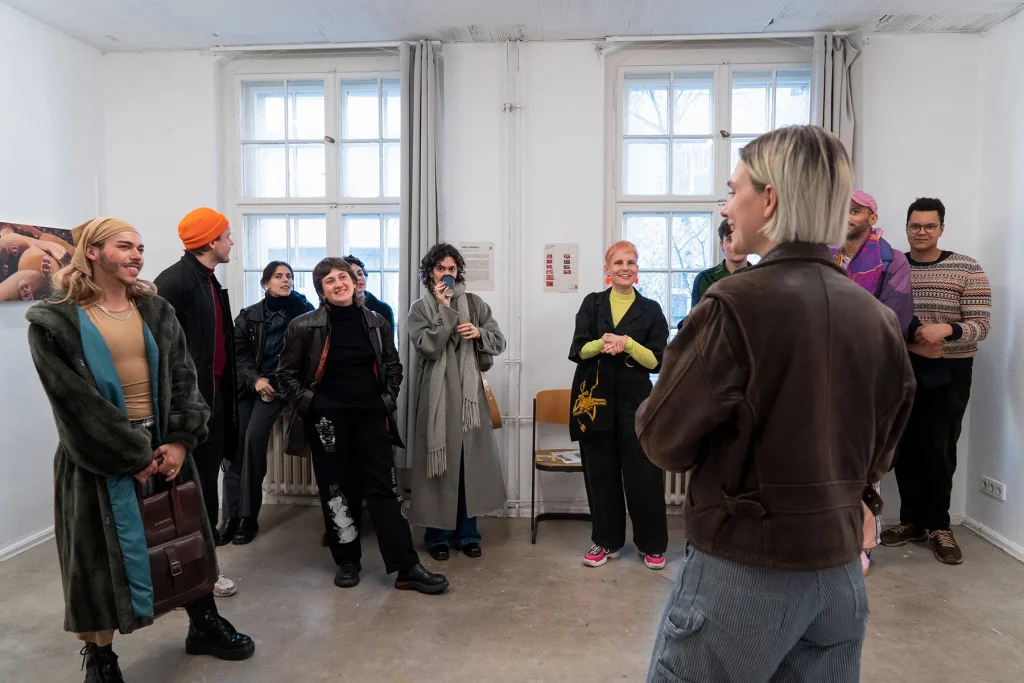
    I feel like this time has been incredibly productive for me, Berlin is such an energetic and playful place. It’s amazing to live in the same building with 13 other artists. Even coffees in the morning are about catching up on what we’re seeing, doing or what we’re working on. Yeah. It has been very invigorating for me.

    Berlin and the residency are about freedom for me because I’m used to working  a nine-to-five job and then trying to tackle my art practice on the side, which was really draining. So I’m just trying to make the most of this opportunity.

    What are your plans after the residency?

    I have to hurry back to L.A. for practical reasons, but who’s to say what the future holds in regards to where I’ll end up   practising. Maybe I would want to go abroad again or live abroad if possible.

    Statement

    Tiffany Adler is an American artist practicing in Los Angeles, CA. Adler graduated with a Masters in Architecture in 2017. After graduating, she worked as a performing artist and model maker at Mike Kelley’s Kandors exhibit for 8 months at Hauser and Wirth, interpreting and constructing futuristic skyscrapers from Kelley’s imagined cities within the Superman comic book series. Adler practiced at several architecture firms thereafter, until deciding to leave the profession completely at the beginning of 2023, in pursuit of advancing her career as an artist.

    Adler’s architectural background and interest in materiality informs her calibrated processes upon which her sculptures and contemporary narratives are derived from. Her interests lie both in the process of sculpture, as well as the conceptualization, fabrication, and construction of a scene, in service of communicating alternative narratives within classical frameworks of representation and architectural forms. In a woven effort, she seeks to interrogate and examine ever-evolving cultural ideas about feminism, gender dynamics, and human connection.

    Her experience as a woman, in general, and in a profession that is still predominantly male led, informs her work symbolically through material manipulation, misbehaving formations of the body, and satirical narratives within the medium of film and photography. She often uses her own body as part of the narrative, and as a vehicle for communicating such ideas – a process by which is famously demonstrated in other female artists’ works, such as Cindy Sherman & Nadia Lee Cohen, to name just a few.

    Her sculpture works also pivot off of classical and or architectural materials, often using plaster as the skin of the body, but foam at the core. A concept that is practically, functionally, and metaphorically suited to her artistic practice.

    At this point in her career, she would like to use this focussed time at GlogauAIR to develop her own skill sets within the medium of photography and other, perhaps, post production, and other analogue processes, while still integrating her previous skill set, in hopes of finding a more integrated and holistic practice.

    GlogauAIR Project

    What if Vitruvius was a Woman?

    If we intuit that patriarchy starts at the foundation of the built environment, then Leonardo da Vinci’s famous Vitruvian Man may be worth reimagining. Literally drawn from the ancient figure, Marcus Vitruvius Pollio, best known for his ten volume work, De Architectura, a Roman writer and engineer, he set the foundation for future architectures with the leading principles being that of firmitas, utilitas, and venustas, in english, translating to solidity, usefulness, and beauty. His classical ideas have influenced young architects, myself included, at the foundation of architectural education.

    I’d like to explore replacing Vitruvius’s original principles, juxtaposing them with possible new terms, and entertaining the idea of what might be if Vitruvian was a woman. With that in mind, I will be using Da Vinci’s Vitruvian Man, which represents the “perfect man”, based on the ancient knowledge of ratios and proportions present in human anatomy, as the point of departure. Da Vinci’s drawing depicts two superimposed positions of a man fitting within a square and a circle – a formal language that rules much of the built environment we exist and function in today.

    By exchanging Vitruvius’s terms for new ones, I want to challenge his ideas about, perhaps most importantly, “beauty”, alongside his ideas about “usefulness” and “solidity”. Keeping the Vitruvian Man in mind, the focus of my exploration will therefore be that of juxtaposing an alternative and abstract representation through symbols, form, the body, and movement.

    The re-envisioning of a well known representation here is a continuation of my earlier works, as seen in Fuck Your Pedestal, where the goal is to portray a feminine narrative in place of a well known male one. This process of juxtaposition therefore acts as research and experimentation, allowing for new perspectives to take the stage.

    I look forward to seeing what inspiration Berlin has to offer me in my pursuit of the Vitruvian Woman project, as well as developing as an artist alongside the GlogauAIR community.

    Performance, Photography, and Sculpture

    CV Summary

    Education

    • 2014-2018 SCI-Arc, Los Angeles — Masters of Architecture
    • 2011-2014 James Madison University, Harrisonburg — Bachelor of Fine Arts, Minor in Architectural Design

    Exhibitions

    • 2023 Motherboard. Kim Sing Theatre, Los Angeles — Artist in Solo Exhibition
    • 2022 Watch me. Wonzimer, Los Angeles — Artist in Group Exhibition
    • Holy crap. Modest Common, Los Angeles — Artist in Group Exhibition

    Projects and Workshops

    • 2017-18 Hauser & Wirth, Los Angeles — Model Maker & Performing Artist
    • 2014 B.A.S.E. Beijing, Caochangdi — Workshop Participant

    Residencies

    • 2023 Atlas, Lisbon — 1 month residency

    Awards and festivals

    • 2023 Chinatown Film Festival, Los Angeles
    • Les Femmes Underground Film Festival, Los Angeles
    • Paris Awards Film Festival, Paris
    • Los Angeles Super Shorts Film Festival, Los Angeles

    Gallery

  • Working Hard

    Working Hard

    Working Hard is GlogauAIR resident
    from October, 2023 to December, 2023 and January, 2024 to March, 2024

    “Working Hard” emerged in 2015, as the brainchild of the innovative collaboration between Wen-Ying She and Po-Yu Kuo. The creative duo operates at the intersection of audio memories and installation art, and their approach involves the meticulous reconstruction of imaginative spaces through archival techniques. Beyond being just the moniker for their art collective, “Working Hard” represents a profound philosophy. 

    Having earned their MFA sculpture degrees from Taiwan University of Arts, their artistic journey has been shaped by diverse experiences gained from travelling and living in several art residencies, immersing themselves in different cultures. 


    Meet the Artist

    How did you start your artistic journey? 

    She: We have been using the name “Working Hard” since 2015, and we graduated from our sculpture degree in 2016. After our studies, we had a very special experience of a residency in Indonesia in 2017, which shaped our practice. We went to Yogyakarta, a city in Indonesia and we did the residency with LIFEPATCH. They are one of the groups that also participated in Documenta 15 last year. We worked with the Taiwanese group OCAC which invited  different types of artists to go there and participate in this project. This residency lasted for one and a half months. We were very welcomed by the local community to participate in their activities, and we got so inspired by the environment. It was a very special residency as we weren’t just working on our own processes, our own practices, but there was a real focus on collaboration, and working together with artists and people living there.

    Boy: The people of the residency had just moved to a new place, so we needed to talk about how to design this space, because the space is empty. We created stairs, and a pool, for people to meet there and spend time together. We made many workshops there.

    She: When we rebuilt the house and fixed some stuff with them, we did an “open house” for people to come and visit. So, it’s not just our work. We really had to listen to the local people, and try to understand the culture of Indonesia.

    How did this experience lead you to your current practice? 

    She: This is how we started to work closely with people, have conversations with people, and not just focus on our own practice. In sculpture school, we learnt to concentrate on one piece only, to have an idea, to buy the material, and to build what we want alone in the studio. This residency really inspired and changed us.

    You mentioned working individually and as a duo, but also the importance of working collectively with the populations around you and others. How would you describe your practice ? 

    She: I would say we work in the border between visions and the self-scape, and the relationship, and the history of the culture, and the social landscape. I think our work presents different angles and different shapes. It’s based a lot on dialogues.

    What are your inspirations, apart from the place where you travel to and the social landscape? What are the themes that inspire you the most? 

    She: We are inspired by things  soon to be forgotten, or things which will soon  disappear. We are also inspired by daily life. Not just talking about the object of daily life, but about how to figure out daily life in Berlin. It’s not so easy for outsiders. This is not our country, this is not our language, so we become more sensitive to how people survive in this urban space, where daily life can become very complicated.

    Do you think the city of Berlin has an impact on your work?

    Boy: During our stay in Berlin, we saw some other foreigners from outside, like people coming from immigration, especially Turkish or Vietnamese people. We are focusing now on getting to know about these immigration waves, how Vietnamese people came as migrant workers around the 50s, 60s.

    She: Vietnam had a complicated political situation at the time, with the war. People from the North and the South came to Berlin in different ways; some people ran away from the country and became refugees, while others were allowed to come to work. So, even within the community, people come from very different situations. This is one of the topics we want to research in Berlin. We did another residency in Berlin already, last year, and we were interested in the German language, because we can’t speak it.

    Boy: Some migrant workers here only speak Vietnamese as well. So, for us it can be a little difficult to “get inside” the community and have conversations. We had a tour guide, and visited the Dong Xuan Center, where they built warehouses and lots of shops and restaurants.

    She: We are also interested in the topic of isolation. It seems like some groups of people moved to Berlin, settled down here, but didn’t become really local, and stayed isolated. Like in a safety bubble. People don’t really understand each other.

    As community, dialogue and meeting people is very important for your work, you’ve been going from residency to residency. Is that what motivated you to come to GlogauAIR?  

    She: Doing our last residency in Berlin, in Künstlerhaus Bethanien, we met another artist who participated in the GlogauAIR residency program before. He told us that, in his experience, GlogauAIR felt like an art village, with more opportunities for connections than in Bethanien. Bethanien is way bigger, and everyone has their own kitchen in their studio, so people don’t use the common space so much to have tea or talk together. We still made lots of friends there, but we’ve been told GlogauAIR felt warmer, more like a collective. We also like that everyone starts at the same time, and live together for at least three months.

    Statement

    WORKING HARD is the brainchild of creative duo WEN-YING SHE and PO-YU KUO since 2015. They work on the border of audio memories and installation. For them, Working Hard is more than a name of the art collective but a method of aesthetic practice to reconstruct an imaginative space via archival approaches. After they gained their MFA sculpture degree from Taiwan University of Arts, their creations evolved with their experience working and living at different artist residencies. From an individual angle, they observe and experience the collective life of different cultures and societies. Through field research and artistic practice, they unveil the soon-to-be-forgotten social landscapes by conjuring the memories of a distinct, culturally hybridized immigrant history.

    GlogauAIR Project

    Observing people, their histories, their relationships and the social circumstances in which they live is an imperative part of the narrative in our projects. This may stem from our origin in Taiwan, where people have various complicated national identities. This has led to our curiosity about migration and the pursuit of vanishing histories under modernization. Thus, under the concept of ‘absence’, our residency project set up the audience as the critical element in the scene in which they will be given a chance to disclose the strange scenario. To trigger them to rethink the different narratives in the unfamiliar landscape. We are also interested and inspired by the museum with the verisimilitude facility, and archives about migrants’ history and nature. Within the combination of sound, smells, and vision, our work expresses the ‘transition’ and ‘exclusion’ of a culture that survives at the slit of the city.

    Installation

    CV Summary

    Education

    • 2016 National Taiwan University of Arts, Department of Sculpture, MFA

    Solo exhibitions

    • 2023 Feeder, Pedvāle Open Air Art Museum, Latvija
    • 2022 Cómo están de ausentes las cosas queridas [How Dear Things are Absent], Vernàcular Institute, México City, Mexico
    • 2022 A Better Tomorrow, Künstlerhaus Bethanien, Berlin, Germany
    • 2021 Rolling on, Tsung-Yeh Arts and Cultural Center, Tainan, Taiwan
    • 2021 A Portal to… – Seeing Taiwan Cultural Association in the Chiayi Street Art Project, Chiayi Art Museum, Chiayi, Taiwan
    • 2021 Lose sight of the shore, Cultural Affairs Bureau of Kinmen County, Taiwan
    • 2021 Newww.Land.com, Inart Space, Tainan, Taiwan
    • 2019 There is no Chinatown, Taipei Artist Villiage, Taipei, Taiwan
    • 2019 There is no______, Pier‐2 Art Center, Kaohsiung, Taiwan
    • 2018 There is no Chinatown, NZ’, Snowwhait Gallery, Unitec, Auckland, New Zealand

    Group exhibitions

    • 2023 Romantic Route 3, ’Travelers in Low-elevation Mountains’, Taiwan Oil Field Exhibition Hall, Miaoli, Taiwan
    • 2022 Mattauw Triennial, Tsung-Yeh Arts and Cultural Center, Tainan, Taiwan
    • 2021 Tomorrow, Towarding, ’The World is yet to Come’, MoCA Taipei, Taiwan
    • 2021 Kaohsiung Award, Kaohsiung Museum of Fine Arts, Taiwan
    • 2020 Authentic World – Greater Taipei Biennial of Contemporary Art, Yo-Chang Art Museum, NTUA, New Taipei City, Taiwan
    • 2020 To Lift a Curfew Group Exhibition, Matsu New Village Cultural and Creative Park, Zhongli, Taiwan
    • 2019 City Flip-Flop, Taiwan Contemporary Culture Lab (C-Lab), Taipei, Taiwan
    • 2018 Indicate Injustice: Proposals for Visual Identity and Memorial Object of Monuments of Injusticework, National Human Rights Museum, Taipei

    Residencies

    • 2023 ‘Pedvāle Open Air Art Museum’, Latvija
    • 2022 ‘Vernacular Institute’, Mexico City, Mexico
    • 2022 ‘Künstlerhaus Bethanien’, Berlin, Germany
    • 2021 ‘Tsung-Yeh Arts and Cultural Center’, Tainan, Taiwan
    • 2021 ‘Cultural Affairs Bureau of Kinmen County’, Kinmen, Taiwan
    • 2019 ‘National Museum of Taiwan History’, Tainan, Taiwan
    • 2019 ‘PAIR, Pier‐2 Art Center’, Kaohsiung, Taiwan
    • 2018 ‘National Museum of Prehistory’, Peinan Cultural Park, Taitung City, Taiwan
    • 2018 ‘Unitec Institute of Technologies’, Funded by TAV, Auckland, New Zealand

    Gallery

  • Anji Lesourne

    Anji Lesourne

    Anji Lesourne is GlogauAIR resident
    from January, 2024 to March, 2024

    Anji Lesourne, is an artist from Jamaica who has a deep passion for exploring human emotions through art. Using various mediums such as oil paint, paper, plaster, and acrylic, she continuously challenges herself to innovate. Her art blends abstract and figurative elements, aiming to offer viewers a glimpse into the human experience and provoke contemplation. 


    Meet the Artist

    In her project in GlogauAIR, she is focused on developing wonder through abstract representations of the human form. She seeks to evoke diverse emotions and invite viewers to look beyond the surface. The project aims to convey the structure and beauty of the human form through highly emotive abstracts, utilizing vibrant colors to capture the energy of human emotions.

    Statement

    My artwork is an exploration of form where I delve into elevating human emotions.

    Born in Jamaica (1980), from early I’ve immersed herself in art. Through years of education in the U.S.A, my quest for evolution led me to Toulouse, France, in 2011. It was here that my art grew. I use oil paint, paper, plaster, and acrylic, and challenge myself to be innovative.

    I continue to explore abstracts and figuratives. And with every piece, offer the human experience. I aim to evoke a sense of contemplation. It is an invitation for viewers to look beyond the surface, and embrace their emotion.

    GlogauAIR Project

    With this project I aim to develop a sense of wonder with the abstract human form.

    It is always interesting to me the emotions that abstracts can provoke (its a different narrative looking at figurative work), and also that the emotions experienced while looking at an abstract can vary from one person to the other.

    I aim to convey the structure of figurative paintings( and the beauty of the human form in all its states) , but representing it as highly emotive abstracts using vibrant paint colours to represent the energy of the human form.

    Drawing and Painting

    CV Summary

    • Born in 1980, Anji is a self-taught French-Jamaican artist with a background in software development and communications.
    • As an artist she looks for openness and vulnerability with the goal of portraying the mysterious and time-worn parts of humanity.
    • Her figurative paintings focus on portrayals of mostly the female figure and her abstract work looks at the idea of portals.
    • She creates by pulling inspiration from music, literature, historical references, and personal experiences to construct paintings that form an emotive experience for the viewer.
    • The figures often are derived from memory and imagination and there is an intended roughness that speaks to the honestly and humanity in the pieces.

    Gallery

  • BAKERBREW

    BAKERBREW

    BAKERBREW is GlogauAIR resident
    from January, 2024 to March, 2024

    BAKERBREW is a collaborative duo composed of Maddie Baker and Ella Brew, both multimedia artists from the US. Their work resides at the crossroads of sculpture and design. Utilizing materials sourced from nature, technology, and urban environments, they intervene with these systems through acts of imitation, reordering, distortion, and destruction in their studio practice. They aim to disrupt embedded power structures while exploring their aesthetic possibilities as survival forms within the constructed world.


    Meet the Artist

    Who are you?

    BAKERBREW is a collaborative project between Maddie Baker and Ella Brew, working somewhere between drawing, sculpture, and design. It began at Bennington College in the U.S. in 2022 and is currently continuing in Berlin.

     How would you describe your artistic practice?

    Our practice is one of place-based observation, collection, and transposition. We are not bound within any medium but are always drawn to materials that translucify, mattify, and/or merge our found material. 

    It’s also defined by a shared interest in structural and visual systems around us—discovered through a shared fascination with 80’s and 90’s editions of Electronica magazine—which we found piles of in the basement of a toy museum in CDMX. Our manipulation of its contents into new nonsensical diagrams allowed us to open a visual path between confusion and curiosity. Since then we’ve continued to draw largely from found objects, instructional images, and a collection of discarded printed material.

    What is your methodology or process for creating a new project? How is your work as a duo?

    One of our most important processes of collection involves walking and noticing together. Forms of functional city elements are discovered and cataloged, and visual material is collected. New ideas for projects emerge from what we notice.

    Material exploration remains crucial when manipulating and understanding our sources. Exploring methods of illumination and transparency has been one way of discovering kinetic, living qualities within the work. New intuitive visual languages are uncovered as we layer our hand within found material. An example is using perforated aluminum sheets as a drawing tool: commonly found in urban architecture, stores, and buses, this structure becomes a tool for mark-making—extracting our own patterns from the once-static object and changing its original use.

    The continual exchange of ideas defines our collaboration as a conversation—an ongoing dialogue not just among ourselves but also with the material. With two minds guiding our choices, a strangeness emerges in the work that wouldn’t be possible without the influence of the other.

     How do you select your material? Why are you drawn to aged or discarded media?

    We seek visual elements that go beyond one singular visual world—ones capable of situating each other in a new light. We avoid any source, aesthetic of line or color, or shape too tethered to one connotation. The goal is not to collage but to seamlessly merge into a new surface, so we seek multi-worlded images and shapes. 

    We continue to seek out discarded and decaying media because we’ve learned that certain colors only emerge in aged form, and that as city structures live and wear, they reveal layers of marks and material. The transparency emerging from disintegration also tells us what was and what is. Being not made from our hands or heads, our found starting material is energized, not passive, and full of memories outside of our own.

    What have you decided to focus on in your current project at GlogauAIR?

    Our current project focuses on merging three found elements into new artifacts: graphic forms from infrastructure, paper from handwerk manuals, and errant collected marks from the street.

    This time has allowed us to finish several illuminated ceramic sculptures based on shapes pulled from sewer grates and bricks. As we continue to settle into living here, this first project was a shifting introduction for us to some of the design and material of Berlin, especially the things beneath our feet. 

    During this time we’ve also developed a new print practice involving pasting fabric posters in the street. After a few days, the leftovers are stripped from their surface and brought back to the studio. Used as tools for excavating past layers and capturing new ones, these skins seek the unfolding action at public sites as a mark-maker. The result is a sort of hyper-aged drawing—an active participation turned into a landscape painting.

    And finally, this time has allowed us to reconsider our cataloging methods, understand the importance of our base materials, and prepare new images for an upcoming book project. 

    Statement

    BakerBrew is composed of Maddie Baker and Ella Brew, two multimedia artists who met while studying at Bennington College. They operate at the intersection of sculpture and design, drawing on technical backgrounds in ceramics, painting, animation, and sewing.

    Their collaboration is defined by shared interests in image systems, infrastructure, and collection.

    BakerBrew’s materials consist of gathered fragments of structural and visual systems found in nature, technology, and city. Their practice in the studio involves interventions–imitation, reordering, distortion, destruction—acts that allow for both a disruption of the power embedded within these gathered systems and an exploration of the aesthetic. BakerBrew seeks an innate beauty in these everyday and/or mass-produced sources as a form of survival within the increasingly inescapable constructed world.

    GlogauAIR Project

    This project draws inspiration from Berlin’s temporally layered architecture and discarded printed matter. Functional city elements, such as sewer grates, bricks, and exhaust covers, are chosen as initial forms from which various sculptural interventions can occur. A collection of scavenged visual material (old instructional manuals, textbooks, and disintegrating flyers) becomes a usable image supply.

    The use of shadows and light design as additional materials establishes a new order for what is to be seen—drawing attention to the elements of function one walks past every day and encouraging new habits of uncovering and reconsideration.

    Installation and Sculpture

    CV Summary

    Education

    • 2022 BFAS in Sculpture: Bennington College – Vermont, USA

    Exhibitions

    • BREW
    • 2019-2023 Group Show: Plains Art Museum – Fargo ND
    • Group Show: Salem Art Works Gallery – Salem NY
    • Group Show: Usdan Gallery – Bennington VT
    • Group Graduates Show: Pamela Salisbury Gallery – Hudson NY
    • 2018 Solo Exhibition: Taller la Chicharra – Oaxaca, MX
    • BAKER
    • 2022 Group Show: Usdan Gallery, Bennington VT
    • 2017 Group Show: Maryland Institute College of Art, Baltimore MD

    Residency

    • BREW
    • 2022 Salem Art Works – Salem, NY, 2 mo.

    Experience

    • BREW
    • 2023-2024 Ceramic Teacher: Clayers Collective, Violaine Toth Ceramic, Sculpture Club Berlin
    • 2018-2022 Artist Assistant: Clyde Petersen, Willard Boepple, Alan Altamirano
    • BAKER
    • 2018-2023 Fabricator: Maya Brenner Designs, Alchemilla, Rebekah Brooks
    • Artist Assistant: Lauren Bon (Metabolic Studio), Mauro Giaconi, Alejandra Seeber, Jonathan Entler Design

    Gallery